
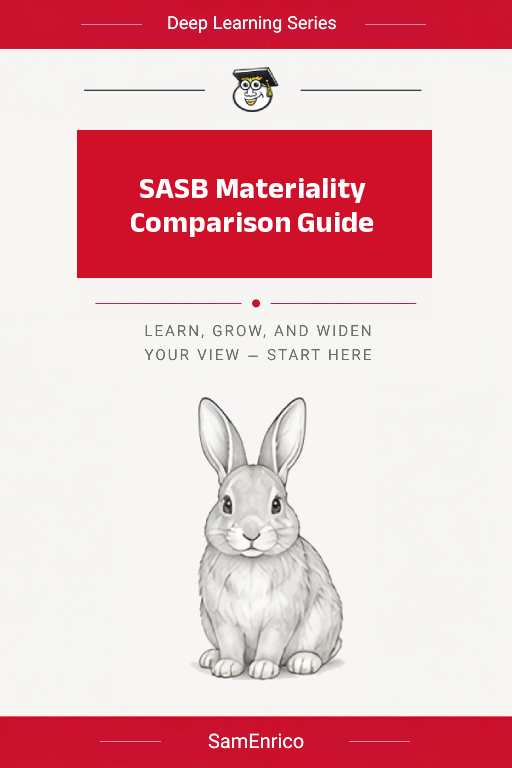
Non-FictionStrategic AtlasMateriality
SASB Materiality Comparison Guide eBook
Compares public firms on SASB materiality map alig
Compares public firms on SASB materiality map alignment, focusing disclosure on financially material ESG issues for each industry.
Formats
Free sample
Chapter 1: The Index Mirage--–- The quarterly portfolio review meeting was not going well. Maria, a senior equity analyst at a $15 billion asset manager, had just presented her ESG-integrated analysis of two seemingly similar consumer-facing companies. The first, a beverage giant with global bottling operations, had received an “AA” ESG rating from MSCI. The second, a regional bank with a growing digital payments business, had received a “BBB.” Her recommendation was to overweight the beverage company and underweight the bank. The head of investments asked a simple question: “Why?”Maria launched into her prepared remarks: superior water management, strong community engagement, low carbon intensity.
Then the follow-up question came: “Which of these factors actually affect each company’s earnings, asset values, or cost of capital?” Silence. Because the honest answer was that she did not know. The beverage company’s water usage was absolutely material—a drought in a bottling region could shut down production for weeks. The bank’s water usage was irrelevant. Yet the generic ESG score had rewarded the beverage company for something that mattered and penalized the bank for something that did not, but the scores themselves obscured this distinction entirely.This scenario plays out daily in investment firms around the world.
Analysts and portfolio managers rely on aggregated ESG ratings from vendors like MSCI, Sustainalytics, Bloomberg, and Refinitiv, treating them as if they were comparable across industries—as if a “good” score for a bank means the same thing as a “good” score for a beverage company, an oil producer, or a semiconductor fab. They do not. They cannot. And the gap between what these scores claim to measure and what investors actually need is the single largest source of misallocated capital in sustainable investing today.The Illusion of Comparability To understand why generic ESG scores fail, we must first understand what they actually do. Aggregated ESG ratings take dozens—sometimes hundreds—of underlying indicators, apply a weighting scheme, and produce a single number.
MSCI’s rating scale runs from CCC to AAA. Sustainalytics scores from 0 to 100, with lower scores indicating lower risk. Bloomberg’s ESG disclosure scores measure transparency, not performance. Each vendor uses a different methodology, different industry classifications, and different assumptions about which issues matter.The problem is not that these vendors are incompetent. The problem is structural.
To produce a single score that claims to compare a bank to a beverage company, the vendor must implicitly assume that the same set of issues matters equally for both. Water management receives a certain weight in the beverage industry score; it also receives a weight—often a small one, but a non-zero weight nonetheless—in the bank’s score. That small weight is already too large, because for a bank, water management is simply not financially material. Yet the existence of that weight means that a bank that reports extensive water conservation programs will see its ESG score improve, even though that improvement has no bearing on the bank’s financial risk profile.This is what I call the Index Mirage—the false appearance of comparability across fundamentally different business models. The mirage convinces investors that they are comparing apples to apples when they are actually comparing apples to the concept of an apple, abstracted of all its specific characteristics.The Beverage Company and the Bank: A Worked Example Let us make this concrete.
Consider a hypothetical beverage company, Thirst Quench Inc., which operates ten bottling plants in water-stressed regions of Mexico and India. Water accounts for 40 percent of its production costs in those regions, and a prolonged drought could force plant shutdowns, reducing revenue by an estimated 15 percent and increasing procurement costs by 25 percent. This is a clear, quantifiable financial risk.Now consider a regional bank, First Metro Financial, which operates 200 branches across the northeastern United States. Its water usage consists of employee bathrooms, landscaping, and maybe a few decorative fountains in the headquarters lobby. Even a complete cessation of water supply would cost the bank less than 0.1 percent of operating expenses, and alternative sources (bottled water, portable tanks) are readily available at low cost.
Water risk is not financially material.Under MSCI’s rating methodology, both companies are scored on water stress. Thirst Quench might receive a high score if it has robust water management practices—but that score reflects the fact that it has a large risk to manage. First Metro receives a neutral or slightly negative score for water because it has no practices to report, even though it has no risk to manage. The result is that the beverage company’s score improves for managing a real risk, while the bank’s score stagnates for not managing an irrelevant risk. An investor looking only at the final ESG rating might conclude that Thirst Quench is a superior ESG investment.
That conclusion is correct only if the investor believes that managing a large risk is better than having no risk at all—a debatable proposition at best.Now consider the reverse. For a bank, data privacy and cybersecurity are critically material. A breach could lead to regulatory fines, customer lawsuits, reputational damage, and loss of deposits. For Thirst Quench, data privacy is largely irrelevant—it holds customer credit card information for online sales, but the volume is low and the operational impact of a breach would be minimal. Yet the generic ESG score treats data privacy as a universal issue, applying some weight to both companies.
If First Metro suffers a minor breach, its ESG score drops. Thirst Quench, with no breach to report, sees no change. The score suggests that Thirst Quench is better on data privacy, when in fact the issue simply does not matter for its business model.The SASB Alternative: Industry-Specific Materiality The Sustainability Accounting Standards Board was founded in 2011 with a specific mandate: to identify the ESG issues that are financially material for each industry and to create accounting standards for disclosing those issues. Not issues that are “important” in a general sense. Not issues that stakeholders care about.
Issues that have a reasonable likelihood of affecting a company’s financial condition, operating performance, or risk profile.SASB’s materiality framework rests on a simple but radical premise: materiality is industry-specific. Water consumption is material for beverage companies and semiconductor manufacturers. It is not material for banks, software companies, or asset managers. Data privacy is material for banks, technology companies, and healthcare providers. It is not material for extractive industries or construction materials companies.
Greenhouse gas emissions are material for oil and gas, chemicals, airlines, and autos. They are not material for real estate investment trusts or consumer finance companies.This insight is not new—accounting standards have long recognized that materiality depends on context. What is new is the systematic application of this insight to ESG issues. SASB identified 77 industries, from Aerospace & Defense to Waste Management, and for each one produced a Materiality Map showing which of 26 general sustainability issues are likely to be financially material. For each material issue, SASB developed one or more accounting metrics—specific, quantitative, comparable metrics that companies can use to disclose their performance.The result is a framework that respects the fundamental reality of investing: different industries face…
This is the end of the free sample. Get the eBook to keep going. Buy now
About this book
Details
- Author
- Scoggins Madelene
- Publisher
- SamEnrico
- Language
- English
- Genre
- Non-Fiction, Strategic Atlas, Materiality
- Released
- 2026-06-01
- Pages (approx.)
- 140
- Available as
- eBook, Audiobook

Read better in the ZLOADR app
Your eBooks on your phone or tablet. Sign in with your SamEnrico account and start reading.
More by Scoggins Madelene
 Loci for World CapitalsScoggins Madelene$11.99
 Lip Reading Emotions GuideScoggins Madelene$11.99
 PCOS Hirsutism Treatment GuideScoggins Madelene$11.99
 Peterson Ware House InvestigationScoggins Madelene$11.99
 The Senior Tax Planning HandbookScoggins Madelene$11.99
 The Silk Road’s Forgotten Tycoon: The Rise and Fall of a Medieval MogulScoggins Madelene$11.99
 How to Start a Padlock Business (Beginners Guide)Scoggins Madelene$11.99
 Dot Us Nexus Requirements GuideScoggins Madelene$12.99
 IT Help Desk AssociateScoggins Madelene$11.99
 Understanding ParturiphobiaScoggins Madelene$17.99
You may also like
 Hong Kong Handover 1997Dunn Johnnie$11.99
 Zumba For Postnatal Recovery CourseNeal Christian$11.99
 Zumba for BeginnersLadner Nikia$11.99
 YouTube Comment Mining GuideHumes Pandora$12.99
 Worry Box MeditationCarlin Rudy$11.99
 Workplace Stress MeditationNguyen Lynn$11.99
 Workplace Stress and Sleep RepairHawley Ivory$11.99
 Workplace Perfectionism CureDelaney Jeffry$11.99
 Workplace Injustice Anger GuideWallen Isabelle$11.99
 Work Addiction and Burnout LinkGreenwood Ester$11.99
 Women in Yoga and WellnessBeattie Galina$11.99
 Women in Stand Up ComedyChun Evangeline$11.99