
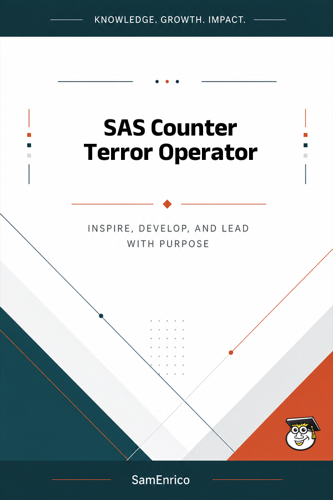
Non-FictionBiographyCounterterrorism
SAS Counter Terror Operator eBook
Train for plane train and metro hostage scenarios
Train for plane train and metro hostage scenarios with live fire drills.
Formats
Free sample
Chapter 1: The Broken Filter...–- The rain was cold against his face, but John Reeves did not blink. He had been standing in the Welsh moorland for eleven minutes, forty-two seconds, his 25-kilogram bergen cutting into his shoulders, his boots submerged in peat-brown water that had long since ceased to feel cold. Around him, seventeen other candidates shivered, coughed, or muttered. Two had already vomited. One was crying—a sound that would earn him a medical discharge before dawn.
The DS—Directing Staff—stood twenty meters away, silent, smoking, watching. No orders had been given for the past hour. No one knew what came next. That was the point.The test was not physical. By this stage—Week 9 of SAS selection—every remaining candidate could run, ruck, and rope with the required proficiency.
The test was something else entirely. It was the gap between knowing what to do and doing it when every nerve screamed stop. It was the filter that broke men who could run marathons but could not silence the voice in their head that asked why.John had learned that voice two years earlier, in a different rain, on a different continent. He had been a Royal Military Police close protection officer then, guarding a provincial reconstruction team in Helmand. The IED had taken his driver’s legs and his own hearing for three days.
He had dragged the man two hundred meters through irrigation ditches while small arms fire cracked overhead. He had not thought about fear. He had not thought about his daughter, who was three years old and whose face he carried in the breast pocket of his body armor. He had simply moved. The voice had been silent.It was silent now.
That was why he would pass, and the crying man would not.The Architecture of the Kill Zone The operator’s mindset is not a collection of techniques. It is not positive thinking, motivational quotes, or breathing exercises learned from a You Tube video. It is a fundamental re-engineering of the brain’s threat-response system, achieved through progressive exposure to controlled danger over months and years. The SAS Counter-Revolutionary Warfare (CRW) selection process does not look for warriors. It looks for men who can function when the world becomes a screaming, flashing, bleeding chaos of incomplete information and irreversible consequences.In the context of transport hostage scenarios—planes, trains, and metros—this psychological architecture is tested more severely than in almost any other military environment.
Consider the differences. A conventional soldier on a battlefield has room to maneuver, time to react, and the luxury of cover. A CT operator inside a hijacked aircraft has none of these. The aisle is one meter wide. The ceiling is two meters high.
There are 150 hostages sitting in rows, each one a potential human shield or an accidental casualty. The terrorist may be three rows ahead, or behind, or wearing an explosive vest under a jacket. The operator has less than half a second to decide who to shoot and who to shield. The wrong choice kills innocent people. Hesitation kills the team.This chapter builds the psychological foundation for every drill, tactic, and weapon system that follows.
It explains how SAS operators are selected for mental resilience, how they manage sensory overload in confined kill zones, how they develop the reflexive trust that eliminates hesitation, and how they control their own physiological stress responses under live fire. The techniques described here are not theoretical. They are drawn from after-action reviews, training curricula, and interviews with operators who have assaulted hijacked trains, cleared dark metro tunnels, and stacked outside aircraft doors with seconds on the clock.The Psychological Selection: Breaking the Rationalizer Most people believe that courage is the absence of fear. This is incorrect. Fear is a neurological and physiological response to perceived threat, mediated by the amygdala and the sympathetic nervous system.
It cannot be eliminated, and attempts to suppress it entirely lead to catastrophic failures of judgment. The goal of psychological selection is not to find fearless men. It is to find men whose fear response does not hijack their executive function.The SAS selection process, often called "The Hills" in its early phases and "The Test Week" in its final iteration, uses a series of progressively extreme stressors to identify candidates who can maintain cognitive function under duress. The mechanics are worth understanding because they directly parallel the demands of a hostage rescue.Phase One: Loaded Marching. Candidates carry 25kg bergens over 60 kilometers of Welsh mountain terrain, navigating by map and compass, with no sleep for the first 48 hours.
The physical demands are extreme, but the psychological filter is not about endurance. It is about the candidate’s internal monologue. The DS listen for what they call "the rationalizer"—the voice that says, "I’ll rest at the next tree," "I can cut this corner," "No one will notice if I dump two kilos of weight." Candidates who rationalize are failed, not because they are weak, but because they will rationalize in a kill zone. They will think, "That shadow might be a hostage," instead of shooting. They will hesitate.Phase Two: The Swamp.
After the march, candidates are marched into freezing water up to their chests and ordered to stand still for thirty minutes. Hypothermia begins to set in after fifteen. The body shakes uncontrollably. Teeth chatter. The rationalizer whispers, "This is pointless.
They won’t fail me if I step out. It’s a test of limits, not a real requirement." Candidates who step out are correct—it is a test of limits. They fail. Those who stand until the order to exit are given is the ones who understand that in hostage rescue, there is no stepping out. There is only the mission and the men to your left and right.Phase Three: The Room.
The final psychological filter is a simulated kill zone. Candidates enter a darkened room with strobe lights, recorded screams, and pop-up targets. Some targets are armed terrorists. Some are hostages holding black objects that could be weapons or phones or nothing. Candidates have 0.5 seconds to decide.
Live ammunition is not used, but the psychological pressure is real—the DS shout contradictory orders, fire blank rounds from behind the candidates, and occasionally physically shove them to simulate the chaos of a breach. Candidates who shoot a hostage are immediately failed. Candidates who hesitate and are "killed" by a pop-up terrorist are failed. Candidates who freeze are failed. The pass rate for this phase is approximately 15 percent.John Reeves passed the Room on his second attempt.
The first time, he had shot a hostage—a silhouette holding a child’s toy that had been painted black. The DS had stopped the exercise, walked him out, and said nothing. He spent the next six months training on threat discrimination, using flash cards and a custom-built computer program that flashed images for 0.3 seconds. By his second attempt, his reaction time had dropped to 0.27 seconds. He shot four terrorists and no hostages.
He does not speak about the first attempt.Sensory Overload: The Cocktail Party Problem in Hell One of the most dangerous misconceptions about close-quarters battle is that…
This is the end of the free sample. Get the eBook to keep going. Buy now
About this book
Details
- Author
- Coppola Mickie
- Publisher
- SamEnrico
- Language
- English
- Genre
- Non-Fiction, Biography, Counterterrorism
- Released
- 2026-06-08
- Pages (approx.)
- 150
- Available as
- eBook, Audiobook

Read better in the ZLOADR app
Your eBooks on your phone or tablet. Sign in with your SamEnrico account and start reading.
More by Coppola Mickie
 EQ Grief Support GuideCoppola Mickie$11.99
 Workaholism In Solo EntrepreneursCoppola Mickie$11.99
 The 5 Whys Anger MethodCoppola Mickie$11.99
 Introvert Friendly Team CreativityCoppola Mickie$11.99
 The Silk Road's Forgotten Cartographer: Xuanzang's Epic Journey to the Heart of AsiaCoppola Mickie$11.99
 Anansi and the Weaver’s Vow: A Spider’s Web of Love and DeceitCoppola Mickie$11.99
 Monthly Runway Tracker WorkbookCoppola Mickie$12.99
 Business English to ChineseCoppola Mickie$12.99
 Understanding Furlong–kurczynski–hennessy SyndromeCoppola Mickie$17.99
 Claw Machine StockerCoppola Mickie$11.99
 How to Start a Software Publishing BusinessCoppola Mickie$11.99
You may also like
 Hong Kong Handover 1997Dunn Johnnie$11.99
 Zumba For Postnatal Recovery CourseNeal Christian$11.99
 Zumba for BeginnersLadner Nikia$11.99
 YouTube Comment Mining GuideHumes Pandora$12.99
 Worry Box MeditationCarlin Rudy$11.99
 Workplace Stress MeditationNguyen Lynn$11.99
 Workplace Stress and Sleep RepairHawley Ivory$11.99
 Workplace Perfectionism CureDelaney Jeffry$11.99
 Workplace Injustice Anger GuideWallen Isabelle$11.99
 Work Addiction and Burnout LinkGreenwood Ester$11.99
 Women in Yoga and WellnessBeattie Galina$11.99
 Women in Stand Up ComedyChun Evangeline$11.99