
Non-FictionSelf-HelpCommunication
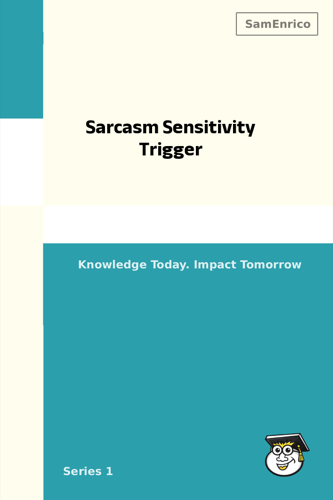
Sarcasm Sensitivity Trigger eBook
Explores how perceived mocking or veiled criticism
by Shearer Dann
Explores how perceived mocking or veiled criticism sparks disproportionate anger.
Formats
Free sample
Chapter 1: The Tear-Flesh Word...--–- The word lands before you can prepare for it. Someone says, "Wow, brilliant idea," but the tilt of their head, the slight curl of their lip, the half-second pause before the word "brilliant" tells you everything. Your face flushes. Your jaw tightens. Before you have consciously decided to react, your heart is already pounding.
By the time you open your mouth, what comes out is not a witty retort but something sharper, louder, more damaging than you intended. You have exploded over what they will later call "just a joke."If you are reading this book, you know this scene. Perhaps you know it as the person whose chest burns after a sarcastic comment from a partner, a coworker, or a parent. Perhaps you know it as the person who has been told, more times than you can count, that you are "too sensitive" or that you "can't take a joke." Perhaps you know it as the person who has apologized, hours or days later, for a rage that felt, in the moment, completely justified—and now feels, in retrospect, bafflingly disproportionate.This book is for you. And the first thing you need to know is this: you are not broken.
Your reaction is not random. And the problem is not simply that you need to "lighten up."The problem—the one this entire book exists to solve—begins with a single, ancient word. The Greek verb sarkazein meant, originally, to tear flesh like a dog tearing at meat. It meant to bite lips in rage. It meant to speak in a way that cuts.
Over time, sarkazein evolved into the noun sarkasmos, which Latin adopted as sarcasmus, which English finally borrowed as sarcasm. The word itself carries the memory of violence. Sarcasm, at its root, is not wit. It is tearing flesh.Most people do not know this. Most people think of sarcasm as a form of intelligence, a verbal shorthand for people who are quick and clever.
In popular culture, sarcastic characters are often the fan favorites—the quick-witted best friend, the cynical detective, the sharp-tongued sitcom star. Sarcasm has become, in many social circles, a marker of belonging. It says, I am smart enough to see the absurdity. I am cool enough not to take things seriously. I am one of you.But for a significant minority of people—perhaps as many as one in five, as we will explore in Chapter 4—sarcasm does not feel like belonging.
It feels like an attack. And for an even smaller but still substantial group, sarcasm triggers something that looks, from the outside, like a shocking overreaction. A cutting remark about their work. A teasing comment about their appearance. A veiled criticism disguised as humor.
And then—explosion. The slammed door. The shouted insult. The tearful exit. The day ruined, sometimes the relationship damaged, all over what the other person insists was "just a joke."The Central Mystery of This Book Here is the mystery that drove me to write this book, and that I suspect brought you here: why does the same stimulus—a sarcastic comment—produce such wildly different responses in different people?
And why, in the people who are most affected, does the response so often seem to be less about the comment itself and more about something else entirely?These are not academic questions. They are the questions that keep people up at night, replaying conversations, wondering if they are crazy, wondering if they are the problem. They are the questions that destroy relationships, poison workplaces, and create cycles of shame that last for decades.The answers, as it turns out, lie at the intersection of neuroscience, trauma research, attachment theory, and the study of shame. And the first answer—the one we need to establish before we can go any further—is that there is no single "sarcasm sensitivity." There are at least two distinct neurological pathways, and understanding which one is active in a given moment is the difference between continuing to explode and beginning to heal.The Two Timelines of Perceived Mockery Imagine two different scenarios.In the first scenario, a coworker says to you, "That was really efficient." The words are neutral. The tone is flat.
But something about the way they looked at you while saying it—a slight pause, a raised eyebrow—makes you wonder. Were they being sincere? Or were they implying the opposite? You cannot tell. You spend the next hour replaying the comment, testing different interpretations, feeling a low-grade sense of unease.
By the time you get home, you are exhausted, though you never said a word.In the second scenario, a different coworker says, "Oh, excellent work, as always," with an exaggerated eye roll and a smirk directed at a nearby colleague. There is no ambiguity. The contempt is obvious. Your face flushes instantly. Before you have time to think, you hear yourself saying, "What is that supposed to mean?" in a voice louder and sharper than you intended.
The explosion happens in seconds.These two scenarios represent the two distinct timelines of sarcasm sensitivity. In the first, the brain encounters ambiguous sarcasm—veiled, deniable, unclear in intent. This triggers what we will call the ambiguity loop: a prolonged state of alert in which the brain works overtime to decode meaning, unable to resolve the threat. The distress is slow-burn, cumulative, and exhausting.In the second, the brain encounters contemptuous sarcasm—obvious, hostile, clearly intended to wound. This triggers what we will call the amygdala hijack: an immediate, full-throttle fight-or-flight response that bypasses the rational prefrontal cortex entirely.
The rage is instant, explosive, and often disproportionate to the surface-level offense.Here is the crucial insight that most self-help books miss: these are not the same problem. They require different interventions. And if you try to solve one with tools designed for the other, you will fail, feel worse, and reinforce the belief that something is wrong with you.Throughout this book, we will use the term sarcasm sensitivity trigger to refer to the moment when a perceived sarcastic comment—whether ambiguous or contemptuous—activates a threat response in the brain. The trigger itself is neutral. It is simply the spark.
What matters is the wound it ignites.The Linguistic Trap: Why Veiled Criticism Hurts More Before we dive deeper into the neuroscience, we need to understand one of the strangest and most frustrating features of sarcastic communication: veiled criticism often hurts more than direct insults.Consider two statements directed at you after a presentation at work. Statement A: "That was terrible. You should be embarrassed." Statement B: "Well, that was certainly... thorough." delivered with a knowing glance at someone else.Which one stings more? For many people, the answer is Statement B.
And here is why.Direct criticism, for all its unpleasantness, is cognitively clean. You know where you stand. You can evaluate the criticism, accept it, reject it, or argue with it. The threat is clear, and your brain can respond appropriately.Veiled criticism, by contrast, creates a cognitive trap. You have to ask yourself: Did they mean that as criticism?
Am I reading too much into it? What if they were being sincere and I am being paranoid? This decoding…
This is the end of the free sample. Get the eBook to keep going. Buy now
About this book
Details
- Author
- Shearer Dann
- Publisher
- SamEnrico
- Language
- English
- Genre
- Non-Fiction, Self-Help, Communication
- Released
- 2026-06-06
- Pages (approx.)
- 136
- Available as
- eBook, Audiobook

Read better in the ZLOADR app
Your eBooks on your phone or tablet. Sign in with your SamEnrico account and start reading.
More by Shearer Dann
 Burnout Sabbatical PlanningShearer Dann$11.99
 The Quiz Funnel StrategyShearer Dann$11.99
 Workaholic Productivity Paradox GuideShearer Dann$11.99
 IBS Antispasmodic Medication GuideShearer Dann$11.99
 The Great Timber Heist: How a Rogue Lumber Baron Outsmarted the LawShearer Dann$11.99
 The Unseen First Lady: How Hillary Clinton Reinvented DiplomacyShearer Dann$11.99
 Understanding Chronic Granulomatous DiseaseShearer Dann$17.99
 Casino DealerShearer Dann$11.99
 Notion Template Product GuideShearer Dann$12.99
 HedgeDoc Google Docs AlternativeShearer Dann$12.99
 How to Start a Hobby in RacquetballShearer Dann$11.99
You may also like
 Hong Kong Handover 1997Dunn Johnnie$11.99
 Zumba For Postnatal Recovery CourseNeal Christian$11.99
 Zumba for BeginnersLadner Nikia$11.99
 YouTube Comment Mining GuideHumes Pandora$12.99
 Worry Box MeditationCarlin Rudy$11.99
 Workplace Stress MeditationNguyen Lynn$11.99
 Workplace Stress and Sleep RepairHawley Ivory$11.99
 Workplace Perfectionism CureDelaney Jeffry$11.99
 Workplace Injustice Anger GuideWallen Isabelle$11.99
 Work Addiction and Burnout LinkGreenwood Ester$11.99
 Women in Yoga and WellnessBeattie Galina$11.99
 Women in Stand Up ComedyChun Evangeline$11.99