
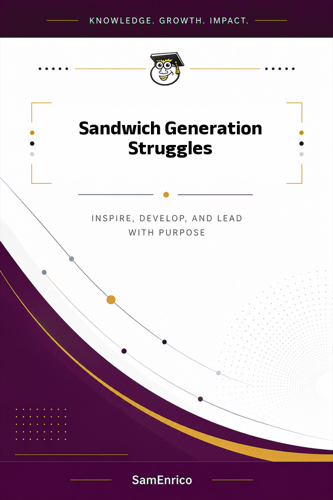
Sandwich Generation Struggles eBook
Caring for aging parents while raising teenagers o
by Layton Jovan
Caring for aging parents while raising teenagers of your own.
Formats
Free sample
Chapter 1: The Vanishing Middle...--You wake up at 5:47 a.m. to a text message from your mother: “What day is it?” You scroll down to the next message, sent three minutes later: “I think I left the stove on.” Below that, a third: “Never mind. That was three years ago.” You rub your eyes and realize you never actually fell asleep—you just lay in the dark between 2:00 and 5:00 a.m., replaying the argument with your sixteen-year-old daughter about why she cannot go to a party where no parents will be present. Your phone buzzes again. This time it is your boss: “Can you jump on a call at 7:00 instead of 9:00?” You have not brushed your teeth, you do not know if your mother took her blood pressure medication yesterday, and you are fairly certain your teenager left her backpack in the driveway overnight.
It is Tuesday.Welcome to the vanishing middle. You are not losing your mind. You are losing the space that used to belong to you.The term “sandwich generation” entered the popular lexicon in 1981, when sociologist Dorothy Miller published a study of women who found themselves caring for both young children and aging parents simultaneously. Four decades later, the bread has changed. The filling has changed.
The appetite has changed. You are not caring for toddlers who need diapers and naps. You are caring for teenagers who need rides to therapy and college application essays and privacy and autonomy and also, secretly, the same bedtime stories they pretended to hate at twelve. And you are caring for parents who need medication management and transportation to specialists and someone to listen to the same story about 1974 for the thirty-seventh time.This chapter is not a pep talk. It is a map.
Before you can solve any problem in this book—the financial S-curve, the emotional whiplash, the multi-generational territorial wars—you have to understand what is actually happening to you. And that requires naming the three invisible forces that make the sandwich generation fundamentally different from any other caregiving stage in human history.Force One: The Compression of Responsibility Your parents had their children in their twenties. Their parents died in their seventies. That created a gap—sometimes decades long—between launching children and burying parents. You, by contrast, likely had your first child in your early thirties.
Your parents, thanks to modern medicine, are living into their eighties and nineties. That means your teenager and your aging parent are both in high-need phases at the exact same time. There is no gap. There is no breather. There is no season of life where you get to sit on a porch and read a novel.Force Two: The Paradox of Visibility Young children demand attention loudly and immediately.
A crying baby cannot be ignored. A toddler climbing a bookshelf requires instant intervention. Teenagers and aging parents, however, often struggle in silence—or in ways that look like defiance rather than need. Your teen’s withdrawal looks like disrespect. Your parent’s confusion looks like stubbornness.
The result is that you feel angry at behaviors that are actually cries for help. And then you feel guilty for being angry. And then you feel exhausted from the emotional whiplash. This is not a character flaw. This is a structural feature of the sandwich.Force Three: The Absence of Institutional Support American society has built systems for the beginning of life (pediatrics, schools, daycare) and the end of life (hospice, nursing homes, Medicare).
But there is almost nothing for the messy middle—the years when your parent is too independent for a facility but too dependent to live alone, and your teen is too old for babysitters but too young for full autonomy. You are expected to invent solutions on the fly. And you are expected to do it while holding down a job, maintaining a marriage, and pretending to have hobbies.This book exists because that expectation is impossible. Not difficult. Not challenging.
Impossible. And the only way through is to stop trying to be a hero and start building systems that do not require heroism.Why This Chapter Matters Every other chapter in this book assumes you have internalized the reality that you are living in an unprecedented caregiving configuration. Chapter 2 will teach you about the adolescent brain versus the aging mind—the biological reasons your teen cannot control impulses and your parent cannot remember instructions. Chapter 3 introduces the Velcro Dynamic and the Scarcity of Attention. Chapter 4 tackles the financial S-Curve, including the boomerang kid phenomenon introduced at the end of this chapter.
But none of those strategies will land if you are still secretly believing that you should be able to handle all of this effortlessly.You cannot. No one can. And that is not failure. That is physics.The Three Illusions That Keep You Stuck Before we go any further, we need to name and destroy three illusions. These are the lies the sandwich generation tells itself, usually late at night when sleep will not come.Illusion One: "If I just try harder, I will find balance."Balance implies equal weight on both sides.
Your teen and your parent do not have equal needs on any given day. Some weeks, your parent will have three medical appointments, and your teen will need nothing except a ride to school. Other weeks, your teen will have a mental health crisis, and your parent will be stable. Balance is not a static state. It is a lie sold by influencers with good lighting and no dependents.
The goal is not balance. The goal is dynamic response—the ability to shift weight without collapsing.Illusion Two: "Other people seem to manage this better than I do."They do not. They are just better at hiding it. The sandwich generation suffers from what sociologists call "presentation of self"—the performance of competence in public while privately disintegrating. Your neighbor who always has a hot meal and a clean house?
She cried in the car after dropping her mom at dialysis. Your coworker who never misses a deadline? He has not slept more than five hours in three months. Comparison is not just the thief of joy. It is the thief of reality.Illusion Three: "This phase will end soon."This is the cruelest illusion because it contains a grain of truth.
The sandwich phase does end. Eventually, your teen will launch (or boomerang back, which we will discuss in the next section). Eventually, your parent will decline to the point where full-time care is necessary. But "soon" is a lie. The average sandwich generation duration is now eleven years.
Eleven. Years. That is longer than many marriages. That is longer than a typical mortgage term for a starter home. If you are waiting for rescue, you will drown.
The only sustainable path is to build a life that works within the squeeze, not despite it.The Boomerang Kid: The Third Layer of the Sandwich The introduction to this book mentioned the "boomerang kid phenomenon." Now it is time to take that seriously. If you are caring for a teenager and an aging parent, you are already in a classic sandwich. But if…
This is the end of the free sample. Get the eBook to keep going. Buy now
About this book
Details
- Author
- Layton Jovan
- Publisher
- SamEnrico
- Language
- English
- Genre
- Non-Fiction, Biography, Sandwich Generation
- Released
- 2026-06-12
- Pages (approx.)
- 144
- Available as
- eBook, Audiobook

Read better in the ZLOADR app
Your eBooks on your phone or tablet. Sign in with your SamEnrico account and start reading.
More by Layton Jovan
 Breaking the Action SuperstitionLayton Jovan$11.99
 The Anger and Money ConflictLayton Jovan$11.99
 Emotional Spending TriggersLayton Jovan$11.99
 Small Talk for Post OfficeLayton Jovan$11.99
 Titanic Porthole CollectionLayton Jovan$11.99
 Political Disagreement With FamilyLayton Jovan$11.99
 Social Anxiety And AlcoholLayton Jovan$11.99
 The Mole in the Shadows: The Unsolved Spy Murder That Rocked the Cold WarLayton Jovan$11.99
 The Tsars of Enlightenment: Russia's Golden Age of CultureLayton Jovan$11.99
 Mastering The Art of Wu (Hao)-style T'ai Chi Ch'uanLayton Jovan$11.99
 A Collector's Handbook to the Ford Capri Ii 1300Layton Jovan$11.99
 How to Produce Hockey SticksLayton Jovan$11.99