
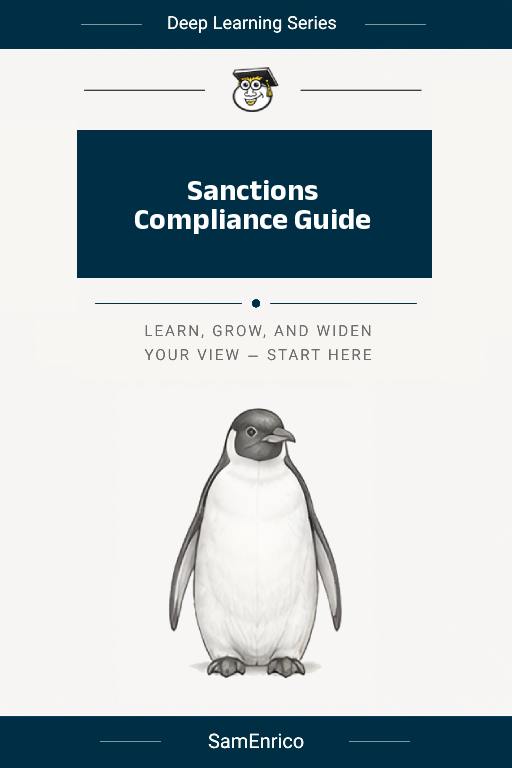
Non-FictionCrisis ManagementSanctions
Sanctions Compliance Guide eBook
Navigate international sanctions regimes and prote
Navigate international sanctions regimes and protect business from secondary sanction risks.
Formats
Free sample
Chapter 1: The New Battlefield--–- The email arrived at 9:47 AM on a Tuesday. Sara Chen, compliance director for a mid-sized logistics company in Singapore, had just poured her first coffee of the day. The subject line read: “Urgent – OFAC Inquiry.” Her company had never dealt directly with the United States. No US offices, no US employees, no US bank accounts. They simply moved shipping containers from Dubai to various ports in the Middle East.
One of those containers, it turned out, had been booked by a freight forwarder who was owned by a company that was owned by an Iranian petrochemical trading group. That trading group had been designated by the US Treasury eighteen months earlier. Sara’s company had no idea. They had never screened their customer’s customer. Within six months, that email led to a $4.2 million settlement, the resignation of Sara’s CEO, and a personal interview with regulators that left Sara questioning everything she thought she knew about international business.This is not a story about rogue states or terrorist financiers.
It is a story about a normal, profitable, growing company that was destroyed by a rule its leadership had never heard of. And it is happening every day, to companies just like yours, in industries that have nothing to do with politics or national security.Welcome to the new battlefield of the twenty-first century. The guns have fallen silent in most of the world, but the economic war has never been more intense. And you, whether you know it or not, are already on the front lines.The Quiet Revolution in Global Power For most of human history, nations resolved their disputes with armies, navies, and eventually air forces. When the United States wanted to pressure North Korea, it stationed aircraft carriers off the coast.
When Russia wanted to influence Ukraine, it massed troops at the border. When China wanted to assert its claims in the South China Sea, it built islands and deployed missiles. Military power was the ultimate currency of international relations.That era is ending. Not because military power has become irrelevant—it has not—but because a cheaper, more precise, and often more effective weapon has emerged: economic sanctions. Between 1990 and 2000, the United States imposed an average of thirty new sanctions designations per year.
Between 2010 and 2020, that number jumped to over six hundred per year. In 2022 alone, following Russia’s full-scale invasion of Ukraine, the US, EU, UK, Japan, Australia, and other allies imposed more than nine thousand new sanctions designations—more than in the previous decade combined.To understand what this means for your business, you need to understand a fundamental shift in how power works. In the old model, if the United States wanted to stop a Russian oil pipeline, it would have to convince European allies, negotiate with Russia, and potentially threaten military action. The process took years and often failed. In the new model, the United States simply designates the pipeline company’s CEO as a Specially Designated National, prohibits any US person from doing business with him, and threatens any non-US bank that processes his transactions with loss of access to the US dollar clearing system.
The pipeline does not stop immediately, but the financing dries up, the insurance becomes impossible to obtain, and within months, the project is effectively dead. No troops, no negotiations, no casualties. Just a few lines of text on a Treasury Department website, and billions of dollars of economic activity vanish.This is the new battlefield. And your company is a potential target.Why This Chapter Matters to You You might be reading this and thinking: “I’m not a bank. I’m not an oil trader.
I’m not doing business with Iran or North Korea. Why should I care?”Here is the uncomfortable truth: the vast majority of sanctions penalties in the past five years have been imposed on companies that never intended to violate any law. They were logistics firms that unknowingly shipped goods through a sanctioned country. They were manufacturers whose distributors resold products to a sanctioned end-user. They were tech startups whose cloud software was used by a company that was thirty percent owned by a sanctioned individual.
They were freight forwarders who picked up a container from a port in Turkey without realizing that the goods had originated in Iran.Consider these real examples:A German machine tool company sold a precision grinding machine to a distributor in Malaysia. The distributor resold it to a company in Russia. The Russian company was not sanctioned, but it supplied parts to a military entity that was. The German company had no knowledge of any of this. OFAC fined them $14.5 million for “failure to exercise due diligence in its supply chain.”A French software company provided cloud-based project management tools to a construction firm in Dubai.
The construction firm was a front for a North Korean procurement network. The French company’s software was used to manage a project that ultimately benefited North Korea’s missile program. The French company had never heard of the North Korean entity. The US Treasury designated the French company’s CEO personally, freezing any assets he had in US banks and banning him from traveling to the United States.A Canadian freight forwarder shipped a container of industrial bearings from Germany to Armenia. The bearings were not controlled items, and Armenia was not sanctioned.
The container was then trucked across the border into Iran. The Canadian company had no idea. OFAC imposed a $2.8 million penalty for “aiding and abetting” a sanctioned transaction, even though the company had no knowledge and no intent.In each of these cases, the company had one thing in common: they thought sanctions compliance was someone else’s problem. They thought that because they were not a US company, not a bank, and not in a “risky” industry, they were safe. They were wrong.The Expanding Web of Secondary Sanctions To understand how a logistics company in Singapore, a software firm in France, or a freight forwarder in Canada can be punished by the United States for conduct that is perfectly legal in their home countries, you need to understand the concept of secondary sanctions.Primary sanctions are straightforward.
They say: if you are a US person (a US citizen, a US company, or a foreign subsidiary of a US company), you cannot do business with a sanctioned party. If you do, you go to jail or pay a fine. That is the traditional model of sanctions enforcement, and it has existed for decades.Secondary sanctions are different, and they are the reason this book exists. Secondary sanctions say: even if you are not a US person, even if you have no office in the United States, even if you never touch the US dollar, if you do business with certain sanctioned parties or in certain sanctioned sectors, the United States will punish you. The punishment is not jail—the US cannot arrest a French citizen in Paris for violating US law.
Instead, the punishment is exclusion. The US will cut you off from the US financial system, block your assets held in US banks, prohibit US companies…
This is the end of the free sample. Get the eBook to keep going. Buy now
About this book
Details
- Author
- Jacks Houston
- Publisher
- SamEnrico
- Language
- English
- Genre
- Non-Fiction, Crisis Management, Sanctions
- Released
- 2026-06-01
- Pages (approx.)
- 155
- Available as
- eBook, Audiobook

Read better in the ZLOADR app
Your eBooks on your phone or tablet. Sign in with your SamEnrico account and start reading.
More by Jacks Houston
 MLK Oratory Mastery GuideJacks Houston$11.99
 The Study Motivation GuideJacks Houston$11.99
 Sam Sheppard Retrial AnalysisJacks Houston$11.99
 Teaching Others to Solidify LearningJacks Houston$11.99
 Infidelity ConversationJacks Houston$11.99
 Writing Goal Action SystemJacks Houston$11.99
 Pet Loss and RelationshipsJacks Houston$11.99
 CEO Morning Routine GuideJacks Houston$11.99
 The Silk Road Merchants of the Swahili Coast: Africa's Forgotten Trade TycoonsJacks Houston$11.99
 The Great Bombay Diamond Heist: How a Victorian-Era Forensic Breakthrough Cracked the CaseJacks Houston$11.99
 Service Providers Guide to WeldingJacks Houston$11.99
 Two Week Product Launch ReviewJacks Houston$12.99
You may also like
 Hong Kong Handover 1997Dunn Johnnie$11.99
 Zumba For Postnatal Recovery CourseNeal Christian$11.99
 Zumba for BeginnersLadner Nikia$11.99
 YouTube Comment Mining GuideHumes Pandora$12.99
 Worry Box MeditationCarlin Rudy$11.99
 Workplace Stress MeditationNguyen Lynn$11.99
 Workplace Stress and Sleep RepairHawley Ivory$11.99
 Workplace Perfectionism CureDelaney Jeffry$11.99
 Workplace Injustice Anger GuideWallen Isabelle$11.99
 Work Addiction and Burnout LinkGreenwood Ester$11.99
 Women in Yoga and WellnessBeattie Galina$11.99
 Women in Stand Up ComedyChun Evangeline$11.99