
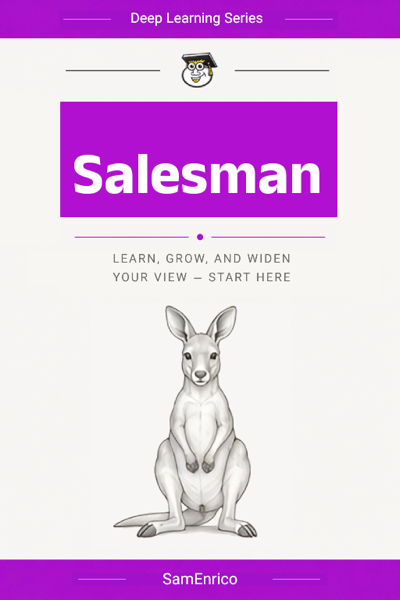
Non-FictionInformativeEducational
Salesman eBook
A Coursebook on Salesman
by Rice Rhonda
A Coursebook on Salesman
Formats
Free sample
Chapter 1: The Likability Trap...–- The first lie they ever told you about sales is that people buy from people they like. The second lie, delivered in the same breath, is that your job is to build relationships. These two falsehoods have destroyed more careers, emptied more pipelines, and created more mediocre salespeople than any other myths in the history of commerce. I know this because I have trained over fifteen thousand sales professionals across forty-three industries, and the single most consistent pattern I observe is this: the most liked salesperson on a team is almost never the top performer. Often, they are not even in the top half.
Meanwhile, the top performer is frequently described by peers as “intense,” “direct,” or even “difficult.” Not hated, but certainly not the person you would invite to a barbecue. This is not a coincidence. This is a data point.Let me tell you about Miranda. She was a senior account executive at a enterprise software company, selling compliance solutions to financial services firms. Her peers adored her.
She brought homemade cookies to every team meeting. She remembered birthdays. She volunteered for the DEI committee. Her manager described her as “a cultural cornerstone.” Her win rate was 17 percent. The company average was 31 percent.
When she was finally put on a performance improvement plan, her colleagues were shocked. “But everyone loves Miranda,” they said. Exactly. Everyone loved her. And she was failing.Across the hallway sat Derrick.
Derrick did not bring cookies. He did not remember birthdays. He was not rude—he was simply focused. His typical discovery call opened with: “I have reviewed your last three earnings calls and your investor presentation. You have a problem with regulatory reporting errors that cost you $4.2 million last year.
You mentioned it twice but have not solved it. Why?” His peers found him abrasive. His manager found him effective. His win rate was 58 percent. When Derrick left for a competitor, his clients followed him.
Not because they liked him—because he understood their business better than they did.This chapter is the foundation of everything that follows in this book. If you absorb only one concept from these pages, let it be this: your goal is not to be liked. Your goal is to be trusted. And trust is not built through rapport, small talk, or friendship. Trust is built through demonstrated competence, the courage to tell hard truths, and the willingness to challenge a buyer’s assumptions.
This is what separates the Challenger from every other sales profile. This is what this book means by “The Challenger’s Code.” And this is why the old model of relationship selling is not just outdated—it is actively dangerous to your career.The Five Sales Profiles: Where Do You Stand?Before we can rebuild your approach, we must first diagnose your current orientation. The most comprehensive research on salesperson effectiveness comes from the Corporate Executive Board’s landmark study of over six thousand sales professionals across ninety companies, later published as The Challenger Sale. That research identified five distinct profiles that consistently appear across industries, geographies, and company sizes. Read each description carefully.
Be honest with yourself. Your career depends on it.The Hard Worker. This salesperson believes that effort equals results. They are the first to arrive and the last to leave. They make more calls, send more emails, and log more CRM activity than anyone else on the team.
They are proud of their hustle. The problem is that activity is not productivity. The Hard Worker often mistakes motion for progress. They prospect indiscriminately, present prematurely, and chase deals that should have been disqualified weeks ago. Their manager loves their effort.
Their results are average at best. They burn out within three to five years.The Relationship Builder. This salesperson believes that people buy from people they like. They invest heavily in building personal rapport—asking about family, remembering personal details, sending handwritten notes. They are the team members most likely to be described as “a great person.” They avoid conflict at all costs, which means they avoid asking hard questions, pushing back on buyer objections, or challenging assumptions.
Their win rate is consistently low because they spend their time nurturing relationships with buyers who have no intention of buying. They are often shocked when they lose deals to competitors because “the buyer really liked me.”The Lone Wolf. This salesperson is the renegade. They follow their own processes, ignore the CRM, and bristle at any form of management oversight. They are often charismatic and confident.
They close spectacular deals occasionally, which buys them political capital to ignore the rules. But their performance is wildly inconsistent. One quarter they are the top performer; the next quarter they are at the bottom. They refuse to share best practices or collaborate. The Lone Wolf is a liability disguised as an asset.The Reactive Problem Solver.
This salesperson is responsive, attentive, and detail-oriented. They wait for buyers to come to them with problems, then work diligently to solve those problems. They are excellent at responding to RFPs, answering technical questions, and managing post-sale implementation. The problem is that they never lead. They react to the buyer’s agenda rather than setting their own.
They are order-takers, not value-creators. In a world where buyers can research solutions independently, the Reactive Problem Solver has become increasingly irrelevant.The Challenger. This salesperson leads with insight. They do not wait for the buyer to identify their problems; they identify problems the buyer did not know existed. They teach buyers something new about their business, their industry, or their competitors.
They tailor their message to different stakeholder personas. And crucially, they are not afraid to push back. The Challenger challenges buyer assumptions, pushes against discounting pressure, and takes control of the sales conversation. Their win rate is consistently 30 to 50 percent higher than the other four profiles. They are not always liked.
They are always trusted.Take a moment. Which profile describes your current approach? If you are like most salespeople I train, you identified with either the Hard Worker or the Relationship Builder. Both are losing strategies. The Hard Worker burns out.
The Relationship Builder gets liked into oblivion.Now, here is where the research gets uncomfortable. When salespeople take the profile assessment, 85 percent self-identify as Challengers. But when their managers and peers rate them, only 15 percent actually behave as Challengers. The gap between self-perception and reality is enormous. Most people believe they challenge buyers.
Most people actually avoid conflict, seek approval, and default to rapport-building.This chapter exists to close that gap. By the time you finish reading, you will know exactly what separates a true Challenger from someone who merely wants to be one. You will have a framework for shifting your behavior. And you will understand why being liked is the single most dangerous trap in modern sales.Why “Building Relationships” Is a Trap Let me be precise about what I am arguing, because I want to avoid the confusion that plagues most sales training. I am not saying that relationships do not matter.
I am not saying you should be rude, dismissive, or indifferent to the humans on the other side of the…
This is the end of the free sample. Get the eBook to keep going. Buy now
About this book
Details
- Author
- Rice Rhonda
- Publisher
- SamEnrico
- Language
- English
- Genre
- Non-Fiction, Informative, Educational
- Released
- 2026-05-18
- Pages (approx.)
- 155
- Available as
- eBook, Audiobook

Read better in the ZLOADR app
Your eBooks on your phone or tablet. Sign in with your SamEnrico account and start reading.
More by Rice Rhonda
 Personal Ing For Success Personal VisionRice Rhonda$11.99
 The Talent Mobility Technology GuideRice Rhonda$11.99
 Intuitive Eating For Chronic Dieters CourseRice Rhonda$11.99
 Opioid Induced HyperalgesiaRice Rhonda$11.99
 Free Clinic to Med SchoolRice Rhonda$11.99
 The Vanishing of Flight 447: The Black Box ConspiracyRice Rhonda$11.99
 Binary Apocalypse: The Forgotten Code That Almost Doomed CivilizationRice Rhonda$11.99
 Ultimate Handbook Guide to Ramallah and Gaza : (State of Palestine) Travel GuideRice Rhonda$11.99
 Merging Multiple Non Resident LLCsRice Rhonda$12.99
 Indian IT Degree DominanceRice Rhonda$12.99
 Understanding Bindewald–ulmer–muller SyndromeRice Rhonda$17.99
You may also like
 Hong Kong Handover 1997Dunn Johnnie$11.99
 Zumba For Postnatal Recovery CourseNeal Christian$11.99
 Zumba for BeginnersLadner Nikia$11.99
 YouTube Comment Mining GuideHumes Pandora$12.99
 Worry Box MeditationCarlin Rudy$11.99
 Workplace Stress MeditationNguyen Lynn$11.99
 Workplace Stress and Sleep RepairHawley Ivory$11.99
 Workplace Perfectionism CureDelaney Jeffry$11.99
 Workplace Injustice Anger GuideWallen Isabelle$11.99
 Work Addiction and Burnout LinkGreenwood Ester$11.99
 Women in Yoga and WellnessBeattie Galina$11.99
 Women in Stand Up ComedyChun Evangeline$11.99