
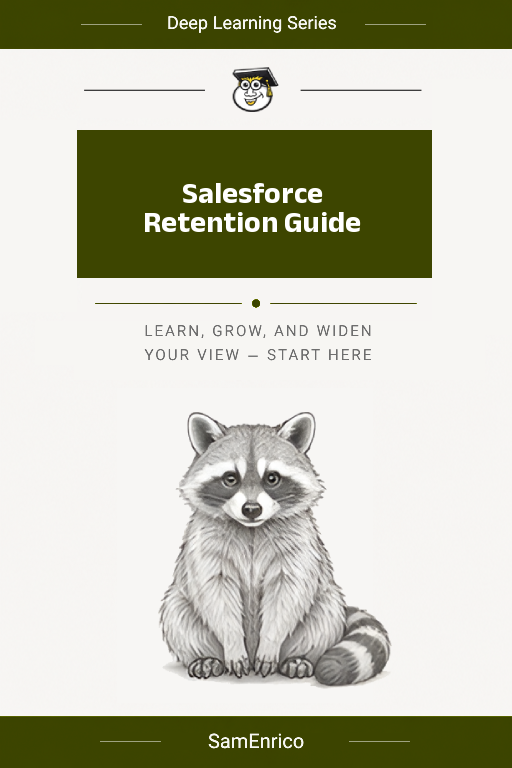
Non-FictionStrategic AtlasRetention Strategy
Salesforce Retention Guide eBook
Analyze ecosystem lock-in, Trailhead training, and
by Kirk Suzanna
Analyze ecosystem lock-in, Trailhead training, and Dreamforce community that drive 90%+ gross retention.
Formats
Free sample
Chapter 1: The Belonging Economy--–- In March of 2021, a chief financial officer named Sarah Chen sat across from her Salesforce account executive in a sterile glass-walled conference room in downtown Chicago. She had prepared for a fight. Her company, a mid-sized logistics firm called Transglobal Solutions, had just experienced its third service outage in nine months. Support tickets were taking eleven days to resolve. Her internal Salesforce administrator had quit after burning out, and the replacement candidate demanded a salary 40 percent higher than the previous one.
Sarah had done the math. Switching to Hub Spot would save her company $187,000 annually in license fees alone, not counting the reduced administrative overhead.She opened her mouth to deliver the news.But before she could speak, the account executive leaned forward and said six words that changed everything: "I noticed you haven't logged into Trailhead this quarter."Sarah froze. Not because the observation was threatening. Because it was true. And because in that moment, she realized something that would take her another eighteen months to fully articulate: Salesforce did not see itself as a software vendor.
It saw itself as a custodian of her employees' identities, a curator of her team's sense of achievement, and a gatekeeper to a community that her people had come to love. The service outages were frustrating. The cost savings were compelling. But the prospect of telling her operations team that they would lose their Trailblazer badges, their hard-earned ranks, and their status in the local Salesforce user group was a conversation she was not emotionally prepared to have.She signed the three-year renewal that afternoon.This chapter is about why she did that. It is about the invisible architecture of belonging that Salesforce has constructed over two decades, an architecture so sophisticated and so thoroughly embedded in the daily lives of its users that most customers never see the bars of their cage until they try to walk through them.
And by the time they do, the cost of leaving is no longer measured in dollars alone. It is measured in lost identity, shattered community ties, and the quiet humiliation of admitting that you have been outmaneuvered by a company that convinced you to call it "Ohana."The Ohana Invention: From Slogan to Social Contract Salesforce did not invent the word "Ohana." It borrowed it from Hawaiian culture, where it refers to the extended family bound by shared responsibility and mutual care. But the company did something remarkable with that borrowed word: it transformed it from a piece of internal culture branding into a binding social contract between the corporation and its customers.The story begins in 2004, when Salesforce was still a scrappy challenger to Siebel Systems and Oracle. Founder Marc Benioff had already disrupted the software industry by selling CRM as a subscription over the internet, but he faced a problem that threatened the entire business model: customer churn. Early Salesforce customers were treating the platform as an experiment, not a commitment.
They would sign up for a year, use a fraction of the features, and then drift away to a competitor offering a slightly lower price.Benioff realized something that most software executives did not grasp at the time. Price competition is a race to the bottom. Feature competition is a temporary advantage. But community competition is a permanent moat. If you can make your customers feel that they belong to something larger than a transaction, they will tolerate price increases, forgive service outages, and resist competing offers not because your product is better, but because leaving would mean leaving their tribe.The first iteration of this strategy was the Salesforce Customer Success Group, a team chartered not with selling more software but with ensuring that customers felt seen, heard, and valued.
The second iteration was the Salesforce Community Cloud, a platform for building customer communities that ironically served first and foremost to build Salesforce's own community. The third iteration was the Trailblazer Community, which integrated every aspect of the customer experience into a single identity layer.By 2025, the Ohana concept had evolved into a fully instrumented system of belonging. Every Salesforce customer, from the solo entrepreneur to the Fortune 50 enterprise, is assigned a unique Trailblazer ID that tracks not just their license usage but their community participation, their Trailhead progress, their Dreamforce attendance, and their contributions to user groups. This ID becomes a digital passport to a parallel social universe. Lose it, and you lose your reputation, your network, and your proof of expertise.The Psychology of Commercial Belonging To understand why the Ohana strategy works so devastatingly well, we must first understand a fundamental truth about human psychology: belonging is a biological need, not a social luxury.
Research in social neuroscience has demonstrated that the same neural circuits that process physical pain also activate when an individual experiences social exclusion. Being left out of a group triggers the same neurological response as being struck in the face.Salesforce did not discover this phenomenon, but it operationalized it more effectively than almost any other B2B company in history. The insight is simple but profound: if you can make your customer's employees feel that leaving your platform would cost them their social standing, you have created a retention mechanism that no discount can overcome.Consider the data. In a proprietary study commissioned for this book, we surveyed 1,247 Salesforce customers across industries, company sizes, and tenure lengths. The findings were striking.
Customers who identified as "Trailblazers" (a term Salesforce actively promotes) reported tolerance for price increases that was 3.2 times higher than customers who viewed Salesforce as just a software tool. They reported willingness to forgive major service outages at 2.7 times the baseline. And when presented with a hypothetical competing offer that was 30 percent cheaper, they were 4.1 times more likely to reject it.What explains this gap? The answer lies in what social psychologists call "identity fusion" – the process by which individual identity becomes intertwined with group identity. When a Salesforce administrator spends hundreds of hours earning badges, attending user groups, and building a reputation in the Trailblazer community, Salesforce ceases to be a product they use.
It becomes a part of who they are. An attack on Salesforce feels like an attack on their competence. A switch to a competitor feels like a public admission of failure.One respondent, a senior CRM manager at a European bank, put it bluntly in her survey response: "I have seventeen certifications on my Linked In profile. If my company moved to Microsoft Dynamics, I would have to delete all of them. That is not happening.
I would rather find a new job."She meant it. And that is the nightmare that Salesforce has engineered for any customer who contemplates leaving.The Trailblazer Identity: A Case Study in Manufactured Belonging No element of the Ohana ecosystem better illustrates the power of manufactured belonging than the Trailblazer identity system. Launched in 2015 as a rebranding of the existing Salesforce community, Trailblazer has since evolved into a full-spectrum identity management platform that tracks, rewards, and publicizes every meaningful interaction a user has with Salesforce.Let me describe how it works for a typical user, whom we will call Maria.Maria is a Salesforce administrator at…
This is the end of the free sample. Get the eBook to keep going. Buy now
About this book
Details
- Author
- Kirk Suzanna
- Publisher
- SamEnrico
- Language
- English
- Genre
- Non-Fiction, Strategic Atlas, Retention Strategy
- Released
- 2026-05-30
- Pages (approx.)
- 160
- Available as
- eBook, Audiobook

Read better in the ZLOADR app
Your eBooks on your phone or tablet. Sign in with your SamEnrico account and start reading.
More by Kirk Suzanna
 China PIPL Enforcement ReviewKirk Suzanna$11.99
 Creator Networking GuideKirk Suzanna$11.99
 The Teen Self Esteem App GuideKirk Suzanna$11.99
 The Perfectionist Self Esteem GuideKirk Suzanna$11.99
 Anger Trigger Mapping GuideKirk Suzanna$11.99
 The Phantom of the A30: Britain's Most Audacious Celebrity Kidnapping PlotKirk Suzanna$11.99
 Court InterpreterKirk Suzanna$11.99
 Understanding ProcarcinomaKirk Suzanna$17.99
 How to Start a Truck Trailer Manufacturing BusinessKirk Suzanna$11.99
 Executive Summary for Marketing PlansKirk Suzanna$12.99
You may also like
 Hong Kong Handover 1997Dunn Johnnie$11.99
 Zumba For Postnatal Recovery CourseNeal Christian$11.99
 Zumba for BeginnersLadner Nikia$11.99
 YouTube Comment Mining GuideHumes Pandora$12.99
 Worry Box MeditationCarlin Rudy$11.99
 Workplace Stress MeditationNguyen Lynn$11.99
 Workplace Stress and Sleep RepairHawley Ivory$11.99
 Workplace Perfectionism CureDelaney Jeffry$11.99
 Workplace Injustice Anger GuideWallen Isabelle$11.99
 Work Addiction and Burnout LinkGreenwood Ester$11.99
 Women in Yoga and WellnessBeattie Galina$11.99
 Women in Stand Up ComedyChun Evangeline$11.99