
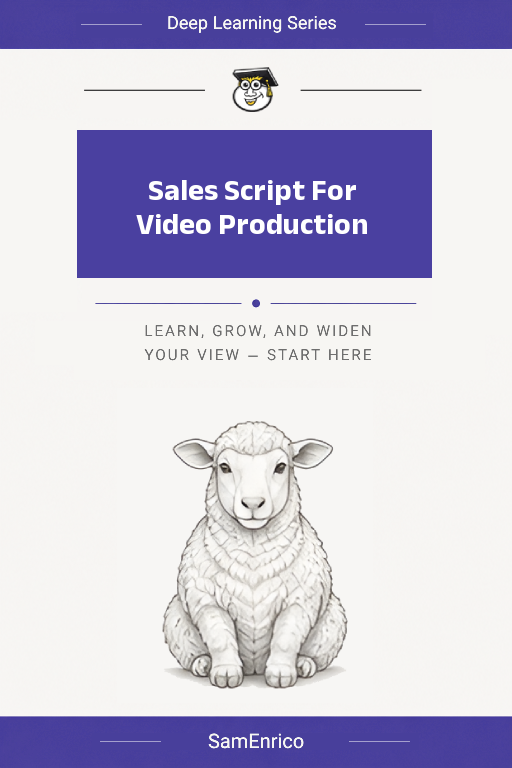
Sales Script For Video Production eBook
Sell video ads using completion rates and brand st
by Singer Helga
Sell video ads using completion rates and brand storytelling.
Formats
Free sample
Chapter 1: The Zero-Second Decision--–- The human brain processes images in 13 milliseconds. In the time it takes you to blink—roughly 100 milliseconds—a viewer scrolling through their feed has already decided whether to watch your video, scroll past it forever, or tap the "skip" button before your logo even finishes fading in. This is not an exaggeration. This is not marketing hype. This is the neuroscience of the modern attention economy, and it has fundamentally rewritten every rule of video advertising that was written before 2015.For most of television history, the rules were simple.
You bought thirty seconds of airtime during a popular show, and a captive audience had no choice but to watch your message. They could change the channel, but that required getting up from the couch—a friction point high enough that most people simply waited for their show to return. The commercial break was a captive environment. Your video had a guaranteed audience.That world is dead. It was murdered by the smartphone.Today, your video ad appears in a feed alongside a text from the viewer's mother, a breaking news alert about a natural disaster, a Tik Tok dance that has been viewed four hundred million times, and a photo of their best friend's newborn baby.
The viewer's thumb rests millimeters from your video. The cognitive cost of scrolling past you is zero. The cognitive cost of watching you is the most precious resource a person has: their time.This chapter is about the first five seconds of your video. Specifically, it is about the neurological reflex that determines whether those five seconds become fifty seconds—or whether they become zero. I call this reflex the zero-second decision, because it happens before the viewer has consciously decided to make a decision at all.Understanding the zero-second decision is not optional.
It is the foundation upon which every other principle in this book is built. If you lose the viewer in the first five seconds, you never get to the problem statement, the solution, the proof, or the call to action. You never get to use the ABCD framework from Chapter 3, the story archetypes from Chapter 4, or the benefit-driven storytelling from Chapter 6. You do not get a second chance to make a first impression because there is no second chance. The scroll is permanent.
The decision is final.Let me show you exactly how this works, why it works, and what you must do about it.The 13-Millisecond Reality To understand the zero-second decision, you must first understand the speed of human visual processing. The number 13 milliseconds appears repeatedly in the cognitive neuroscience literature as the approximate time required for the brain to register and categorize a visual stimulus. That is 0.013 seconds. In that time, light enters the retina, travels along the optic nerve, reaches the visual cortex at the back of the brain, and triggers a cascade of neural activity that results in a preliminary classification: friend or foe, relevant or irrelevant, interesting or boring, worth another 13 milliseconds or not.This processing happens entirely outside conscious awareness. You do not decide to see something and then interpret it.
You see it, your brain interprets it automatically, and only after that interpretation does your conscious mind become aware that you have seen anything at all. The decision to pay attention—or to withdraw attention—is made by ancient neural circuits that evolved long before the prefrontal cortex, the seat of rational decision-making, even existed.This is why the zero-second decision is so dangerous for video advertisers. You are not competing for rational evaluation. You are competing for a reflex. And that reflex is brutally efficient at filtering out anything that looks like an advertisement.Consider what happens when a viewer scrolls through Instagram, Tik Tok, or You Tube Shorts.
Their thumb moves in a steady rhythm: scroll, pause for 1-2 seconds, scroll, pause for 1-2 seconds, scroll. During each pause, the viewer's visual cortex processes the image on the screen. Within that 1-2 second window, the brain has already made a preliminary decision about whether to continue watching or to scroll.Most videos lose that decision. The average scroll-pause duration across social platforms is approximately 1.7 seconds. If your video has not communicated something worth watching within that window, the thumb moves, and you are gone.The research on this phenomenon is staggering.
A study by Microsoft cited in attention economy literature found that the average human attention span dropped from twelve seconds in the year 2000 to eight seconds in 2015—one second shorter than the attention span of a goldfish. More recent data suggests the decline has accelerated with the rise of Tik Tok and Reels. But attention span is actually the wrong frame. The real issue is not how long someone can pay attention; it is how quickly they decide whether something is worth paying attention to at all.That decision speed has increased dramatically. In the era of television, viewers had thirty seconds to decide whether a commercial was interesting.
In the early era of You Tube pre-roll, viewers had five seconds before the "Skip Ad" button appeared. In the current era of infinite scroll, viewers have approximately one to two seconds—and often less.This is the reality you are scripting for. Not a captive audience. Not a patient viewer. A person whose thumb is already in motion, whose brain is already filtering, whose neural circuits are already categorizing your video as either worth watching or not worth watching, before you have said a single word.The Three Scroll-Stopper Categories After analyzing thousands of successful video ads across platforms including You Tube, Tik Tok, Instagram, and Linked In, and after reviewing the neurological research on attention capture, I have identified three distinct categories of scroll-stoppers that reliably trigger the orienting response and freeze the thumb.
Each category works through a different neurological mechanism, and each is appropriate for different products, audiences, and platforms.The first category is the Pattern Interrupt. The human brain is a prediction engine. It is constantly generating expectations about what will happen next based on what has happened before. When reality violates those predictions—when something unexpected appears—the brain releases a small burst of dopamine and norepinephrine, neurotransmitters associated with attention, arousal, and reward prediction error. This is the pattern interrupt mechanism, and it is one of the most reliable ways to stop the scroll.Effective pattern interrupts in video advertising take many forms.
An extreme close-up of something unexpected—a cracked phone screen, a child's tear-streaked face, a product being used in an unconventional way—creates a visual prediction violation. A sudden loud sound or, perhaps more effectively, a sudden silence where music is expected creates an auditory prediction violation. A visual mismatch between what is being said and what is being shown—a voiceover that says "luxury" while the screen shows a beat-up sedan—creates a conceptual prediction violation that forces the brain to pause and resolve the inconsistency.The key to the pattern interrupt is that the violation must be meaningful, not random. A cat jumping across the screen for no reason will grab attention briefly, but that attention will not transfer to your message because the viewer's brain will categorize…
This is the end of the free sample. Get the eBook to keep going. Buy now
About this book
Details
- Author
- Singer Helga
- Publisher
- SamEnrico
- Language
- English
- Genre
- Non-Fiction, First 30 Days
- Released
- 2026-06-01
- Pages (approx.)
- 146
- Available as
- eBook, Audiobook

Read better in the ZLOADR app
Your eBooks on your phone or tablet. Sign in with your SamEnrico account and start reading.
More by Singer Helga
 The Voice Tone ConnectionSinger Helga$11.99
 Circadian Rhythm And ADHDSinger Helga$11.99
 Academic Competition PressureSinger Helga$11.99
 Growing Up With Borderline ParentSinger Helga$11.99
 Twelve Step for Eating DisordersSinger Helga$11.99
 Survival Game AddictionSinger Helga$11.99
 Caregiving for Multiple SclerosisSinger Helga$11.99
 Growth Hormone Secrets for LongevitySinger Helga$11.99
 Sugar Withdrawal Management GuideSinger Helga$11.99
 The Alchemist of Damascus: Unlocking the Secrets of the AtomSinger Helga$11.99
 The Silk Road Heist: How a Teen Hacker Laundered Millions in BitcoinSinger Helga$11.99
 How to Start a Custom Software Development Business (Beginners Guide)Singer Helga$11.99
You may also like
 Hong Kong Handover 1997Dunn Johnnie$11.99
 Zumba For Postnatal Recovery CourseNeal Christian$11.99
 Zumba for BeginnersLadner Nikia$11.99
 YouTube Comment Mining GuideHumes Pandora$12.99
 Worry Box MeditationCarlin Rudy$11.99
 Workplace Stress MeditationNguyen Lynn$11.99
 Workplace Stress and Sleep RepairHawley Ivory$11.99
 Workplace Perfectionism CureDelaney Jeffry$11.99
 Workplace Injustice Anger GuideWallen Isabelle$11.99
 Work Addiction and Burnout LinkGreenwood Ester$11.99
 Women in Yoga and WellnessBeattie Galina$11.99
 Women in Stand Up ComedyChun Evangeline$11.99