
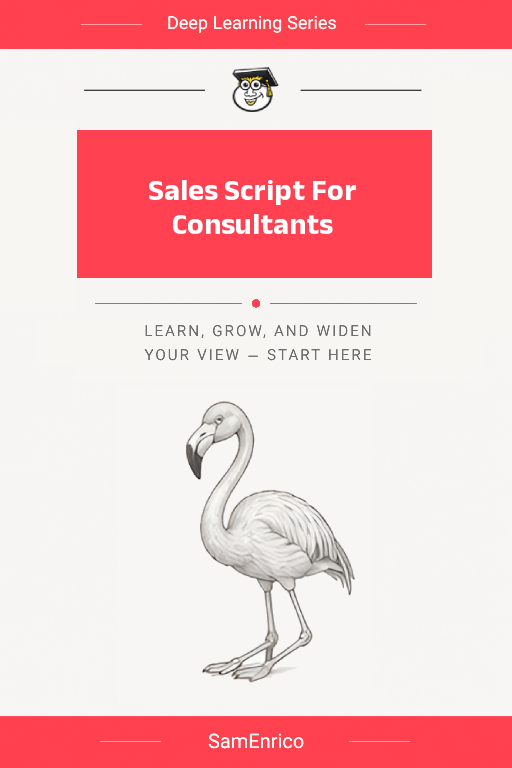
Sales Script For Consultants eBook
Sell expertise-based services using authority and
Sell expertise-based services using authority and results frameworks.
Formats
Free sample
Chapter 1: The Rapport Trap--Most consultants believe they are terrible at sales. The truth is far worse: they are terrible at the wrong kind of sales. They have been trained, implicitly or explicitly, to sell like product peddlers. And when an expert peddles, everybody loses.Let me paint a scene that will feel painfully familiar. You are on a discovery call with a promising prospect.
You have done your research. You have your questions prepared. You open with something warm and disarming: “So, tell me a little about what’s been going on in your business lately.” The prospect launches into a meandering explanation of market conditions, internal frustrations, and vague hopes for improvement. You listen attentively. You nod.
You ask a few follow-ups: “How long has that been happening?” “Who else is affected?” “What have you tried so far?”An hour later, the call ends. The prospect says, “This was really helpful. Let me think about it.” And then you never hear from them again. Or worse, you hear from them six months later with a budget that is half of what you normally charge, asking if you can “just do a quick version.”What happened? You did everything the sales books told you to do.
You built rapport. You asked open-ended questions. You listened more than you talked. You were helpful. And yet, you walked away with nothing but a “let me think about it.”Here is the brutal truth that no one tells you about selling expertise: the traditional sales script is not merely ineffective for consultants—it is actively destructive.
Every time you open with a rapport-building question, you are signaling that you do not know something you should know. Every time you ask a prospect to “tell you about their pain,” you are positioning yourself as a subordinate seeking permission to serve. And every time you leave a call without a clear, forward-moving commitment, you have taught the prospect that your time is worth nothing.This chapter is called The Rapport Trap for a reason. Rapport is not the enemy. But rapport first—rapport before authority, connection before credibility—is a poison that has infected the consulting industry for decades.
In this chapter, we will diagnose why traditional sales scripts fail for expertise-based services, introduce the Diagnostician model that replaces the broken Rapport-First approach, and give you the first concrete script shift that will change every sales conversation you have from this moment forward.The Myth of the Relationship Builder For the past thirty years, the dominant sales philosophy in B2B has been some variation of “people buy from people they like.” This idea, popularized by countless relationship-selling gurus, suggests that if you can build sufficient personal rapport—find common ground, share a laugh, demonstrate genuine curiosity—the sale will naturally follow.This works beautifully when you are selling a commodity. If you are selling office supplies, printing services, or standardized software, differentiation is minimal. In that world, likability becomes a legitimate competitive advantage. The prospect thinks: “Well, all these vendors offer roughly the same thing. I might as well buy from the person I enjoy talking to.”But consulting is not a commodity.
You are not selling a widget with fixed specifications and predictable outcomes. You are selling judgment, pattern recognition, and the ability to produce a result that the client cannot produce on their own. In this world, likability is not a competitive advantage—it is a table stake. What actually drives the purchase decision is perceived authority.Let me define what I mean by authority, because the word gets thrown around loosely. Authority, in the context of selling expertise, is the client’s belief that you have seen their problem before, solved it successfully, and can do so again with them—despite their unique circumstances.
Authority is not arrogance. Authority is not credential-dropping. Authority is the quiet confidence that comes from pattern recognition. And without it, no amount of rapport will ever close a deal.Consider the difference between two hypothetical consultants. Consultant A opens with: “It’s so great to meet you.
Tell me about your business. What keeps you up at night?” Consultant B opens with: “Based on what we’ve seen across four other firms in your industry, there’s a specific operational leak that costs most companies your size about 18% of their margin. I don’t know if that applies to you, but if it does, we should spend our time there. Does that resonate?”Which one sounds like an expert? Which one sounds like they have solved this problem before?
Which one would you trust with a six-figure engagement?Consultant A is playing the role of the curious amateur. They are asking the client to educate them. And here is the dirty secret of high-stakes consulting: clients hate educating consultants. They are busy. They are stressed.
They have explained their problems to a dozen other consultants who all nodded sympathetically and then disappeared. When you ask a prospect to “tell you about their pain,” you are not building rapport. You are burning it.Why Insight Sells and Likability Merely Lubricates The research behind the Challenger Sale, one of the most rigorously studied sales models of the past decade, found something counterintuitive: the highest-performing salespeople were not the Relationship Builders. They were the Challengers—people who actively taught prospects something new about their own problems, who pushed back on assumptions, and who were not afraid to create constructive tension.This finding shocked the sales establishment. For years, everyone assumed that “being liked” was the primary driver of sales success.
But the data told a different story. In complex B2B environments—exactly where consultants operate—the ability to teach and provoke predicted success more strongly than any other factor.Why does insight sell? Because clients are swimming in uncertainty. They know something is wrong, but they are not sure what. They have tried fixes that did not work.
They have hired consultants who delivered generic advice. What they are desperately seeking is not another sympathetic ear—it is a diagnosis. They want someone to look at their symptoms and say, with confidence: “I have seen this before. Here is the underlying cause that you are missing. And here is what it will take to fix it.”When you lead with insight, you do three things simultaneously.
First, you demonstrate that you are not a beginner. You have pattern recognition. You have seen variations of this problem across multiple contexts. Second, you reduce the client’s cognitive load. Instead of forcing them to articulate a problem they may not fully understand, you give them a hypothesis to react to.
Third, and most importantly, you flip the power dynamic. You are no longer a supplicant hoping for permission to serve. You are a peer offering a perspective.That last point is critical. The traditional sales script positions the consultant as the asker and the client as the answerer. “Tell me about your business.” “What are your goals?” “What’s not working?” Each question reinforces the client’s superiority in the relationship.
They have the information; you need it. They are the expert on their business; you are a visitor.The insight-first approach…
This is the end of the free sample. Get the eBook to keep going. Buy now
About this book
Details
- Author
- Shepherd Dortha
- Publisher
- SamEnrico
- Language
- English
- Genre
- Non-Fiction, First 30 Days
- Released
- 2026-05-30
- Pages (approx.)
- 152
- Available as
- eBook, Audiobook

Read better in the ZLOADR app
Your eBooks on your phone or tablet. Sign in with your SamEnrico account and start reading.
More by Shepherd Dortha
 Twelve Step Meetings DecodedShepherd Dortha$11.99
 Music Theory MemorizationShepherd Dortha$11.99
 Depression Fatigue ManagementShepherd Dortha$11.99
 Female Blue Angel PilotShepherd Dortha$11.99
 Assertiveness in Financial ConversationsShepherd Dortha$11.99
 Disappointment In HealthShepherd Dortha$11.99
 Little Boy and Fat Man Design DifferencesShepherd Dortha$11.99
 The Betrayal Code: How a Math Genius Cracked the Stock Market—Then Sold Out the WorldShepherd Dortha$11.99
 Splendid Little War: The Battle of Santiago de Cuba (1898)Shepherd Dortha$11.99
 Crowns and Chaos: The Year That Changed Royalty ForeverShepherd Dortha$11.99
 The Complete Guide to the RemedyShepherd Dortha$11.99
 VFX Production ManagerShepherd Dortha$11.99
You may also like
 Hong Kong Handover 1997Dunn Johnnie$11.99
 Zumba For Postnatal Recovery CourseNeal Christian$11.99
 Zumba for BeginnersLadner Nikia$11.99
 YouTube Comment Mining GuideHumes Pandora$12.99
 Worry Box MeditationCarlin Rudy$11.99
 Workplace Stress MeditationNguyen Lynn$11.99
 Workplace Stress and Sleep RepairHawley Ivory$11.99
 Workplace Perfectionism CureDelaney Jeffry$11.99
 Workplace Injustice Anger GuideWallen Isabelle$11.99
 Work Addiction and Burnout LinkGreenwood Ester$11.99
 Women in Yoga and WellnessBeattie Galina$11.99
 Women in Stand Up ComedyChun Evangeline$11.99