
Non-FictionInformativeEducational
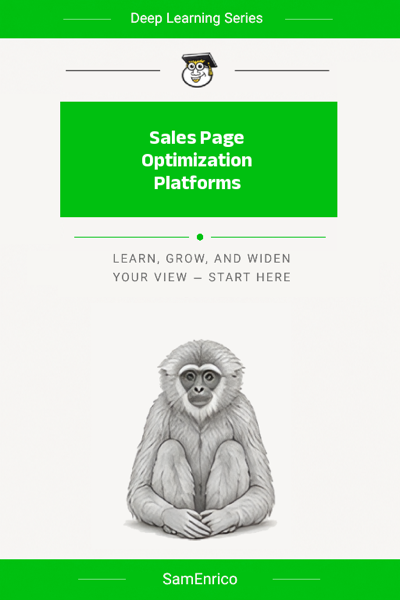
Sales Page Optimization Platforms eBook
A Coursebook on Sales Page Optimization Platforms
A Coursebook on Sales Page Optimization Platforms
Formats
Free sample
Chapter 1: The $100,000 Button--It was 11:47 PM on a Tuesday when Marcus deleted the button.Not a bad button. Not a broken button. A perfectly good green button that said “Get Started” – the same button that had been on his company’s pricing page for fourteen months. He wasn’t trying to be a hero. He wasn’t trying to prove a point.
He was just tired of watching his paid traffic budget burn.Marcus was the head of growth at a mid-sized Saa S company called Lead Forge. They sold sales intelligence software to B2B teams. Their product was solid. Their team was smart. Their ads were well-written.
And yet, for fourteen months, their conversion rate from landing page to free trial had sat at a stubborn, soul-crushing 2.1 percent.The marketing team had tried everything that conventional wisdom suggested. They had run a brand awareness campaign. They had produced case study videos. They had rewritten their value proposition five times. They had hired a conversion copywriter who charged eighteen thousand dollars for a single landing page rewrite.Nothing moved the needle.The CEO, a well-intentioned former sales executive named Patricia, had her own theories.
“The button should be orange,” she said during a Q3 review, pointing at the screen with the confidence of someone who had never run an A/B test in her life. “Orange is energetic. Orange says ‘click me.’ I read a study once about orange.”The marketing team changed the button to orange. Conversion dropped to 1.9 percent.“Make it blue,” Patricia said the following month. “Blue is trustworthy.”The marketing team changed the button to blue.
Conversion returned to 2.1 percent. Patricia declared victory. “See? Blue was the answer.”Marcus didn’t say what he was thinking, which was that the button color had made no measurable difference whatsoever. The 0.2 percent fluctuation was well within the margin of error of their tiny sample size.
But Patricia was the Highest Paid Person in the Room, and her Opinion carried weight. The Hi PPO had spoken.Then, at 11:47 PM on a Tuesday, Marcus did something reckless. He opened their landing page platform – a tool called Unbounce that the company had been paying for but barely using – and he changed one word on the button.Not the color. Not the size. Not the placement.One word.He changed “Get Started” to “See Plans.”That was it.
No meeting. No approval. No Power Point presentation justifying the change to Patricia. Just a tired marketer at midnight who had decided that he would rather ask for forgiveness than permission.He went to bed.The next morning, Marcus checked the platform’s analytics dashboard. His coffee mug stopped halfway to his mouth.The button with “See Plans” was converting at 3.7 percent.Not a 0.2 percent fluctuation.
Not a rounding error. A seventy-six percent relative increase in conversion rate. Overnight. With one word.Marcus ran the test for another seven days, terrified that the numbers would regress to the mean. They did not.
Over eight hundred visitors, the “See Plans” button consistently outperformed the fourteen-month incumbent “Get Started” button by a margin that made his statistics professor weep with joy.He calculated the annual impact. Lead Forge spent roughly one hundred and twenty thousand dollars per month on paid traffic. At a 2.1 percent conversion rate, that traffic produced approximately twenty-five hundred free trial signups per month. At a 3.7 percent conversion rate, that same traffic produced approximately forty-four hundred signups per month – an increase of nineteen hundred trials.Their average free trial converted to paid customer at 18 percent. Nineteen hundred additional trials meant three hundred forty-two additional customers per month.
Their average customer paid four thousand dollars per year.Marcus did the math three times because he didn’t believe it the first two times.One word on a button was worth roughly one hundred and thirty-six thousand dollars per month in new annual recurring revenue.One hundred and thirty-six thousand dollars. Per month. From a button.He walked into Patricia’s office later that week, showed her the data, and waited for the explosion. Instead, Patricia looked at the screen, looked at Marcus, and said something that changed how he thought about optimization forever.“I still think orange would have been better,” she said. “But run with the blue one.”Patricia was not a bad leader.
She was not stupid. She was simply operating under the same delusion that infects almost every organization that touches a sales page: the belief that good design, good copy, and good intentions are enough. That optimization is about creativity. That the best idea wins.The truth is far stranger and far more frustrating.The best idea almost never wins. The idea that wins is the one that someone actually tests.This book is about why that distinction matters more than any design principle, any copywriting formula, or any marketing framework you have ever encountered.
It is about the specific class of software tools known as sales page optimization platforms – the Unbounces, Instapages, VWOs, and Optimizelys of the world – and how to use them not as page builders but as truth-finding engines.But before we talk about platforms, before we talk about A/B testing or heatmaps or dynamic text replacement, we need to talk about the fundamental shift in mindset that makes those tools useful in the first place. Because if you bring the wrong mindset to the right platform, you will simply automate your own ignorance at scale.The Unaccountable Opinion Problem Every sales page ever built was shaped by someone’s opinion. This is not, in itself, a problem. Opinions are how work gets done. Someone has to decide where the headline goes, what the button says, how many form fields to include.
The problem is not opinion. The problem is unaccountable opinion.An unaccountable opinion is a decision made by someone who does not have to answer for whether that decision actually worked. It is the executive who demands a button change because she “likes orange better” and then never checks the conversion data. It is the designer who insists on a complex animation because it “feels premium” while having no idea that the animation slows page load time by two seconds and costs the company ten thousand dollars per month in lost sales. It is the copywriter who falls in love with a clever headline that confuses every single visitor who lands on the page.The term “Hi PPO” – Highest Paid Person’s Opinion – has been used in optimization circles for years to describe this problem.
But the term is imprecise and, frankly, a bit unfair. The problem is not that the highest paid person has an opinion. The problem is that anyone – regardless of salary, title, or expertise – can have an unaccountable opinion.In this book, we will use the term Unaccountable Opinion to describe any decision about a sales page that is made without being tested, measured, or held responsible for its outcomes. An unaccountable opinion can come from the CEO. It can come from an intern.
It can come from a consultant who charges five hundred dollars per hour. The source does not matter. What matters is accountability.The opposite of an unaccountable…
This is the end of the free sample. Get the eBook to keep going. Buy now
About this book
Details
- Author
- Friend Tomoko
- Publisher
- SamEnrico
- Language
- English
- Genre
- Non-Fiction, Informative, Educational
- Released
- 2026-05-04
- Pages (approx.)
- 147
- Available as
- eBook, Audiobook

Read better in the ZLOADR app
Your eBooks on your phone or tablet. Sign in with your SamEnrico account and start reading.
More by Friend Tomoko
 Self Hypnosis For Public Speaking GuideFriend Tomoko$11.99
 Recall Public Relations RecoveryFriend Tomoko$11.99
 Body Image for AthletesFriend Tomoko$11.99
 Menopause Dream Journal GuideFriend Tomoko$11.99
 Nicaraguan Contra EscapeFriend Tomoko$11.99
 Dreams About Being TrappedFriend Tomoko$11.99
 Berberine Natural InsulinFriend Tomoko$11.99
 Work Addiction Recovery TimelineFriend Tomoko$11.99
 The Business Constraints CreativityFriend Tomoko$11.99
 The Spice Wars: How McCormick Built a Global Flavor EmpireFriend Tomoko$11.99
 The Last Mile: How a Forgotten Marathoner Defied the OddsFriend Tomoko$11.99
 The Day the Music Died: The 1959 Plane Crash That Changed Rock 'n' Roll ForeverFriend Tomoko$11.99
You may also like
 Hong Kong Handover 1997Dunn Johnnie$11.99
 Zumba For Postnatal Recovery CourseNeal Christian$11.99
 Zumba for BeginnersLadner Nikia$11.99
 YouTube Comment Mining GuideHumes Pandora$12.99
 Worry Box MeditationCarlin Rudy$11.99
 Workplace Stress MeditationNguyen Lynn$11.99
 Workplace Stress and Sleep RepairHawley Ivory$11.99
 Workplace Perfectionism CureDelaney Jeffry$11.99
 Workplace Injustice Anger GuideWallen Isabelle$11.99
 Work Addiction and Burnout LinkGreenwood Ester$11.99
 Women in Yoga and WellnessBeattie Galina$11.99
 Women in Stand Up ComedyChun Evangeline$11.99