
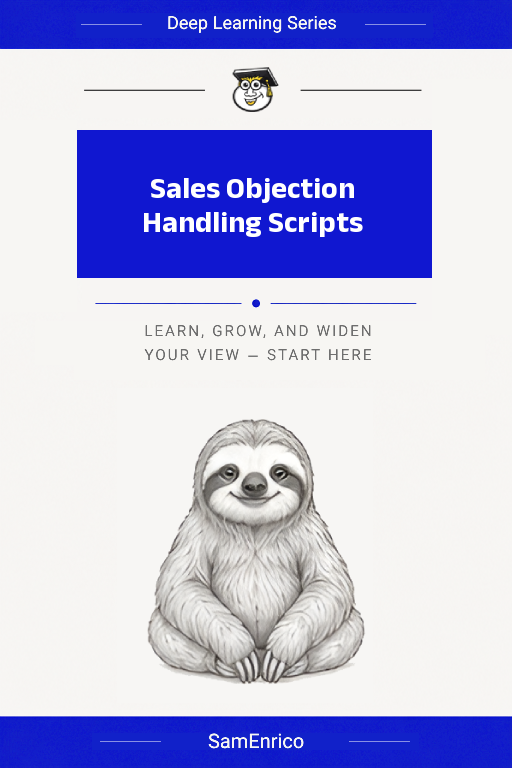
Sales Objection Handling Scripts eBook
Respond to budget authority and timing objections
by Reddy Maude
Respond to budget authority and timing objections with proven rebuttals.
Formats
Free sample
Chapter 1: The $100,000 Flinch--–- The email arrived at 2:17 PM on a Tuesday. Sarah, a senior account executive with six years of experience, had just finished what she believed was her best discovery call of the quarter. The prospect—a mid-sized manufacturing company with a clear problem, a stated budget, and a timeline that aligned perfectly with her quota—had said all the right things. He laughed at her jokes. He asked thoughtful questions.
He even used the word "partnership." Then came the final five minutes of the call."Sarah, this has been really helpful," the prospect said. "I need to think it over. Let me run it by my team and I'll get back to you."Sarah felt her chest tighten. She knew what was coming. She had heard this exact phrase two hundred times before.
And every time, her brain did the same thing: it froze. She said, "Okay, sounds good, I'll follow up next week." She hung up. She never heard from him again. A $100,000 deal—one that would have put her over quota, earned her President's Club, and paid for her daughter's summer camp—evaporated into the silent void of "I'll think about it."Sarah is not incompetent. She is not lazy.
She is not bad at sales. Sarah is a victim of what this book calls The $100,000 Flinch—that split second of panic when a prospect objects, when your amygdala hijacks your brain, and when every ounce of sales training you have ever received suddenly vanishes.This chapter is about why that flinch happens, why it is not your fault, and why the solution is simpler than you think.The Anatomy of a Flinch Let us define the term precisely. The $100,000 Flinch is not a character flaw. It is a neurological event. When a prospect raises an objection—"It's too expensive," "I need to check with my boss," "Now is not the right time," "Let me think about it"—your brain processes that statement as a threat.
Not a physical threat, of course, but a social threat. Your prospect is potentially rejecting you, your solution, your expertise, and by extension, your value as a professional.The amygdala, that small almond-shaped cluster of neurons deep in your brain, does not distinguish between a predator lunging at you and a prospect saying "no." It floods your system with cortisol and adrenaline. Your heart rate increases. Your breathing becomes shallow. Your prefrontal cortex—the part of your brain responsible for strategy, creativity, and calibrated responses—literally begins to shut down.
You are, for all practical purposes, operating with a diminished mental capacity.This is not weakness. This is biology.The flinch manifests in three predictable ways. The first is verbal defensiveness, where you immediately explain, justify, or defend your price or product. "Well, let me tell you why it costs that much..." The second is premature concession, where you offer a discount or additional features before the prospect even asks. "I can probably get you a better rate if you sign today..." The third is silent agreement, where you say nothing—or worse, say "I understand" and move on—effectively agreeing with the objection.Sarah exhibited the third form.
She said "Okay, sounds good," which is salesperson for "You are right to hesitate, and I have no idea how to change your mind."The cost of this flinch is not theoretical. According to research cited in The JOLT Effect, 60 percent of customers say "no" four times before saying "yes," yet 92 percent of sales representatives give up after the fourth "no." Let me repeat that statistic because it is staggering: nearly all salespeople stop asking after four rejections, even though more than half of customers need to hear five or more "nos" before they are ready to buy.Every time you flinch, you are leaving money on the table. Not a little money. The average B2B deal size in the United States is 50,000to50,000 to 50,000to150,000. The $100,000 Flinch is not hyperbole.
It is the actual, measurable cost of freezing at the wrong moment.Why Most Sales Training Makes It Worse Here is the cruel irony: most sales training does not prevent the flinch. It accelerates it.Traditional objection handling training falls into three flawed categories. The first is canned rebuttals—memorized scripts that you are supposed to recite like a robot when a prospect objects. "When they say X, you say Y." The problem is that a prospect's objection is never exactly X. It is X with context, emotion, history, and politics attached.
A canned rebuttal delivered at the wrong moment sounds exactly like what it is: a script. And prospects can smell a script from three time zones away.The second flawed category is feature dumping—responding to an objection by listing more features, more benefits, more reasons why your product is amazing. This fails because the prospect's objection is rarely about missing features. When a prospect says "It's too expensive," they are not asking for a list of features. They are asking for safety.
They are asking for proof that their decision will not get them fired. Features do not provide that safety. Evidence does.The third flawed category is the assumption of logic. Most sales training assumes that prospects are rational actors who make decisions based on data, ROI, and objective analysis. This is false.
Decades of behavioral economics research—from Daniel Kahneman to Amos Tversky—proves that humans make decisions emotionally and then justify them logically. Your prospect's objection is almost never logical. It is emotional. It is fear dressed up in business clothing.Traditional training tells you to fight logic with logic. You end up in a debate.
You lose. Not because you are wrong, but because you are fighting the wrong war.The Three-Bucket Framework: Budget, Authority, Timing This book is built on a simple premise: every objection, no matter how it is phrased, falls into one of three buckets. If you can identify which bucket the objection belongs to, you have already won half the battle.Bucket One: Budget. The prospect says things like "We don't have the money," "Your price is too high," "We are cutting costs right now," or "Can you do better on pricing?" These are value questions. The prospect is not really saying "no." They are saying "You have not yet proven that solving this problem is more urgent than the ten other problems I am already ignoring."Bucket Two: Authority.
The prospect says things like "I need to run this by my boss," "Let me check with the committee," "I am not the final decision maker," or "We have a whole approval process." These are safety questions. The prospect is not really saying "no." They are saying "I am scared to say yes without someone else taking responsibility with me."But here is a critical distinction that most sales books miss, and one that will save you months of wasted effort. Authority objections split into two subcategories:Structural Authority: The prospect literally cannot sign. They lack the title, the budget signature authority, or the organizational mandate. This is a mechanical problem.
It requires multi-threading and economic buyer identification.Psychological Authority: The prospect can sign but is scared to. They have the title…
This is the end of the free sample. Get the eBook to keep going. Buy now
About this book
Details
- Author
- Reddy Maude
- Publisher
- SamEnrico
- Language
- English
- Genre
- Non-Fiction, First 30 Days
- Released
- 2026-05-29
- Pages (approx.)
- 137
- Available as
- eBook, Audiobook

Read better in the ZLOADR app
Your eBooks on your phone or tablet. Sign in with your SamEnrico account and start reading.
More by Reddy Maude
 Career Transition for New GraduatesReddy Maude$11.99
 Emotional Boundaries At WorkReddy Maude$11.99
 Uber Driver Safety ManualReddy Maude$11.99
 Concrete Examples Study GuideReddy Maude$11.99
 Laci Peterson Body TransportReddy Maude$11.99
 Helicopter Pilot MemoirReddy Maude$11.99
 Citation Rules for Vancouver Style ManualReddy Maude$11.99
 Indian GST TDS and TCS Registration ManualReddy Maude$11.99
 The Compass and the Cosmos: Zheng He’s Western LegacyReddy Maude$11.99
 Ford River RougeReddy Maude$11.99
 The Great Bitcoin Heist: Iceland's Digital Gold RushReddy Maude$11.99
 Ibn Battuta: The Unseen Paths of the Indian OceanReddy Maude$11.99
You may also like
 Website Launch For New LLCStrunk Tracee$12.99
 Shopify Market Expansion GuideGaffney Jude$12.99
 Power Backup Solutions for Philippine VAsPearce Eldon$12.99
 Feedback License Clause TemplateCrum Ashli$12.99Feedback License Clause TemplateCrum Ashli$12.99Feedback License Clause TemplateCrum Ashli$12.99Feedback License Clause TemplateCrum Ashli$12.99Feedback License Clause TemplateCrum Ashli$12.99Feedback License Clause TemplateCrum Ashli$12.99Feedback License Clause TemplateCrum Ashli$12.99Feedback License Clause TemplateCrum Ashli$12.99
 Channel Distribution On One PagePetersen Narcisa$12.99