
Non-FictionInformativeEducational
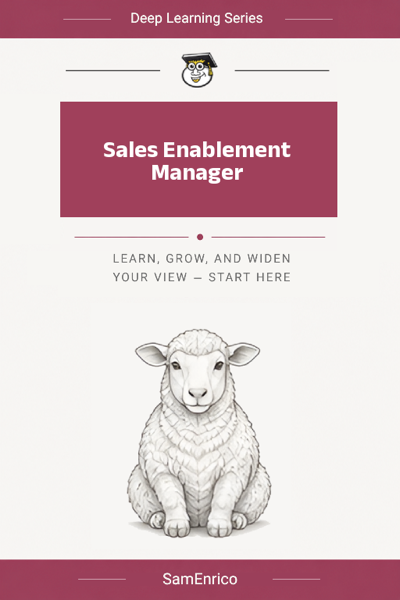
Sales Enablement Manager eBook
A Coursebook on Sales Enablement Manager
by Clark Emmett
A Coursebook on Sales Enablement Manager
Formats
Free sample
Chapter 1: The Enablement Delusion--–- You were hired to be a strategist. Instead, you became a schedule-maker.If you are reading this book, you likely hold a title that includes the words “Sales Enablement,” “Revenue Enablement,” or perhaps the more aspirational “Sales Performance.” You were hired because someone in your organization believed that the sales team needed help. They believed that the reps were leaving money on the table. They believed that training, content, and coaching could fix whatever was broken.And then you arrived.Within your first ninety days, you were probably asked to do the following: schedule a training day, build a slide deck, upload files to a shared drive, chase reps to log their calls in the CRM, mediate an argument between Marketing and Sales about lead quality, and explain for the third time why the new battle card isn’t being used. You may have also been asked to “fix the onboarding process,” “reduce ramp time,” and “make the reps sell better” – all without being given authority over hiring, compensation, or manager accountability.This is the Enablement Delusion.The delusion is this: organizations believe they want strategic enablement, but they hire, resource, and reward tactical administration.
They want you to transform the revenue engine, but they treat you as internal event planning. They want higher win rates, but they give you no power over the people, process, or technology that actually produce those wins. And worst of all, you have internalized this delusion. You have begun to believe that if you just build one more deck, schedule one more training, or create one more playbook, things will change.They will not.This chapter is the diagnosis. It will name the disease, expose its symptoms, and give you the language to describe what has happened to your role.
By the end of this chapter, you will understand why most enablement initiatives fail – and it is not because of bad content or lazy reps. It is because the entire function has been designed to fail from the start.The Evolution of a Broken Role To understand why you are drowning in administrative work, you must understand where the role of Sales Enablement came from. It did not emerge from a grand strategic vision. It emerged from pain.In the 1980s and 1990s, the concept of “sales support” was simple. There were salespeople.
There were trainers. Occasionally, the trainers would gather the salespeople in a hotel conference room, show them overhead slides about new products, and send them back into the field. Training was an event, not a system. The metric was attendance, not behavior change. No one expected the trainer to influence the forecast or fix a broken compensation plan.In the 2000s, the rise of CRM systems and marketing automation created a new problem: information overload.
Salespeople had leads, contact data, content libraries, and competitive intelligence – but no one had taught them how to use any of it. The response was to create a new role. First came “Sales Operations,” which owned the CRM and the data. Then came “Sales Enablement,” which was supposed to own everything else: training, content, coaching, onboarding, and methodology.But here is the critical point that no one tells you: Enablement was bolted onto the side of an existing machine. It was not given clear ownership.
It was not given authority over managers. It was not given a seat at the revenue table. It was given a budget for lunch-and-learns and a mandate to “make things better.”According to research from the Sales Enablement Society and Forrester, organizations with a formal enablement charter achieve 12 percent higher win rates than those without one. But the same research shows that fewer than 40 percent of enablement teams have such a charter. The rest operate in a gray zone, fighting for relevance and begging for a seat at a table that was built before they arrived.This is your origin story.
You inherited a role that was designed as a Band-Aid and then expected to function as a heart transplant. The fact that you are frustrated is not a sign of your inadequacy. It is a sign that you have finally seen the truth.The Silo Fallacy Most enablement initiatives fail not because the training was boring or the content was ugly. They fail because enablement operates in a silo.Here is a common scenario. The Enablement Manager builds a beautiful onboarding curriculum.
It includes videos, quizzes, role plays, and a certification exam. New reps go through the curriculum and pass the exam. Then they are handed over to their sales manager. The sales manager does not reinforce the curriculum because the manager was never trained on it and has fourteen other priorities. Within sixty days, the new reps are selling the way the manager sells – not the way the curriculum taught.
The Enablement Manager blames the manager. The manager blames the curriculum. The reps sell poorly. Everyone loses.This is a silo failure. The curriculum was built in isolation, without manager buy-in, without manager training, and without a reinforcement system.
The Enablement Manager acted as if the training event was the finish line, when in fact it was the starting line.But the silo problem goes deeper than managers. Consider the relationship between Enablement and Marketing. Marketing produces content: white papers, case studies, ROI calculators, and blog posts. Enablement produces content: battle cards, playbooks, objection handlers, and call scripts. In most organizations, these two content engines never speak to each other.
The rep receives two separate folders from two separate teams and is expected to synthesize them on the fly. The result is not enablement. It is confusion.Consider the relationship between Enablement and Sales Operations. Sales Operations owns the CRM. They build the fields, the dashboards, and the forecasting logic.
Enablement wants reps to follow a specific sales process. But if that process is not reflected in the CRM fields, the reps will ignore it because the CRM is where they are measured. The Enablement Manager builds a beautiful process diagram. Sales Operations ignores it. The reps live in the CRM.
The process dies.Consider the relationship between Enablement and Product. Product trains the sales team on features. Enablement trains the sales team on value and positioning. When these two trainings contradict each other – and they often do – the rep defaults to features because features are concrete and value is abstract. The Enablement Manager blames Product for being too technical.
Product blames Enablement for being too fluffy. The rep sells features. The deal takes three months longer than it should.And finally, consider the relationship between Enablement and Human Resources. HR owns hiring, performance management, and terminations. Enablement identifies that a rep has a skill gap.
But if HR’s performance review process does not measure that skill, and if the manager is not required to address it, then the gap will persist forever. Enablement can train until it is blue in the face. The rep will not change because there is no consequence for not changing.This is the ecosystem. Enablement sits at the center of Marketing, Sales Ops, Product, HR, and Sales Management. But sitting at the center is not the same as owning…
This is the end of the free sample. Get the eBook to keep going. Buy now
About this book
Details
- Author
- Clark Emmett
- Publisher
- SamEnrico
- Language
- English
- Genre
- Non-Fiction, Informative, Educational
- Released
- 2026-06-02
- Pages (approx.)
- 150
- Available as
- eBook, Audiobook

Read better in the ZLOADR app
Your eBooks on your phone or tablet. Sign in with your SamEnrico account and start reading.
More by Clark Emmett
 Escobar Drug Lord RoutineClark Emmett$11.99
 Tap Water Toxin Filter GuideClark Emmett$11.99
 Creativity For Operations ManagersClark Emmett$11.99
 Diamond Center Security FailureClark Emmett$11.99
 Stress and Diabetes Management GuideClark Emmett$11.99
 The Unlikely Alliance: How a Pop Star and a Dictator’s Daughter Changed HistoryClark Emmett$11.99
 Ballots & Shadows: The Phantom Voters of 1824Clark Emmett$11.99
 Understanding Fanconi Syndrome, Renal, With Nephrocalcinosis and Renal StonesClark Emmett$17.99
 UAE Designated Zone RulesClark Emmett$12.99
 Strategy Meeting One Hour Mastery GuideClark Emmett$12.99
 Ultimate Handbook Guide to Samut Prakan : (Thailand) Travel GuideClark Emmett$11.99
You may also like
 Hong Kong Handover 1997Dunn Johnnie$11.99
 Zumba For Postnatal Recovery CourseNeal Christian$11.99
 Zumba for BeginnersLadner Nikia$11.99
 YouTube Comment Mining GuideHumes Pandora$12.99
 Worry Box MeditationCarlin Rudy$11.99
 Workplace Stress MeditationNguyen Lynn$11.99
 Workplace Stress and Sleep RepairHawley Ivory$11.99
 Workplace Perfectionism CureDelaney Jeffry$11.99
 Workplace Injustice Anger GuideWallen Isabelle$11.99
 Work Addiction and Burnout LinkGreenwood Ester$11.99
 Women in Yoga and WellnessBeattie Galina$11.99
 Women in Stand Up ComedyChun Evangeline$11.99