
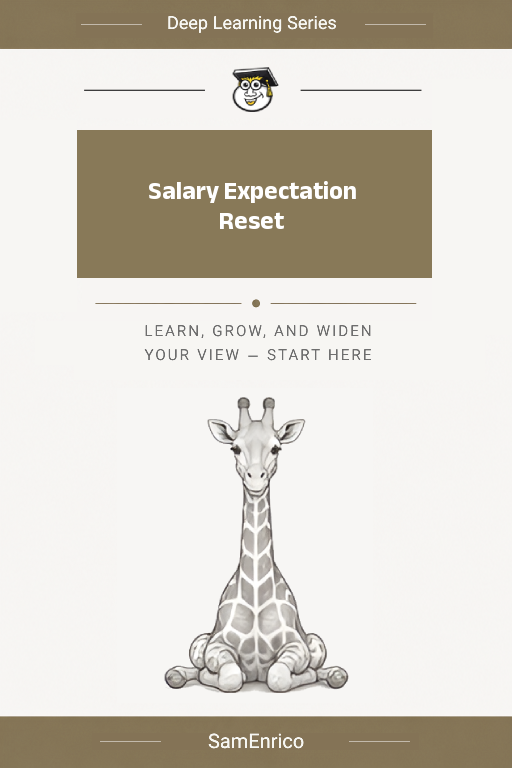
Non-FictionNon-Obvious CareerSalary AdjustmentMission Alignment
Salary Expectation Reset eBook
Expect 30-50 percent pay cut but gain mission alig
by Lentz Hee
Expect 30-50 percent pay cut but gain mission alignment and work-life balance.
Formats
Free sample
Chapter 1: The Advancement Tax...--–- The first time I realized I was being paid to tolerate misery, I was sitting in a $900 ergonomic chair, staring at a six-figure bonus I didn't want.The year was 2018. I was a senior director at a mid-sized tech firm, pulling down 187,000annually,plusbenefits,plusaperformancebonusthathadneverdippedbelow187,000 annually, plus benefits, plus a performance bonus that had never dipped below 187,000annually,plusbenefits,plusaperformancebonusthathadneverdippedbelow30,000. By every external metric, I had won. My mother bragged about me at bridge. My college reunion committee asked me to speak.
My credit card had no limit, and my calendar had no breathing room. I worked sixty-two hours most weeks, slept five hours a night, and had developed a low-grade tremor in my left hand that my doctor called "stress-induced" and my wife called "a warning sign."One Tuesday night at 10:47 PM, I finished a slide deck for a client who would not read it. I walked into the kitchen, opened the refrigerator, and realized I had no idea what I was looking for. I wasn't hungry. I wasn't thirsty.
I was standing in front of an open appliance because my brain had short-circuited. That was the moment I understood something terrible: I wasn't being paid 217,000formyskills.Iwasbeingpaidabout217,000 for my skills. I was being paid about 217,000formyskills.Iwasbeingpaidabout90,000 for my actual work. The remaining $127,000 was hazard pay.That is what this chapter calls the Advancement Tax.The Great Deception of High-Income Work We live inside a cultural lie so pervasive that questioning it feels like heresy. The lie is simple: higher salary equals better job.
More money means more success, more security, more freedom, more status, more happiness. The lie is whispered at graduation ceremonies, shouted in Linked In influencer posts, and engraved into every performance review that ties your raise to your "impact."But what if the opposite is often true? What if many high-paying jobs are not better jobs at all—but worse jobs, disguised by a salary large enough to quiet your doubts?Here is the uncomfortable reality this book will prove across twelve chapters: In the modern knowledge economy, a significant portion of your salary is not payment for your productivity, creativity, or skill. It is payment for your endurance, your tolerance for dysfunction, and your willingness to surrender autonomy.I call this the Advancement Tax.The Advancement Tax is the premium employers pay you to accept conditions that would be unacceptable in any other context. You tolerate pointless meetings because the salary is good.
You accept zero schedule flexibility because the bonus is larger. You endure office politics, weekend emails, a boss who cannot manage, and a culture that treats burnout as a badge of honor—all because the number on your W-2 feels like proof that you have made it.But here is the question this chapter forces you to answer: If your job paid you $30,000 less but gave you back fifteen hours a week and a boss who actually respected your time, would you take it?Most people say yes instantly. And that yes reveals the truth: you are not attached to your salary. You are attached to the idea of your salary. The money is not buying happiness—it is buying your silence.The Anatomy of the Advancement Tax Let me break down exactly how the Advancement Tax works.
It is not one thing. It is a collection of invisible deductions that subtract from your life while adding to your bank account. Think of it as a hidden tax on your sanity, collected in five specific forms.Tax #1: The Autonomy Deduction Every hour you spend doing what someone else tells you to do—without room for your own judgment, your own pace, or your own priorities—carries a cost. In high-salary corporate environments, autonomy is often the first thing sold. You are paid well to execute.
You are not paid to think. You are paid to follow the process, attend the meetings, and produce the deliverables that your manager's manager has decided are important.This matters because autonomy is one of the three pillars of human motivation identified by decades of psychological research (Deci & Ryan's Self-Determination Theory, 1985–present). When autonomy disappears, motivation shifts from intrinsic (I do this because I care) to extrinsic (I do this because I am paid). And extrinsic motivation, as any burned-out professional knows, is exhausting. You are not energized by your work.
You are compensated for your exhaustion.The Advancement Tax calculation for autonomy: If you have less than 40% control over your daily schedule, your own priorities, and how you complete your work, roughly half of your salary is autonomy hazard pay.Tax #2: The Dysfunction Premium Pointless meetings. Endless email chains. Reorganizations that reorganize nothing. Strategy documents that no one follows. Performance metrics that measure the wrong things.
Office politics that reward loyalty over competence. These are not accidents. They are features of organizations that have grown beyond their ability to manage themselves cleanly.High salaries often serve as a dysfunction premium—extra money paid to keep you from quitting in frustration. The company knows the Monday morning leadership meeting is a waste of four hours. They know the quarterly planning process produces nothing actionable.
They know the annual review system is a bureaucratic nightmare. But fixing those problems would be expensive and politically dangerous. So instead, they pay you more. The dysfunction remains. You remain.
Everyone remains.The Advancement Tax calculation for dysfunction: If you spend more than ten hours per week in meetings that do not produce decisions, or more than five hours per week on administrative tasks that feel meaningless, add 20% to your hazard pay estimate.Tax #3: The Flexibility Penalty How much control do you have over when and where you work? If the answer is "very little," you are paying the flexibility penalty. High-paying jobs often demand rigid schedules, in-office presence, and availability during arbitrary hours. You cannot leave at 3 PM for your child's school play. You cannot work from a coffee shop for a week while visiting aging parents.
You cannot start your day at 6 AM and finish at 2 PM to accommodate your partner's schedule.This is not because the work requires it. Most knowledge work is asynchronous and location-agnostic. The rigidity exists because organizations confuse presence with productivity. And they pay you enough to accept that confusion.The Advancement Tax calculation for flexibility: If you cannot shift your schedule by two hours in either direction without explicit permission, or if you are required to be in a specific location for more than three days per week despite no collaborative need, add 15–25% to your hazard pay.Tax #4: The Emotional Labor Surcharge Emotional labor is the work of managing your own emotions to meet the demands of a role. It is smiling at a rude client.
It is staying calm during a yelling match. It is pretending to be enthusiastic about a project you know will fail. It is the exhaustion that comes from performing a version of yourself that is not authentic.High-paying jobs, particularly in management, client services, and leadership, demand enormous amounts of emotional labor. You are paid to absorb stress, deflect conflict, and project confidence—even when you have none. This is real work.…
This is the end of the free sample. Get the eBook to keep going. Buy now
About this book
Details
- Author
- Lentz Hee
- Publisher
- SamEnrico
- Language
- English
- Genre
- Non-Fiction, Non-Obvious Career, Salary Adjustment, Mission Alignment
- Released
- 2026-05-30
- Pages (approx.)
- 149
- Available as
- eBook, Audiobook

Read better in the ZLOADR app
Your eBooks on your phone or tablet. Sign in with your SamEnrico account and start reading.
More by Lentz Hee
 Emergency Dental Care KitLentz Hee$11.99
 Anger Management for Volunteer RolesLentz Hee$11.99
 AI Contract Abstraction FundamentalsLentz Hee$11.99
 Small Business Owner ConfidenceLentz Hee$11.99
 Check the Facts MethodLentz Hee$11.99
 Black Smoker Expedition LogLentz Hee$11.99
 Sleep For High AchieversLentz Hee$11.99
 Augmented Reality LociLentz Hee$11.99
 Horus Falcon GodLentz Hee$11.99
 The Siege of Stirling Castle: Wallace’s Stand Against the CrownLentz Hee$11.99
 The Pearl Divers of Bahrain: Women of the Deep and the Secrets of the GulfLentz Hee$11.99
 The Loudest Silence: How Teenage Protesters Shut Down the School-to-Prison PipelineLentz Hee$11.99
You may also like
 Hong Kong Handover 1997Dunn Johnnie$11.99
 Zumba For Postnatal Recovery CourseNeal Christian$11.99
 Zumba for BeginnersLadner Nikia$11.99
 YouTube Comment Mining GuideHumes Pandora$12.99
 Worry Box MeditationCarlin Rudy$11.99
 Workplace Stress MeditationNguyen Lynn$11.99
 Workplace Stress and Sleep RepairHawley Ivory$11.99
 Workplace Perfectionism CureDelaney Jeffry$11.99
 Workplace Injustice Anger GuideWallen Isabelle$11.99
 Work Addiction and Burnout LinkGreenwood Ester$11.99
 Women in Yoga and WellnessBeattie Galina$11.99
 Women in Stand Up ComedyChun Evangeline$11.99