
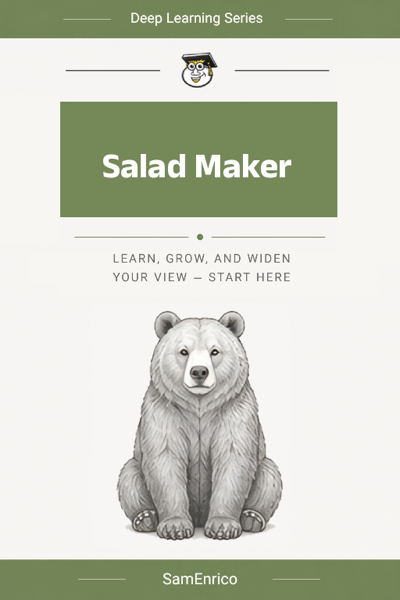
Non-FictionInformativeEducational
Salad Maker eBook
A Coursebook on Salad Maker
by Meacham Nita
A Coursebook on Salad Maker
Formats
Free sample
Chapter 1: Beyond the Sad Desk Salad--Let me tell you about the worst salad I ever ate.It was 2014. I was working twelve-hour days in an office with windows that didn't open. The cafeteria served the same five items on a rotating schedule, and Wednesday was "Chef Salad Day"—a scoop of iceberg, three strips of something called "ham," a hard-boiled egg that had turned gray around the yolk, and a single plastic cup of ranch dressing with a foil seal so impenetrable that opening it required tools.I ate that salad every Wednesday for eleven months.Not because I liked it. Because I had convinced myself that salad was something I was supposed to eat, like flossing or calling my mother. I didn't enjoy it.
I tolerated it. I chewed quickly, swallowed without tasting, and congratulated myself on being a person who ate salad.Here is what I did not know then: salad is not supposed to be tolerated. Salad is supposed to be craved. Salad is supposed to be the thing you look forward to all day, the meal that makes you close your eyes on the first bite and say something embarrassing like "oh my god" to an empty room.I wrote this book because I want you to have that experience. Not occasionally.
Not when you go to an expensive restaurant. Every time you make a salad at home. Every single time.The Great Salad Lie Somewhere along the way, we were sold a story about salad that is not true. The story goes like this: salad is what you eat when you are being good. Salad is the punishment for eating pizza.
Salad is the food you order at a restaurant when you are trying to impress someone with your virtue. Salad is cold, wet, and boring, but it is good for you, so you eat it and feel superior to people who ordered the burger.This is the Great Salad Lie, and I am here to demolish it.Salad is not punishment food. Salad is not virtuous by default. A salad can be as unhealthy as a cheeseburger—drowning in creamy dressing, loaded with bacon and cheese and fried things—and a cheeseburger can be as healthy as a salad—lettuce wrap, tomato, grilled onions, no sauce. The idea that salad equals health and everything else equals indulgence is a marketing fiction perpetuated by people who want to sell you pre-washed lettuce in plastic boxes.Here is what salad actually is: a delivery system for vegetables.That is it.
That is the whole truth. A salad is a way to eat more vegetables in a format that is pleasurable, satisfying, and endlessly variable. You can put anything in a salad. Anything. Leftover roast chicken.
The last few spoonfuls of quinoa from Tuesday night. Half an avocado that is starting to brown. A handful of nuts from the back of the pantry. A cheese end that is too small to slice but perfect for crumbling.The salad I eat most often is made from whatever is in my refrigerator that needs to be used before it goes bad. I do not follow a recipe.
I do not measure. I look at my ingredients, ask myself what they want to become, and build accordingly.This is not chaos. This is freedom.Why This Book Exists I have read most of the salad books published in the past decade. Some are beautiful—photographs that make you want to frame them and hang them on your wall. Some are encyclopedic—every salad from every culture, meticulously documented.
Some are hyper-specialized—kale only, bowl only, dressing only.What none of them did was teach me how to think.They taught me recipes. Lots of recipes. Recipes for every possible combination of ingredients, organized by season or protein or dietary restriction. And recipes are useful. I am not anti-recipe.
But recipes are not the same as understanding. Recipes tell you what to do. Understanding tells you why.This book is structured as a coursebook because I believe skills are built sequentially, like a staircase. You cannot skip steps. You cannot jump from "I have never made a vinaigrette" to "I am improvising a Thai-inspired salad with a lime-fish sauce dressing" without the middle steps.
The middle steps are where the learning happens.By the time you finish this book, you will not need me anymore. You will open your refrigerator, see a random collection of vegetables and leftovers and half-used containers, and you will know exactly what to do. Not because you memorized a formula, but because you understand the principles that make salads work.That is the goal of this book. Not to make you dependent on my recipes. To make you independent of all recipes.What You Will Learn Let me give you a roadmap of where we are going.Part One: The Foundation teaches you how to think about salad architecture.
You will learn the Four-Box Framework—Base, Body, Dressing, Garnish—that applies to every salad you will ever make. You will stock your pantry with the oils, acids, and seasonings that do ninety percent of the work. You will learn knife skills that make prep fast and safe. These chapters are the grammar of salad making. You cannot write sentences without grammar, and you cannot build salads without these fundamentals.Part Two: The Heart is about dressings and textures, because these are the elements that separate good salads from great ones.
You will learn the science of emulsion—how to make a vinaigrette that doesn't separate, a mayonnaise that comes together in thirty seconds, a creamy dressing that uses cashews instead of cream. You will learn twenty signature dressings organized into five flavor families. And you will learn the art of crunch—how to make croutons, candied nuts, roasted chickpeas, and a half-dozen other toppings that transform texture.Part Three: The Practice is where theory becomes action. You will learn ten foundation salads that teach you the architectural principles of every salad tradition. You will master the layering technique that keeps meal-prep salads crisp for four days.
You will travel the world through salads—Mediterranean, Asian, Latin American, Middle Eastern. You will learn to build plant-forward salads that satisfy like a steak dinner. And you will learn to cook with the seasons, making the most of what is fresh and cheap and abundant right now.Part Four: The Mastery is for when you are ready to fly. You will learn to plate salads like a professional—height, color, sauce smears, edible flowers. You will learn the Flavor Matrix, a systematic way to pair unexpected ingredients.
You will learn to rescue broken dressings and overdressed salads. And for those who want to take their skills beyond the home kitchen, you will learn the economics of selling salads—pricing, packaging, food safety, and the cottage food laws that allow you to start a business from your home.This is a lot. I know. Do not be intimidated. You do not need to master everything at once.
You do not need to read this book cover to cover before you make a salad. In fact, I encourage you to cook…
This is the end of the free sample. Get the eBook to keep going. Buy now
About this book
Details
- Author
- Meacham Nita
- Publisher
- SamEnrico
- Language
- English
- Genre
- Non-Fiction, Informative, Educational
- Released
- 2026-05-25
- Pages (approx.)
- 139
- Available as
- eBook, Audiobook

Read better in the ZLOADR app
Your eBooks on your phone or tablet. Sign in with your SamEnrico account and start reading.
More by Meacham Nita
 Foster Care Television AccessMeacham Nita$11.99
 Automated Response PlaybookMeacham Nita$11.99
 I Slept In A TreeMeacham Nita$11.99
 Weight Loss Plateaus Breaking GuideMeacham Nita$11.99
 The Adolescent Circadian ShiftMeacham Nita$11.99
 The Golden Crescendo: How Black Composers Shaped Classical MusicMeacham Nita$11.99
 Startup Business Bank AccountMeacham Nita$12.99
 Minority Firm Success StoriesMeacham Nita$12.99
 Learn to Play the AlcahueteMeacham Nita$11.99
 How to Become a Steep TenderMeacham Nita$11.99
You may also like
 Hong Kong Handover 1997Dunn Johnnie$11.99
 Zumba For Postnatal Recovery CourseNeal Christian$11.99
 Zumba for BeginnersLadner Nikia$11.99
 YouTube Comment Mining GuideHumes Pandora$12.99
 Worry Box MeditationCarlin Rudy$11.99
 Workplace Stress MeditationNguyen Lynn$11.99
 Workplace Stress and Sleep RepairHawley Ivory$11.99
 Workplace Perfectionism CureDelaney Jeffry$11.99
 Workplace Injustice Anger GuideWallen Isabelle$11.99
 Work Addiction and Burnout LinkGreenwood Ester$11.99
 Women in Yoga and WellnessBeattie Galina$11.99
 Women in Stand Up ComedyChun Evangeline$11.99