
Non-FictionBiographyMental Endurance
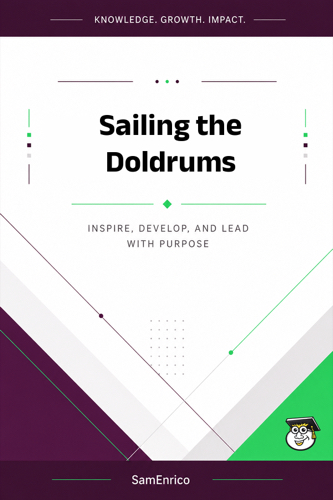
Sailing the Doldrums eBook
Weeks of windless equator, heat, and mental endura
by Woods Lisa
Weeks of windless equator, heat, and mental endurance.
Formats
Free sample
Chapter 1: The Glassy Sea...--–- The wind died at 4:17 in the morning. I know the exact time because I had just checked my watch before climbing back into the cockpit after a useless hour of staring at the chart table. Three weeks out of the Canary Islands, bound for Brazil, and I had sailed into a place where the air simply stopped moving. The ocean went from rolling swells to a polished mirror in less than two hours. The transition was so abrupt that I thought my instruments had failed.
I tapped the anemometer. Zero point zero knots. I tapped it again. Zero point zero. I climbed on deck and held up a wet finger.
Nothing. The boom swung aimlessly with the residual swell, slapping against the rigging with a sound like a metronome counting out seconds that led nowhere.The Smell of Hot Fiberglass The temperature below deck had already climbed past one hundred degrees Fahrenheit, and it was not yet dawn. I had stripped down to a sports bra and shorts, but the air was so thick and wet that sweat would not evaporate. It just sat on my skin, beading and merging and dripping onto the cabin sole. Every few minutes, a single drop would fall from my chin onto the chart table with a sound that seemed unnaturally loud.
Tap. Tap. Tap. I started counting the drops. After one hundred and forty-seven, I realized I was counting drops, and that realization scared me more than any storm ever had.The boat was a thirty-six-foot sloop named Resolute, which I had bought with the last of my savings after the startup collapsed.
She was a good boat—fiberglass hull, reliable diesel, new rigging—but she was not built for this kind of stillness. None of them are. Sailboats are designed to move. When they stop, everything feels wrong. The hull creaks differently.
The waterline changes as barnacles begin to attach themselves within hours. The smell of hot fiberglass and salt and my own unwashed body filled the cabin like a physical presence. I had read about the Doldrums. I had studied the Intertropical Convergence Zone, the ITCZ, that belt around the equator where the northeast and southeast trade winds meet and cancel each other out. I knew the meteorology: the rising warm air creates a low-pressure zone of variable winds and violent thunderstorms, but mostly it creates nothing.
Just stillness. Weeks of stillness. I thought I understood. I did not.The Geography of Zero The Intertropical Convergence Zone is not a line on a map, despite how it is drawn in textbooks. It is a shifting, capricious belt that moves north and south with the seasons, following the sun’s heat.
In the Atlantic, it sits roughly between five degrees north and five degrees south, but it can wander. It can swell. It can swallow a sailor whole. The trade winds from the northern hemisphere and the southern hemisphere converge here, and instead of creating more wind, they create a dead zone. The air rises vertically rather than blowing horizontally.
The result is a region of utter calm, punctuated by violent thunderstorms that come out of nowhere and disappear just as fast.I had crossed the ITCZ once before, ten years ago, on a delivery from Cape Town to the Caribbean. We had been becalmed for three days, and I remembered thinking it was the most boring experience of my life. I was twenty-eight then. I did not know what boredom really was. Three days is nothing.
Three days is a long weekend. Three days is a cold you sleep off. The Doldrums can hold you for weeks. The record, depending on which historical account you believe, is somewhere between thirty and fifty days. Fifty days of no wind.
Fifty days of heat. Fifty days of staring at a sea that looks like black glass under a white sun, reflecting your own face back at you until you no longer recognize it.The Internal Mirror I sat in the cockpit as the sun rose, watching the horizon. It was the first true test of the voyage, and I was failing it within hours. The external stillness was not just a meteorological phenomenon; it was a mirror. And the mirror showed me everything I had been trying to outrun by sailing across an ocean.My daughter’s face appeared in the reflection of the water.
She was fifteen, with my late husband’s eyes and my stubbornness. Our last conversation before I left had been an argument. Not a big one—the kind of argument that is worse because it is small, because it is about nothing, because it reveals the shape of everything unsaid beneath the surface. She had accused me of running away. I had told her she did not understand.
She had said, "Then explain it to me." I had not explained. I had just stood there in the kitchen, holding my passport, feeling the weight of every mistake I had ever made pressing down on my shoulders. Then I had left.The Doldrums do not let you hide from that. The stillness forces it to the surface. You cannot out-sail your regrets when there is no wind.
You cannot distract yourself with navigation or sail trim or radio checks when there is nothing to navigate, nothing to trim, no one to check in with. The satellite phone buzzed twice that morning. I did not answer. I was not ready to hear her voice. I was not ready to hear silence.
So I let it ring and watched the horizon and counted the drops of sweat falling from my chin onto the chart table.The First Day The first day of the Doldrums is almost peaceful. That is the cruelest trick they play. After weeks of constant motion, the sudden stillness feels like rest. Your body relaxes. Your shoulders drop.
You think, Maybe this is a gift. Maybe I needed a break. The boat rocks gently on the long, low swell. The sun warms your skin. The air, though hot, is soft.
You sleep better than you have in days because there is no heeling, no crashing through waves, no midnight sail changes in the rain. The first day of the Doldrums is a lie.I fell for it completely. I made coffee. I read a book. I wrote in my log: "Day 1, no wind.
The sea is like oil. Beautiful, actually. Will enjoy the rest while it lasts." I was an idiot. But I was a well-rested idiot, and that counts for something.By the afternoon, the heat had intensified. The sun was directly overhead—we were close enough to the equator that the angle was almost ninety degrees—and the fiberglass deck had become too hot to touch with bare feet.
I rigged a sunshade with a spare sail and a boat hook, creating a small patch of shade in the cockpit. I lay under it like a lizard on a rock, too hot to move, too restless to sleep. The book I had been reading lay face-down on the seat beside me, the pages curling from the humidity. I had read…
This is the end of the free sample. Get the eBook to keep going. Buy now
About this book
Details
- Author
- Woods Lisa
- Publisher
- SamEnrico
- Language
- English
- Genre
- Non-Fiction, Biography, Mental Endurance
- Released
- 2026-06-08
- Pages (approx.)
- 124
- Available as
- eBook, Audiobook

Read better in the ZLOADR app
Your eBooks on your phone or tablet. Sign in with your SamEnrico account and start reading.
More by Woods Lisa
 Dirgha Three Part BreathWoods Lisa$11.99
 Pediatric Migraine Parent GuideWoods Lisa$11.99
 Instagram Reels CreatorWoods Lisa$11.99
 CPR AED AssessmentWoods Lisa$11.99
 The Identity FlexibilityWoods Lisa$11.99
 How Stress Damages Your HeartWoods Lisa$11.99
 Weekend Recovery NappingWoods Lisa$11.99
 Belonging In Blue ZonesWoods Lisa$11.99
 The Last Transmission: The Titanic’s Radio SilenceWoods Lisa$11.99
 The Navigators of the Indian Ocean: The Swahili Mariners' Silent ConquestWoods Lisa$11.99
 The Clockwork Mind: Jacques de Vaucanson and the Birth of Modern RoboticsWoods Lisa$11.99
 Growing IteaWoods Lisa$11.99
You may also like
 Hong Kong Handover 1997Dunn Johnnie$11.99
 Zumba For Postnatal Recovery CourseNeal Christian$11.99
 Zumba for BeginnersLadner Nikia$11.99
 YouTube Comment Mining GuideHumes Pandora$12.99
 Worry Box MeditationCarlin Rudy$11.99
 Workplace Stress MeditationNguyen Lynn$11.99
 Workplace Stress and Sleep RepairHawley Ivory$11.99
 Workplace Perfectionism CureDelaney Jeffry$11.99
 Workplace Injustice Anger GuideWallen Isabelle$11.99
 Work Addiction and Burnout LinkGreenwood Ester$11.99
 Women in Yoga and WellnessBeattie Galina$11.99
 Women in Stand Up ComedyChun Evangeline$11.99