
Non-FictionMental WealthCompliance
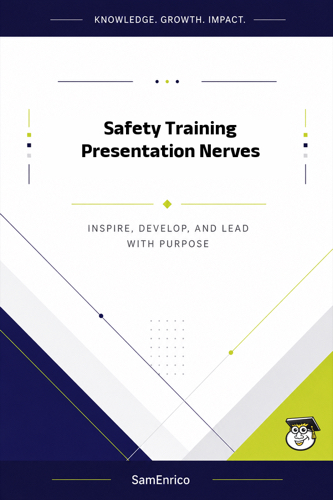
Safety Training Presentation Nerves eBook
Deliver mandatory compliance talks without boring
Deliver mandatory compliance talks without boring or anxious delivery.
Formats
Free sample
Chapter 1: The Lifeguard Lie--You have never been more terrified than the moment you realized you were the only one who knew how to save them.Not from drowning. From themselves.The room is full of steel-toed boots and crossed arms. The veterans have been doing this job since before you graduated high school. The new hires are scrolling on their phones. And somewhere in the back, someone just sighed—loud enough for everyone to hear.
Your slides are open. Your hard hat is on. Your mouth is dry. And your heart is pounding so hard you can feel it in your temples.You open your mouth to speak, and the first word comes out cracked. Not broken.
Just… cracked. Like a radio station slightly off frequency.You clear your throat. Someone smirks.And suddenly you are not a safety professional. You are not the person who spent three days preparing this training. You are not the expert who knows lock-out/tag-out procedures better than anyone in this room.You are a child standing in front of the class, having forgotten your lines.This is not hyperbole.
This is the reality of mandatory safety training for thousands of dedicated, knowledgeable, well-intentioned professionals across every industry. You know the material. You believe in the mission. You have seen what happens when people ignore the rules—the crushed fingers, the fall from height, the near-miss that became a life-changing injury. You care.
God, you care so much.But caring does not stop your voice from shaking.And that is the first lie we need to kill: that caring enough will make you a good speaker.It won't.The Unique Burden No One Talks About Let us name the thing that makes safety training different from every other kind of public speaking.If you are giving a wedding toast and you stumble over your words, people laugh kindly and remember that you tried. If you are giving a sales pitch and you forget a statistic, your prospect might still buy because they liked your energy. If you are giving a TED Talk and you freeze for ten seconds, the audience assumes you are making a dramatic pause.But if you stumble during a safety training session—if you hesitate, if you sound unsure, if you read directly from a slide because your mind went blank—something terrible happens.The audience stops listening.And when the audience stops listening, someone might get hurt.That is the weight you carry. Not the weight of being judged. Not the weight of looking silly.
Those things matter, yes, and we will address them in later chapters. But the primary weight is this: your communication failure could become someone else's physical injury. You are not afraid of embarrassment. You are afraid of responsibility.This is what the standard public speaking books do not understand. They were written for people who want to inspire, persuade, or entertain.
You want to comply. You want to warn. You want to prevent. These are different verbs with different psychological loads.When a motivational speaker fails, the audience feels uninspired. When a safety trainer fails, the audience might die.That is not drama.
That is the job.The Credibility Paradox Here is the second thing the standard books miss: you cannot be too friendly, and you cannot be too strict.If you come across as too friendly—too eager to be liked, too quick to laugh at off-color jokes, too willing to let the veterans run the conversation—you will be ignored. Not because your information is wrong. Because safety training is, at its core, a authority transaction. You are asking people to change their behavior. Behavior change requires respect for the messenger.If you come across as too strict—too rigid, too by-the-book, too quick to cite regulations without translating them—you will also be ignored.
But for a different reason. Because people do not comply with people they resent. They comply with people they trust.This is the credibility paradox. You need enough authority to enforce compliance. You need enough warmth to build trust.
And you have to find that balance while your heart is racing and your palms are sweating and the veteran in the back is already rolling his eyes.Most public speaking advice says "just be yourself."But which self? The self who laughs at safety violations to fit in? The self who lectures like a drill sergeant? The self who hides behind the Power Point and prays no one asks a question?You need a third self. A self that is not performing warmth or performing authority.
A self that is doing something entirely different.The Lifeguard Mindset Let me tell you about a lifeguard named Marcus.Marcus worked a beach in South Carolina for seven summers. He was not a big guy. He was not particularly charismatic. He did not tell jokes or give speeches. Most days, he sat in a high chair, wearing sunglasses, looking bored.But when someone started drowning, Marcus moved.Not elegantly.
Not gracefully. He ran. He shouted. He dove into the water with no concern for how he looked. His hair got messed up.
His shorts got soaked. His voice went hoarse from yelling. And he did not care, because someone was drowning.Here is what Marcus understood that most safety trainers do not: when you are in rescue mode, you do not worry about looking cool.The lifeguard mindset is not about charisma. It is not about confidence. It is not about having a smooth voice or perfect slides or the ability to tell a joke.
It is about one thing: illuminating the hazard.When you shift from "enforcer" to "lifeguard," something fundamental changes in your brain. You stop asking "How do I look?" and start asking "Is anyone drowning?" You stop monitoring your own voice and start watching for signs of confusion. You stop worrying about being liked and start caring about being understood.This is not a metaphor. This is a neurological shift.Why Your Brain Hates Public Speaking (And Why Safety Speaking Is Worse)Let us talk about your amygdala.The amygdala is a small, almond-shaped cluster of neurons deep in your brain. Its job is to detect threats.
It does not have language. It does not have nuance. It has one question: "Is this safe, or is this a tiger?"When you stand in front of a room full of people, your amygdala does not know the difference between a predator and a podium. It sees twenty pairs of eyes looking at you. It interprets this as a threat.
And it floods your system with adrenaline, cortisol, and noradrenaline.This is the fight-or-flight response.Your hands sweat—to improve grip for running or fighting. Your voice shakes—as blood diverts from non-essential muscles to large muscle groups. Your mind goes blank—because digestion and higher cognition shut down when you are about to be eaten.This is biology. Not weakness. Not incompetence.
Not proof that you are "not a natural speaker."Now add the safety element.When a salesperson faces a hostile room, the worst outcome is a lost sale. When a wedding toast recipient faces a silent room…
This is the end of the free sample. Get the eBook to keep going. Buy now
About this book
Details
- Author
- Dillard Denis
- Publisher
- SamEnrico
- Language
- English
- Genre
- Non-Fiction, Mental Wealth, Compliance
- Released
- 2026-06-09
- Pages (approx.)
- 127
- Available as
- eBook, Audiobook

Read better in the ZLOADR app
Your eBooks on your phone or tablet. Sign in with your SamEnrico account and start reading.
More by Dillard Denis
 The Parent Physical Self CareDillard Denis$11.99
 Emotion Regulation for Narcissistic Injury GuideDillard Denis$11.99
 Exam Stress HypnosisDillard Denis$11.99
 Nicotine Anonymous Twelve StepsDillard Denis$11.99
 Hashtag Revolution: How #BlackLivesMatter Redefined Political CampaigningDillard Denis$11.99
 Fractured Steel: The Unraveling of the Tacoma NarrowsDillard Denis$11.99
 Understanding Brachymorphism Onychodysplasia Dysphalangism SyndromeDillard Denis$17.99
 10 Ways to Use Clementine (Recipe Book)Dillard Denis$11.99
 Bootcamp Portfolio Building GuideDillard Denis$12.99
 European Ecommerce Five Year ForecastDillard Denis$12.99European Ecommerce Five Year ForecastDillard Denis$12.99European Ecommerce Five Year ForecastDillard Denis$12.99
You may also like
 Hong Kong Handover 1997Dunn Johnnie$11.99
 Zumba For Postnatal Recovery CourseNeal Christian$11.99
 Zumba for BeginnersLadner Nikia$11.99
 YouTube Comment Mining GuideHumes Pandora$12.99
 Worry Box MeditationCarlin Rudy$11.99
 Workplace Stress MeditationNguyen Lynn$11.99
 Workplace Stress and Sleep RepairHawley Ivory$11.99
 Workplace Perfectionism CureDelaney Jeffry$11.99
 Workplace Injustice Anger GuideWallen Isabelle$11.99
 Work Addiction and Burnout LinkGreenwood Ester$11.99
 Women in Yoga and WellnessBeattie Galina$11.99
 Women in Stand Up ComedyChun Evangeline$11.99