
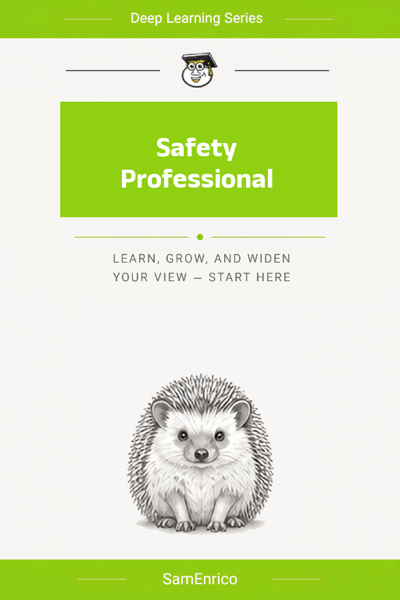
Non-FictionInformativeEducational
Safety Professional eBook
A Coursebook on Safety Professional
by Caro Ching
A Coursebook on Safety Professional
Formats
Free sample
Chapter 1: Beyond the Clipboard...-- The clipboard felt heavy in Maria's hands, though it weighed less than a pound. She had been carrying clipboards for eleven years now—first as a quality technician, then as a safety coordinator, and for the last eighteen months as the site safety manager for a metal stamping plant that employed three hundred people and produced enough noise to damage hearing in under four hours. The clipboard was her badge of office, her shield, her identity. On it were stacked the day's inspection forms: thirty-seven checkboxes for the press department, twenty-two for welding, forty-one for assembly. She had designed the forms herself, drawing from templates she found online and from OSHA's compliance guidance.
Every box that remained unchecked by the end of her shift was a failure. Every checked box was a victory.Maria was good at her job. Her plant had gone 427 days without a lost-time injury. The safety committee met monthly. The training records were immaculate.
Her manager, a production director named Hank who had worked his way up from the shop floor, called her "the best safety cop we've ever had." He meant it as a compliment. She took it as one. But on a Tuesday afternoon in October, everything changed.The accident happened in the press department, Bay 4. A press operator named Danny was running a 400-ton stamping press that produced door panels for a major automotive customer. The press had a light curtain—an infrared safety device that stopped the machine if any object broke the beam.
The light curtain was functioning properly. Danny knew this because he tested it every morning, as required. But on Tuesday, the light curtain was not the problem. The problem was that Danny had not slept in thirty-six hours. His wife had left him the week before.
He was behind on child support. He was working a double shift because the plant was behind schedule, and Hank had told the supervisors that anyone who left before their twelve hours were up would be written up. Danny was exhausted, distracted, and desperate. He reached into the press to clear a jammed piece of scrap metal. The light curtain stopped the press.
But Danny's hand was already inside the point of operation when the press coasted to a stop. The momentum of the flywheel caught his fingers between the die and the bolster. He lost two fingers on his left hand before the press fully stopped.The investigation was thorough, by the standards of the cop model. Maria completed the incident report within twenty-four hours. She interviewed Danny, who told her he had cleared jams "a hundred times before" and had never had an issue.
She reviewed the training records; Danny had completed the Lock-Out/Tag-Out refresher training six months prior, as required. She checked the light curtain's maintenance log; it had been tested weekly and had never failed. She concluded, in the final line of her report, that the root cause was "operator error—Danny bypassed established safety procedures by failing to lock out the press before clearing the jam." She recommended "retraining and disciplinary action."Hank approved the report. Danny was written up and suspended for three days without pay. He returned to work, quiet and withdrawn, wearing a prosthetic that made it impossible for him to hold small parts.
He was transferred to shipping, where his error rate was three times the average. Six months later, he quit. The plant's lost-time counter reset to zero. Maria received a safety award from corporate. She hung the plaque on her office wall, next to the one from last year.But something was wrong.
Maria could not stop thinking about Danny's face when she interviewed him. He was not defiant. He was not careless. He was broken. And the question that haunted her, the question she could not answer, was this: why had Danny been working a double shift while going through a personal crisis?
Why had Hank pressured supervisors to keep everyone on the line despite the obvious signs of fatigue? Why had the plant's production schedule been so aggressive that workers felt they could not stop for a proper lock-out? Why had no one asked these questions during the investigation?Maria had followed the cop model perfectly. She had checked every box. And a man had lost two fingers.
That was the moment she began to suspect that the cop model was not just incomplete—it was dangerous.The Invention of the Safety Cop The safety cop is a relatively recent invention, in the long arc of industrial history. For most of human labor, safety was personal. The blacksmith knew his forge would burn him if he was careless. The farmer knew his plow could crush his foot. The sailor knew the sea could drown him.
Hazards were immediate, visible, and understood. Safety was common sense, not a profession.The Industrial Revolution changed that. Factories introduced new hazards—unguarded gears, flying belts, toxic dust, explosive gases—that workers could not see or understand. The scale of production meant that a single unsafe act could injure dozens of workers. And the division of labor meant that the person operating a machine often did not understand how it worked or what could go wrong.
The stage was set for a professional class whose job was to identify hazards and enforce precautions.The first safety professionals were not hired by factories. They were hired by insurance companies. Firms like Travelers and Hartford realized that they could reduce their payouts by inspecting the factories they insured and requiring safety improvements. These early safety engineers developed the first checklists, the first guard designs, the first ventilation standards. They were effective, in a narrow sense: factories that adopted their recommendations had fewer catastrophic fires and fewer multiple-fatality accidents.
The insurance model proved that safety could be engineered.Then came government regulation. The Occupational Safety and Health Act of 1970 created OSHA and authorized it to set and enforce workplace safety standards. The effect on the safety profession was profound. Suddenly, safety was not just a good business practice—it was the law. Violations carried fines.
Repeat violations carried criminal penalties. Safety professionals became the interpreters and enforcers of a complex legal code. Their power increased. Their flexibility decreased. The cop was born not from malice but from necessity: someone had to ensure compliance with hundreds of pages of regulations, and that someone was you.The cop model was reinforced by the dominant safety theory of the 20th century: Heinrich's Domino Theory.
Herbert William Heinrich, an engineer for Travelers Insurance, analyzed 75,000 accident reports and concluded that 88% of accidents were caused by "unsafe acts" of workers. The implication was clear: to prevent accidents, you must prevent unsafe acts. And to prevent unsafe acts, you must watch workers, enforce rules, and punish violations. The cop was not just a convenient role—it was the logical conclusion of the best available science.We now know that Heinrich was wrong. His data was biased (he only analyzed accidents that were reported, which excluded near misses and minor incidents).
His causality was oversimplified (he ignored organizational and systemic factors). And his historical legacy was tragic (generations of safety professionals…
This is the end of the free sample. Get the eBook to keep going. Buy now
About this book
Details
- Author
- Caro Ching
- Publisher
- SamEnrico
- Language
- English
- Genre
- Non-Fiction, Informative, Educational
- Released
- 2026-05-08
- Pages (approx.)
- 160
- Available as
- eBook, Audiobook

Read better in the ZLOADR app
Your eBooks on your phone or tablet. Sign in with your SamEnrico account and start reading.
More by Caro Ching
 Shower Effect MethodCaro Ching$11.99
 Social Smoker Quit StrategyCaro Ching$11.99
 Social Isolation Hearing LossCaro Ching$11.99
 The Quantum Leap: How the First Room-Temperature Superconductor Shocked the WorldCaro Ching$11.99
 The Frozen Heights: The Unsung Heroes of the Andes' Hidden WondersCaro Ching$11.99
 How to Start a Hobby in Live steam modelsCaro Ching$11.99
 Family Business Selling GuideCaro Ching$12.99
 University Comparison Tool GuideCaro Ching$12.99
 Understanding Cardiac Hydatid Cysts With Intracavitary ExpansionCaro Ching$17.99
 Giant’s BreadCaro Ching$8.99
You may also like
 Hong Kong Handover 1997Dunn Johnnie$11.99
 Zumba For Postnatal Recovery CourseNeal Christian$11.99
 Zumba for BeginnersLadner Nikia$11.99
 YouTube Comment Mining GuideHumes Pandora$12.99
 Worry Box MeditationCarlin Rudy$11.99
 Workplace Stress MeditationNguyen Lynn$11.99
 Workplace Stress and Sleep RepairHawley Ivory$11.99
 Workplace Perfectionism CureDelaney Jeffry$11.99
 Workplace Injustice Anger GuideWallen Isabelle$11.99
 Work Addiction and Burnout LinkGreenwood Ester$11.99
 Women in Yoga and WellnessBeattie Galina$11.99
 Women in Stand Up ComedyChun Evangeline$11.99