
Non-FictionBusiness BriefRetirement Planning
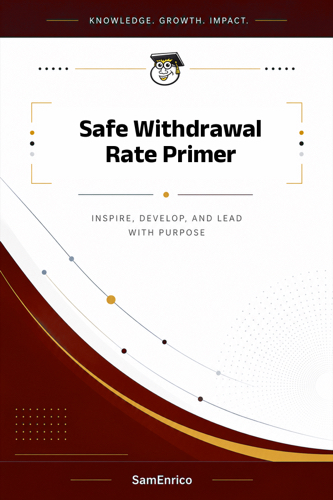
Safe Withdrawal Rate Primer
Teaches calculating sustainable annual income from
by Hamby Eleni
Teaches calculating sustainable annual income from retirement portfolios using the 4 percent rule.
Formats
About this book
Free sample
Chapter 1: The 4% Lie--–- In 1994, a little-known financial planner named William Bengen published a paper that should have terrified the retirement industry. Instead, it gave them a slogan.The paper was titled "Determining Withdrawal Rates Using Historical Data." Buried inside its dry, academic prose was a number that would change how millions of Americans thought about retirement: 4 percent. Bengen had discovered that a retiree who withdrew 4 percent of their portfolio in the first year of retirement, then adjusted that dollar amount annually for inflation, would not have run out of money during any 30-year period in modern US market history. Not during the Great Depression. Not during World War II.
Not during the stagflation hell of the 1970s.That discovery was genuine. It was rigorous. And it was almost immediately misunderstood.Within a decade, the 4 percent rule had escaped the journals and entered popular culture. Financial advisors repeated it like a mantra. Magazine covers promised "The 4 Percent Solution." Retirees built their entire futures around a single number they heard on television.
But somewhere in the journey from Bengen's spreadsheet to your 401(k) statement, the nuance evaporated. The 4 percent rule became a law instead of a guideline, a promise instead of a probability, a destination instead of a starting point.This book exists to undo that damage.The Myth of the Magic Number Before we can build a better retirement plan, we need to understand exactly what the 4 percent rule is—and, more importantly, what it is not.Bengen's original research asked a specific question: *What is the highest initial withdrawal rate that would have survived every 30-year retirement period from 1926 to 1992?* He tested withdrawal rates from 3 percent to 8 percent against actual market data. He discovered that 4 percent was the SAFEMAX—the maximum rate that survived the worst-case scenario.What was that worst-case scenario? Retiring in 1968.Imagine retiring in 1968. You have $1 million saved.
You withdraw $40,000 in your first year, planning to adjust that dollar amount upward with inflation each subsequent year. Then the 1970s arrive. Stocks go nowhere for a decade. Inflation averages 7 percent annually. By 1974, your $40,000…
This is the end of the free sample. Get the eBook to keep going. Buy now
Contents
- Chapter 1
- Chapter 2
- Chapter 3
- Chapter 4
- Chapter 5
- Chapter 6
- Chapter 7
- Chapter 8
- Chapter 9
- Chapter 10
- Chapter 11
- Chapter 12
Details
- Author
- Hamby Eleni
- Publisher
- SamEnrico
- Language
- English
- Genre
- Non-Fiction, Business Brief, Retirement Planning
- Released
- 2026-06-07
- Pages (approx.)
- 153
- Available as
- eBook, Audiobook

Read better in the ZLOADR app
Your eBooks on your phone or tablet. Sign in with your SamEnrico account and start reading.
More by Hamby Eleni
 Self Doubt And Decision Making GuideHamby Eleni$11.99
 Interruption Logging Practice GuideHamby Eleni$11.99
 Gentrification And DisplacementHamby Eleni$11.99
 High Income Subscription RetentionHamby Eleni$11.99
 Glymphatic System Sleep CleanHamby Eleni$11.99
 Keto Flu Prevention GuideHamby Eleni$11.99
 The Last Transmission: How a 19th-Century Clockmaker Predicted the FutureHamby Eleni$11.99
 The Crimson Code: How a Single Dye Transformed the WorldHamby Eleni$11.99
 How to Become a Green-chain OffbearerHamby Eleni$11.99
 How to Produce Sit-down HydrofoilsHamby Eleni$11.99
 WIPO Madrid Representative GuideHamby Eleni$12.99
 Middle East Sales Competitive Landscape HandbookHamby Eleni$12.99
You may also like
 Hong Kong Handover 1997Dunn Johnnie$11.99
 Zumba For Postnatal Recovery CourseNeal Christian$11.99
 Zumba for BeginnersLadner Nikia$11.99
 YouTube Comment Mining GuideHumes Pandora$12.99
 Worry Box MeditationCarlin Rudy$11.99
 Workplace Stress MeditationNguyen Lynn$11.99
 Workplace Stress and Sleep RepairHawley Ivory$11.99
 Workplace Perfectionism CureDelaney Jeffry$11.99
 Workplace Injustice Anger GuideWallen Isabelle$11.99
 Work Addiction and Burnout LinkGreenwood Ester$11.99
 Women in Yoga and WellnessBeattie Galina$11.99
 Women in Stand Up ComedyChun Evangeline$11.99