
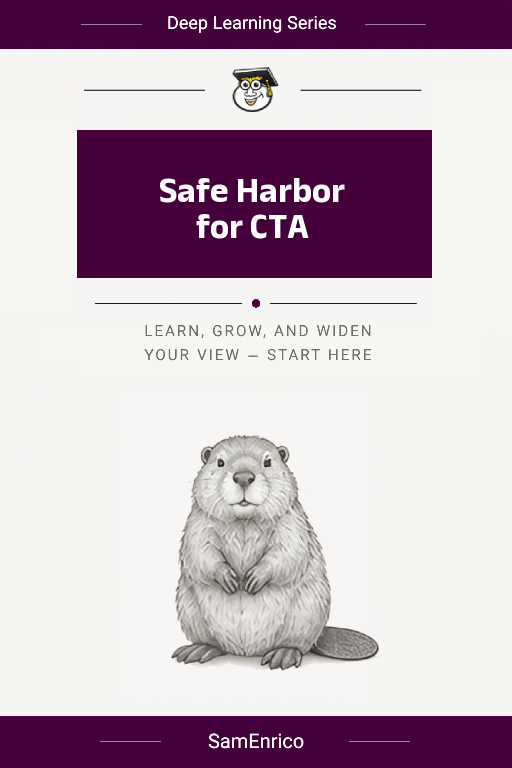
Non-FictionAnnual CheckupSafe Harbor
Safe Harbor for CTA eBook
Uses safe harbor provisions for inaccurate BOI fil
by Muniz Tess
Uses safe harbor provisions for inaccurate BOI filings made in good faith, protecting against penalties for honest mistakes.
Formats
Free sample
Chapter 1: The Transparency Trap--–- On a quiet Tuesday morning in March 2024, a dermatologist in Boise, Idaho, received an email that made her blood run cold. The subject line read: “Notice of Potential Penalty – Corporate Transparency Act.” She had formed a simple LLC three years earlier to rent out a small commercial building she inherited from her father. She had never heard of the Corporate Transparency Act, had no idea she was supposed to file anything, and now faced the prospect of $591 in daily fines that could wipe out years of rental income before she even had a chance to defend herself.Her first call was to her accountant, who told her, “I don’t handle that.” Her second call was to her lawyer, who quoted her $5,000 for an emergency consultation. Her third call was to her sister, a retired banker, who said, “Just ignore it. How are they going to find you?” That third piece of advice—well-meaning, confident, and catastrophically wrong—is exactly the kind of counsel that has already cost thousands of business owners their peace of mind and, in some cases, their savings.The dermatologist eventually found her way to a compliance specialist who filed her Beneficial Ownership Information (BOI) report late.
She paid a reduced penalty of $2,500 after proving she had acted in good faith. But the story haunted her—not because she had done anything wrong, but because she had done nothing at all, and the government had still come calling.This book exists because of people like that dermatologist. It exists because the Corporate Transparency Act (CTA) represents one of the most significant changes to federal business regulation in a generation, and yet most business owners have never heard of it, most accountants are not trained on it, and most lawyers are still figuring it out. More importantly, this book exists because the CTA contains a hidden gem—a “Safe Harbor” provision that can protect honest business owners from devastating penalties—but almost no one knows how to use it.Welcome to the Transparency Trap.The Birth of Transparency To understand the Safe Harbor, you must first understand the law that created it. The Corporate Transparency Act was not passed in a vacuum.
It was enacted on January 1, 2021, as part of the National Defense Authorization Act for Fiscal Year 2021—a massive piece of legislation that funds the military, but also included what many consider the most consequential anti-money laundering reform in decades.The CTA was a response to a simple, embarrassing truth: for most of American history, you could form a company in states like Delaware, Wyoming, or Nevada without ever telling the federal government who actually owned it. You could be a drug trafficker, a terrorist financier, a tax evader, or a fraudster, and as long as you paid your state incorporation fees, no one at the federal level would know your name. The state knew the “registered agent” (often a lawyer or a service company). The state knew the company name. But the state did not know—and was not required to know—the human beings behind the corporate veil.This gap was not an accident.
American corporate law has long valued privacy as a feature of business formation. But after September 11, 2001, after the Panama Papers, after the rise of anonymous shell companies used to launder billions of dollars from Russian oligarchs, Mexican cartels, and North Korean sanctions evaders, the tide began to turn. The Financial Action Task Force (FATF), the global standard-setter for anti-money laundering, began pressuring countries to create centralized registers of beneficial ownership. The European Union enacted its own rules. And finally, the United States—the last major holdout among developed economies—passed the CTA.The Architecture of the New Registry The CTA created a new federal database, housed within the Financial Crimes Enforcement Network (Fin CEN), a bureau of the U.S.
Department of the Treasury. This database is called the Beneficial Ownership Information (BOI) registry. It is not public. Unlike a property deed or a corporate filing with the secretary of state, your BOI report will not appear on Google. It will not be searchable by journalists, competitors, or nosy neighbors.
It is accessible only to certain government agencies and, in limited circumstances, to financial institutions conducting customer due diligence.This point—privacy—is so important that we will return to it in Chapter 10. For now, understand this: the BOI registry is a law enforcement tool, not a public shaming device. Fin CEN has designed it with strict access controls, and unauthorized disclosure is a federal crime punishable by up to five years in prison. The government does not want your competitor to know that you own 40% of a trucking company. The government wants to know that the same person who owns that trucking company is also listed as the beneficial owner of a shell company that received $2 million from a sanctioned foreign entity.The registry is being built in phases.
As of this writing in 2026, Fin CEN has already received millions of BOI reports. The system—called the Beneficial Ownership Secure System, or BOSS—is operational. Fin CEN has issued its final rule, and enforcement is active. This is not a future law. This is the law of the land, right now.Who Must Report?If you are reading this book, there is a good chance you are a “reporting company” under the CTA.
Let’s find out.The CTA defines a reporting company as any corporation, limited liability company (LLC), limited partnership (LP), or other similar entity that is created by filing a document with a secretary of state or similar office. That includes:Domestic corporations (Inc., Corp., Ltd.)Domestic LLCs Domestic LPs and LLPs Any other entity formed by a state filing It also includes foreign entities—companies formed outside the United States that register to do business in any U.S. state by filing with that state’s secretary of state.What is notably absent from this definition? Sole proprietorships that have not filed formation documents. General partnerships that were formed without a state filing.
Trusts that are not registered as businesses. If you are operating as a sole proprietor with a DBA but no LLC, you are not a reporting company. If you and your spouse have an informal partnership without a state filing, you are not a reporting company. But the moment you file those Articles of Organization with your state—the moment you create a separate legal entity—you become a reporting company, and the clock starts ticking.There is an important nuance here that confuses many readers. The CTA applies to entities formed under state law, not to entities that merely have a business license or a tax ID.
If you have an LLC that you formed in 2019, you are a reporting company. If you incorporated your consulting business in 2005, you are a reporting company. If you registered a foreign LLC to do business in California even though you formed it in Delaware, you are a reporting company. The only entities that escape are those that never filed formation paperwork with any state.As of 2023, the final rule interprets these definitions broadly. There has been discussion…
This is the end of the free sample. Get the eBook to keep going. Buy now
About this book
Details
- Author
- Muniz Tess
- Publisher
- SamEnrico
- Language
- English
- Genre
- Non-Fiction, Annual Checkup, Safe Harbor
- Released
- 2026-06-01
- Pages (approx.)
- 150
- Available as
- eBook, Audiobook

Read better in the ZLOADR app
Your eBooks on your phone or tablet. Sign in with your SamEnrico account and start reading.
More by Muniz Tess
 The Vagus Nerve Stress LinkMuniz Tess$11.99
 Cross Border Franchise Privacy PolicyMuniz Tess$11.99
 Dual Diagnosis in ElderlyMuniz Tess$11.99
 The Budget Creative ChallengeMuniz Tess$11.99
 Anger Management for Security GuardsMuniz Tess$11.99
 The Quantum Leap: How a 1989 Experiment Changed the Future of ComputingMuniz Tess$11.99
 Understanding Sacral AgenesisMuniz Tess$17.99
 Supply Chain Finance vs FactoringMuniz Tess$12.99
 Optometrist AssistantMuniz Tess$11.99
 How to Start a Circular or Reciprocating Saws Business (Beginners Guide)Muniz Tess$11.99
You may also like
 Hong Kong Handover 1997Dunn Johnnie$11.99
 Zumba For Postnatal Recovery CourseNeal Christian$11.99
 Zumba for BeginnersLadner Nikia$11.99
 YouTube Comment Mining GuideHumes Pandora$12.99
 Worry Box MeditationCarlin Rudy$11.99
 Workplace Stress MeditationNguyen Lynn$11.99
 Workplace Stress and Sleep RepairHawley Ivory$11.99
 Workplace Perfectionism CureDelaney Jeffry$11.99
 Workplace Injustice Anger GuideWallen Isabelle$11.99
 Work Addiction and Burnout LinkGreenwood Ester$11.99
 Women in Yoga and WellnessBeattie Galina$11.99
 Women in Stand Up ComedyChun Evangeline$11.99