
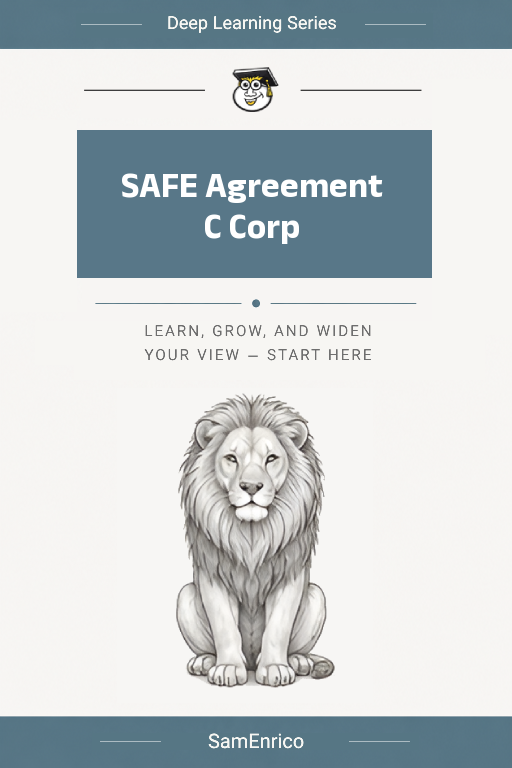
Non-FictionStartup GuideEntity Selection
SAFE Agreement C Corp eBook
Use SAFE agreements in C-Corps. Standard YC docume
Use SAFE agreements in C-Corps. Standard YC documents for early-stage funding.
Formats
Free sample
Chapter 1: The $10 Million Mistake--–- Alex had everything a first-time founder dreams about. He had a brilliant co-founder, a working prototype that early users loved, and a term sheet from a respected seed fund. The fund was offering 500,000ata500,000 at a 500,000ata4 million valuation cap on a SAFE agreement. Alex had read enough blog posts to know that a $4 million cap was respectable for a pre-revenue startup. He signed the documents in under a week, celebrated with his team, and posted a triumphant update on social media.
"We're building the future," he wrote, "and the future believes in us."Eighteen months later, Alex sat across from a Series A partner at one of the top venture capital firms in Silicon Valley. The partner had flown to Austin to meet Alex in person. The meeting started warmly—compliments about the product, the traction, the team. Then the partner slid a single sheet of paper across the table. It was a cap table projection.
"Alex," the partner said, "you've raised 500,000on SAFEswitha500,000 on SAFEs with a 500,000on SAFEswitha4 million cap, plus another $300,000 from three smaller angels on separate SAFEs with different caps. You have an uncapped pro-rata right on one of them and an MFN clause on another. Based on our model, you have sold—not promised, not committed, but sold—thirty-eight percent of your company. You went from majority owner to minority owner overnight. We can't lead a Series A when the founder owns less than fifty percent before we even invest.
Call us when you fix this."Alex never fixed it. The deal died. The company ran out of cash six months later. He sold the intellectual property for pennies on the dollar and spent the next two years as a vice president at a mid-sized software company, telling himself that he had learned a valuable lesson. He had.
But he learned it the hard way.This book exists so you do not have to.The Promise of This Chapter This chapter is not a gentle introduction. It is a wake-up call. By the time you finish reading these pages, you will understand exactly what a SAFE agreement is, why Y Combinator created it, how it differs from the instruments that came before it, and—most importantly—why a seemingly simple document can cost you control of your company if you do not understand its mechanics. You will also receive your first practical tool: The SAFE Health Check, a one-page diagnostic that will tell you whether your existing SAFE agreements are dangerous.Let us begin with a confession. The word "simple" in "Simple Agreement for Future Equity" is the most deceptive word in startup finance.
The document itself is short—usually four to six pages. It uses plain English. It does not have the dense legalese of a priced round term sheet. But simplicity of language is not the same as simplicity of consequence. A hand grenade is also simple.
You pull the pin. You throw it. What happens next is anything but simple.The Origin Story: Why the SAFE Was Born To understand the SAFE, you must first understand what it replaced: the convertible note.In the years before 2013, early-stage startups that were too young for a priced equity round typically raised money using convertible notes. A convertible note was exactly what it sounds like—a loan that converted into equity at a future date, usually during a Series A round. The note had an interest rate (typically five to eight percent per year), a maturity date (usually eighteen to twenty-four months after issuance), and a valuation cap or discount that determined how the loan converted into shares.On paper, this worked.
In practice, it created a time bomb. Consider a startup that raises 500,000onaconvertiblenotewithatwo−yearmaturitydate.Thestartupusesthemoneytobuildaproductandacquireusers.Butproductdevelopmenttakeslongerthanexpected.The Series Arounddoesnotmaterializeineighteenmonths.Suddenly,thenoteiscomingdue.Thestartuphastwooptions:repaythe500,000 on a convertible note with a two-year maturity date. The startup uses the money to build a product and acquire users. But product development takes longer than expected. The Series A round does not materialize in eighteen months.
Suddenly, the note is coming due. The startup has two options: repay the 500,000onaconvertiblenotewithatwo−yearmaturitydate.Thestartupusesthemoneytobuildaproductandacquireusers.Butproductdevelopmenttakeslongerthanexpected.The Series Arounddoesnotmaterializeineighteenmonths.Suddenly,thenoteiscomingdue.Thestartuphastwooptions:repaythe500,000 plus accrued interest (which it cannot afford because the money is already spent) or renegotiate the note with the investors (which signals weakness and often comes with punitive terms). Some startups in this position simply run out of time and shut down—not because their product failed, but because their financing instrument had a ticking clock.Y Combinator identified this problem in late 2013. The accelerator was seeing too many promising companies die not from market failure but from financing structure failure. The partners at YC asked a simple question: what if we created an instrument that had all the advantages of a convertible note—speed, low legal costs, no valuation negotiation—but none of the disadvantages?
What if there was no interest? No maturity date? No debt on the balance sheet?The answer was the SAFE. Y Combinator released the first version of the document in December 2013. The legal structure was elegant.
A SAFE is not debt. It is a contractual right to receive equity upon a future trigger event. Because it is not debt, it has no interest rate and no maturity date. Because it is not debt, it does not appear as a liability on the balance sheet. Because it is not debt, it cannot force the company into insolvency.
The SAFE simply sits in the background, waiting for a priced round, an acquisition, or a dissolution. It is the financial equivalent of a deferred promise.The startup world embraced the SAFE almost immediately. By 2015, it had become the default instrument for seed-stage financing in Silicon Valley. By 2018, Y Combinator had updated the document twice, including the crucial shift from pre-money to post-money SAFEs (a topic we will cover in depth in Chapter 4). Today, the SAFE is used by tens of thousands of startups around the world.
It has funded everything from social media apps to biotech companies to nuclear fusion startups.But here is the truth that no one tells you on social media: the SAFE is only simple if nothing goes wrong. If everything goes perfectly—you raise a SAFE, you build a product, you raise a Series A at a higher valuation, everyone converts happily—then the SAFE works exactly as advertised. But if something goes wrong—if you raise multiple SAFEs at different caps, if you grant MFN clauses to some investors but not others, if you accidentally use pre-money SAFEs when you meant to use post-money SAFEs—the "simple" agreement becomes a web of obligations that can take months and tens of thousands of dollars to untangle.This book is the untangling.What a SAFE Actually Is (And Is Not)Let us define the SAFE with precision. A Simple Agreement for Future Equity is a contract between a startup and an investor. The investor gives the startup a sum of money.
In exchange, the startup promises to give the investor shares of stock at a future date, upon the occurrence of a specific event. That event is almost always a "Qualified Financing"—typically an equity financing…
This is the end of the free sample. Get the eBook to keep going. Buy now
About this book
Details
- Author
- Mclendon Shad
- Publisher
- SamEnrico
- Language
- English
- Genre
- Non-Fiction, Startup Guide, Entity Selection
- Released
- 2026-06-01
- Pages (approx.)
- 145
- Available as
- eBook, Audiobook

Read better in the ZLOADR app
Your eBooks on your phone or tablet. Sign in with your SamEnrico account and start reading.
More by Mclendon Shad
 Catherine Great Enlightenment RuleMclendon Shad$11.99
 The Drywall Contractor GuideMclendon Shad$11.99
 Frank Oz Yoda VoiceMclendon Shad$11.99
 Instagram Comparison TrapMclendon Shad$11.99
 Teen Drama Therapy Self EsteemMclendon Shad$11.99
 The Silk Road Runners: How Ancient Asian Athletes Defied BordersMclendon Shad$11.99
 Understanding Xxxxx SyndromeMclendon Shad$17.99
 How to Become a Lock AssemblerMclendon Shad$11.99
 Freelance Bookkeeping for Medical PracticesMclendon Shad$12.99
 The Gold Rush: American ExpansionMclendon Shad$11.99
You may also like
 Hong Kong Handover 1997Dunn Johnnie$11.99
 Zumba For Postnatal Recovery CourseNeal Christian$11.99
 Zumba for BeginnersLadner Nikia$11.99
 YouTube Comment Mining GuideHumes Pandora$12.99
 Worry Box MeditationCarlin Rudy$11.99
 Workplace Stress MeditationNguyen Lynn$11.99
 Workplace Stress and Sleep RepairHawley Ivory$11.99
 Workplace Perfectionism CureDelaney Jeffry$11.99
 Workplace Injustice Anger GuideWallen Isabelle$11.99
 Work Addiction and Burnout LinkGreenwood Ester$11.99
 Women in Yoga and WellnessBeattie Galina$11.99
 Women in Stand Up ComedyChun Evangeline$11.99