
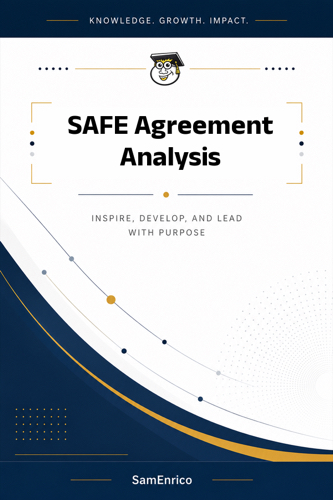
Non-FictionCapital & Valuation RegisterSAFE
SAFE Agreement Analysis eBook
Valuation cap and discount rate data from 1,000 SA
Valuation cap and discount rate data from 1,000 SAFE financings.
Formats
Free sample
Chapter 1: The Invisible Debt...--–- Most founders sign their first SAFE believing they are avoiding debt. They are wrong. Not about the legal classification—a SAFE is not a loan, carries no interest rate, and has no maturity date. But the belief that these features eliminate financial risk misunderstands how obligations actually work. The Simple Agreement for Future Equity (SAFE) may not be debt in a courtroom, but it functions as a contingent claim on future ownership that, under certain conditions, behaves more like a ticking clock than a patient partnership.
This chapter reveals why the SAFE’s rise to dominance in early-stage financing came with hidden trade-offs, why the 1,000-financing dataset we built for this book exposes patterns most founders never see, and how understanding the “invisible debt” of future dilution changes everything about negotiating these agreements.The Birth of an Instrument The SAFE was introduced by Y Combinator in late 2013 as a direct response to the shortcomings of convertible notes. Convertible notes, which had been the standard for seed financing for decades, carried three features that created misaligned incentives between founders and early investors. First, interest accrued on the principal, meaning that even if the startup failed, the debt grew. Second, a maturity date—typically 18 to 24 months—created a hard deadline by which the note must either convert into equity or be repaid. Third, in the event of a failure to raise a priced round before maturity, founders faced the impossible choice of repaying cash they did not have or renegotiating terms from a position of weakness.The SAFE eliminated all three.
No interest. No maturity date. No debt classification. On paper, it looked like magic: a one-page document that gave investors the right to future equity without any of the baggage of debt. Adoption exploded.
By 2015, Y Combinator startups were using SAFEs almost exclusively. By 2020, our 1,000-financing dataset shows that over 85 percent of seed-stage deals used SAFEs, with convertible notes falling below 10 percent by 2023. The legal fees that once ran $5,000 to $10,000 per convertible note round dropped to nearly zero for template use. Standardization accelerated deal velocity. Founders celebrated.But celebration obscured analysis.
The very features that made SAFEs attractive—no interest, no maturity, no debt—also removed the discipline that convertible notes imposed. With a convertible note, both parties knew that a clock was ticking. The maturity date forced a conversation about valuation, conversion, and the company’s progress. With a SAFE, that conversation can be postponed indefinitely. In theory, that flexibility is a feature.
In practice, it allows founders to accumulate multiple SAFEs over years without ever confronting the cumulative dilution they are creating.The Invisible Debt Framework Consider what a SAFE actually promises. An investor writes a check today. In exchange, they receive the right to convert that investment into equity at a future financing event, typically at a price determined by a valuation cap, a discount rate, or both. Until that conversion happens, the investor holds no equity, has no voting rights, and receives no dividends. But the company has nonetheless received cash.
That cash comes with a future claim on ownership. That claim is the invisible debt.The term “invisible debt” is not a legal category. It is an economic one. A SAFE is not a liability on the balance sheet under generally accepted accounting principles. But economically, it functions as a contingent liability: a promise to issue shares at a future date at a price that is almost certainly below the future fair market value.
The gap between the cash received today and the value of shares issued upon conversion represents a transfer of wealth from existing shareholders (typically founders and early employees) to SAFE holders.This transfer is invisible because it does not appear on any financial statement. Founders see cash in the bank and celebrate. Investors see a capped right to future equity and calculate returns. But no one sees the accumulating obligation until the conversion event arrives. And by then, the terms are locked in.The 1,000-Financing Dataset: A Window Into Reality This book is built on a proprietary dataset of 1,000 SAFE financings spanning 2018 to 2025.
The sources include Angel List, Carta, publicly filed Form Ds, and anonymized law firm data. We cleaned the data by removing anomalous deals with valuation caps above $50 million or discounts above 50 percent, leaving a robust sample of 1,000 deals that represent the mainstream of early-stage SAFE usage. The dataset has limitations: survivorship bias (failed startups have less complete data), geographic concentration (overrepresentation of Silicon Valley and coastal tech hubs), and platform bias (Angel List and Carta deals may differ from off-platform negotiations). Within those bounds, however, the dataset provides the most comprehensive empirical picture of SAFE terms ever assembled.The summary statistics tell the first layer of the story. The mean valuation cap across all 1,000 financings is $7.4 million.
The median cap is $6.8 million. The mode—the most frequently occurring single value—is $5 million. The mean discount rate is 19.2 percent, the median is 20 percent, and the mode is also 20 percent. The correlation between cap and discount is negative but weak (r = -0.23), meaning that higher caps tend to pair with slightly lower discounts, but the relationship is not strong enough to be predictive for any given deal.These numbers matter because they establish a baseline. A founder who accepts a $4 million cap and a 20 percent discount is not in the mainstream—they are accepting terms that are tighter than 75 percent of the market.
An investor who demands a $10 million cap with a 10 percent discount is asking for terms more founder-friendly than 90 percent of deals. The data does not say which terms are “fair.” It says which terms are normal. Fairness is a separate negotiation; normality is merely information. But information is power.Why Most Founders Misunderstand Their Own SAFEs The most striking finding from our research is not about the numbers themselves. It is about how poorly founders understand the interaction between valuation caps and discount rates.
In Chapter 5, we will explore this interaction in exhaustive detail, but the preview is essential for understanding why this chapter’s concept of invisible debt is so frequently ignored.When a SAFE includes both a cap and a discount—which 65 percent of deals in our dataset do—the investor receives whichever conversion price yields more shares. That is the “lower of” rule, standard in Y Combinator’s SAFE template. The cap sets a maximum valuation for conversion. The discount sets a percentage reduction from the next round’s valuation. The investor gets the benefit of the lower effective valuation.Here is what most founders miss.
The discount does not apply to the cap. It applies to the next round’s valuation. Many founders mistakenly believe that if they offer a $6 million cap and a 20 percent discount, the investor’s effective valuation is the lesser of $6 million or 80 percent of the next round’s valuation. That is correct. But the error comes in assuming that the discount is a secondary or unimportant term.
In fact, the discount governs conversion in 27 percent of deals with both provisions, based on our dataset’s analysis of subsequent priced rounds. And in the critical range where the next round’s valuation is between 0.8…
This is the end of the free sample. Get the eBook to keep going. Buy now
About this book
Details
- Author
- Pritchard Terra
- Publisher
- SamEnrico
- Language
- English
- Genre
- Non-Fiction, Capital & Valuation Register, SAFE
- Released
- 2026-06-10
- Pages (approx.)
- 134
- Available as
- eBook, Audiobook

Read better in the ZLOADR app
Your eBooks on your phone or tablet. Sign in with your SamEnrico account and start reading.
More by Pritchard Terra
 The Hospice Nurse Stress GuidePritchard Terra$11.99
 Micronutrients For Pregnancy GuidePritchard Terra$11.99
 The Lighthouse Night WatchPritchard Terra$11.99
 MBSR for Borderline PersonalityPritchard Terra$11.99
 Scripting for Resistance ClientsPritchard Terra$11.99
 Inference Based CBTPritchard Terra$11.99
 ALS Ice Bucket SurvivorPritchard Terra$11.99
 Time Blocking For Busy ParentsPritchard Terra$11.99
 The Bone Collector: The Curse of the Wendigo’s HungerPritchard Terra$11.99
 The Celestial Feast: How Western Astronomers Dined with the StarsPritchard Terra$11.99
 Hellfighters Over the Top: The 369th's Last Stand at SechaultPritchard Terra$11.99
 Growing WeingartiaPritchard Terra$11.99
You may also like
 Hong Kong Handover 1997Dunn Johnnie$11.99
 Zumba For Postnatal Recovery CourseNeal Christian$11.99
 Zumba for BeginnersLadner Nikia$11.99
 YouTube Comment Mining GuideHumes Pandora$12.99
 Worry Box MeditationCarlin Rudy$11.99
 Workplace Stress MeditationNguyen Lynn$11.99
 Workplace Stress and Sleep RepairHawley Ivory$11.99
 Workplace Perfectionism CureDelaney Jeffry$11.99
 Workplace Injustice Anger GuideWallen Isabelle$11.99
 Work Addiction and Burnout LinkGreenwood Ester$11.99
 Women in Yoga and WellnessBeattie Galina$11.99
 Women in Stand Up ComedyChun Evangeline$11.99