

SAD Journaling Guide eBook
Write about seasonal mood patterns and coping.
by Harlow Paola
Write about seasonal mood patterns and coping.
Formats
Free sample
Chapter 1: Your Seasonal Blueprint...--–- The first time you noticed it, you probably called yourself lazy. Maybe it was a Tuesday in late October. The sun set at 5:47 PM, and by 6:30 you were on the couch, not because you wanted to be there but because your bones felt like they had been filled with sand. You told yourself to get up. You meant it.
And then you didn't move for another two hours. That wasn't laziness. That was your circadian rhythm beginning its seasonal drift, and no amount of self-criticism was going to override a biological process that has been evolving for millions of years.Before you can fix something, you have to see it clearly. Most people with Seasonal Affective Disorder spend years blaming themselves for a pattern that is as predictable as the tilt of the earth. They think they are undisciplined in winter, unmotivated in December, depressed in January for reasons that are somehow their fault.
This chapter will show you that your seasonal mood shifts are not random, not personal failings, and not mysterious. They follow a blueprint that you can learn to read.The Shadow Season You Never Named Every person with SAD has what this book calls a Shadow Season—the specific time of year when their energy first begins to collapse. For some, it happens in September, the moment the light shifts after the autumn equinox. For others, it waits until November, when daylight saving time ends and the 5 PM darkness feels like a slammed door. A smaller group makes it through the holidays on adrenaline and sugar, only to crash hard in January when the celebrations stop and the darkness remains.Your Shadow Season is not a choice.
It is a biological response to a specific light threshold in your environment. The moment the amount of morning light falling on your retina drops below a certain intensity—different for every person—your brain begins to produce less serotonin and more melatonin. That shift does not ask for your permission. It does not care about your deadlines, your resolutions, or your promises to "do better this year."This chapter will help you identify your exact Shadow Season with precision. Not "winter is hard," which is too vague to be useful.
But rather: "My energy drops below a 5 out of 10 during the third week of October and does not recover until the second week of March." That level of specificity is your first real tool. You cannot outrun a pattern you have not named.The Science You Actually Need to Know Let us talk about the clock inside your brain. The suprachiasmatic nucleus—a tiny cluster of neurons no larger than a grain of rice—sits in your hypothalamus and runs your circadian rhythm. Think of it as your internal conductor, telling every organ in your body when to speed up and when to slow down. This conductor takes its primary cue from one thing: morning light.When light enters your eyes in the morning, it travels along the retinohypothalamic tract directly to that tiny conductor.
The signal is simple: "Day has begun. Wake up the body. Raise the temperature. Release cortisol. Suppress melatonin." Within hours, your entire physiology shifts toward alertness.But when morning light is weak or absent—because the sun rises later, because you wake before dawn, because you spend the first hours of the day in indoor lighting that is 100 times dimmer than outdoor light—that signal does not arrive.
Your conductor waits. And waits. And then eventually gives up and runs a different program: the low-energy, high-sleep, conserve-everything program.This is not a design flaw. It is an evolutionary inheritance from ancestors who needed to conserve energy during winter months when food was scarce. Your body is doing exactly what it evolved to do.
The problem is not your body. The problem is that you now live in a world that demands year-round productivity, and your ancient biology has not received the memo.The Serotonin-Melatonin Seesaw Two chemicals determine most of your seasonal mood shifts. Serotonin is your daytime neurotransmitter—it regulates mood, appetite, energy, and impulse control. Melatonin is your nighttime hormone—it induces sleepiness, lowers body temperature, and signals your body to rest.In summer, bright morning light triggers serotonin production. You wake with energy, your mood lifts, and melatonin stays low until late evening.
In winter, with reduced morning light, your brain produces less serotonin and begins releasing melatonin earlier in the day. By 3 PM in December, your body may already be generating the sleep hormone, which is why you feel inexplicably tired in the middle of the afternoon.Here is what most people get wrong: they think they are tired because they did not sleep enough. But hypersomnia—excessive sleep—is a hallmark of SAD. Many people with winter depression sleep nine, ten, even eleven hours and wake up feeling worse than when they went to bed. That is because the problem is not sleep debt.
The problem is circadian misalignment. You are sleeping during the wrong phase of your internal clock, and no amount of extra hours will fix that.This is why light therapy works when sleeping in does not. Light therapy manually resets that conductor. It delivers the morning signal that your environment is failing to provide. But before you can use light therapy effectively, you need to know exactly when your circadian rhythm is drifting—which brings us to the Energy Map.The Energy Map: Your Personal Seasonal Graph Take out a piece of paper or open a new document.
Draw a grid with twelve columns, one for each month of the year, from January to December. On the vertical axis, label numbers 1 through 10, where 1 means "cannot get out of bed, deeply depressed, no energy at all" and 10 means "full energy, motivated, sleeping well, mood stable."Now think back over the past twelve months. For each month, write a number that represents your average energy level during that month. Do not overthink it. Do not try to be perfectly accurate.
Your memory will not be precise, and that is fine. You are looking for patterns, not data points.When you have all twelve numbers, connect them with a line. What do you see?Most people with SAD see a U-shaped curve or a V-shaped curve. High energy in June and July. A drop starting somewhere between August and October.
A low point somewhere between December and February. A rise beginning in March or April. Back to high energy by May or June.Now look more closely. Where does the drop begin? Not the worst month—the first month that was noticeably lower than the month before.
That is the start of your Shadow Season. For some people, it is September. For others, it is October. For a significant minority, it is January, after the holiday adrenaline wears off.Where is your lowest point? That is your Trough Month—the time when your symptoms are most severe.
For most people with winter SAD, the trough is January or February. But some crash in December. Some hold on until March and then collapse exactly when they think they should be getting better.Now…
This is the end of the free sample. Get the eBook to keep going. Buy now
About this book
Details
- Author
- Harlow Paola
- Publisher
- SamEnrico
- Language
- English
- Genre
- Non-Fiction, Health & Wellness, Journaling
- Released
- 2026-06-09
- Pages (approx.)
- 135
- Available as
- eBook, Audiobook

Read better in the ZLOADR app
Your eBooks on your phone or tablet. Sign in with your SamEnrico account and start reading.
More by Harlow Paola
 Pet Insurance Benefit TrendHarlow Paola$11.99
 Mastering Awkward Silences GuideHarlow Paola$11.99
 Keto Flu Prevention ManualHarlow Paola$11.99
 Mindful Red LightHarlow Paola$11.99
 Validating Emotions Through ListeningHarlow Paola$11.99
 The Used Car GenerationHarlow Paola$11.99
 Networking for IT ProfessionalsHarlow Paola$11.99
 The Great Bitcoin Heist: How a Crypto Kingpin Vanished with MillionsHarlow Paola$11.99
 Pompeii’s Last Warning: Rome’s Volcanic IngenuityHarlow Paola$11.99
 Service Providers Guide to Herb GardenersHarlow Paola$11.99
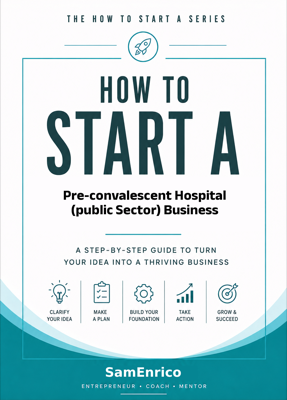 How to Start a Pre-convalescent Hospital (public Sector) Business (Beginners Guide)Harlow Paola$11.99
 A Collector's Handbook to the Mercedes-benz 220sHarlow Paola$11.99
You may also like
 The Nap Journaling MethodLai Velva$11.99
 Social Anxiety JournalPoindexter Tosha$11.99
 The Gaming Relapse JournalMcswain Jessika$11.99
 Beginner Fitness Journal GuideBills Sylvie$11.99
 Menopause Empowerment JournalRedden Emeline$11.99
 IBS Trigger Identification WorkbookDelatorre Takako$11.99
 Endometriosis JournalEleby Zenobia$11.99
 Sustainable Weight Loss JournalBellamy Mui$11.99
 Intuitive Eating Journal WorkbookJohn Beatriz$11.99
 The Postpartum JournalSanchez Tina$11.99
 Journaling Before BedCouch Remedios$11.99
 Bipolar Journaling WorkbookWiggins Marquetta$11.99