
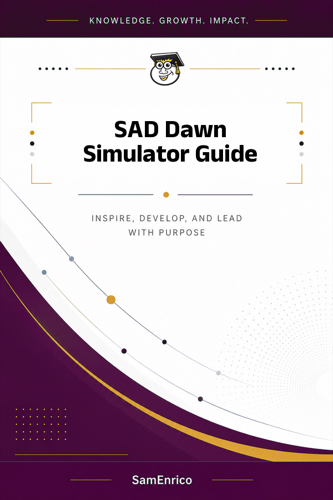
Non-FictionHealth & WellnessSleep
SAD Dawn Simulator Guide eBook
Use sunrise alarm clocks to ease winter morning wa
Use sunrise alarm clocks to ease winter morning wake up.
Formats
Free sample
Chapter 1: The 7 AM Horror…--–- The first time I realized something was physically wrong with winter mornings, I was sitting on the edge of my bed at 7:15 AM, fully dressed, holding a cold cup of coffee I had no memory of making. My wife had asked me a question. I stared at her for what felt like a full minute, my brain spinning like a hard drive trying to read a corrupted sector. The words she had spoken—something about Thursday, something about a school form—had entered my ears and then simply vanished. No processing.
No comprehension. Just a thick, soupy fog where my thoughts should have been.I had slept eight hours. I had not consumed alcohol. I had gone to bed at a reasonable hour. By every objective measure, I should have been alert, functional, and capable of understanding a simple question about a permission slip.
Instead, I felt like I had been drugged. Not tired in the normal sense—not the pleasant drowsiness of a lazy Sunday morning—but chemically sedated, as if someone had injected a tranquilizer into my pillow while I slept.For years, I blamed myself. I called it laziness. I called it a lack of discipline. I told myself that if I just went to bed earlier, or exercised more, or drank less caffeine, or meditated, or tried that one weird trick from the internet, I would finally wake up feeling like a normal human being.
I tried everything. Cold showers. Motivational alarms that played激昂 music. A vibrating wristband that was supposed to shock me into alertness. I even tried one of those apps that makes you solve math problems before the alarm will shut off—which only taught me that I am capable of solving simple equations while remaining completely unconscious.Nothing worked.And then, quite by accident, I discovered something that changed everything.
I was traveling for work in late July, staying in a hotel room with terrible blackout curtains that had a two-inch gap on the side. At 5:47 AM, a blade of summer sunlight sliced through that gap and landed directly across my closed eyelids. I woke up. Not with a jolt. Not with a groan.
Not with the familiar sensation of being dragged out of a deep well against my will. I simply opened my eyes, sat up, and realized I was already awake. Fully awake. Alert. Present.I checked my phone.
I had slept six hours. Six hours, in a hotel bed with a mediocre pillow, and I felt better than I had felt after any eight-hour winter night in my own home.That was the moment I stopped asking "What's wrong with me?" and started asking "What just happened?"The answer, as it turns out, is biology. And the solution, which I will spend the rest of this book teaching you, is simpler, cheaper, and more effective than almost anything I tried in those years of desperate experimentation.Welcome to the truth about winter mornings. They are not your fault.The Laziness Trap Before we go any further, I need you to hear something that may contradict everything you have been told about yourself. The difficulty you experience waking up on dark winter mornings is not a moral failure.
It is not a character flaw. It is not evidence that you are weak, undisciplined, or somehow broken. It is a physiological response to an environmental condition that your body was never designed to handle.This is not positive thinking. This is not self-help affirmation. This is biology.The human circadian system evolved over hundreds of thousands of years in environments where sunrise and sunset were the primary sources of light.
Your ancient ancestors did not have alarm clocks. They did not have jobs that required them to be productive at 8:00 AM regardless of the season. They woke when the sun rose and slept when the sun set, and their bodies were perfectly calibrated to this rhythm.Winter, in this evolutionary context, was a period of rest. Shorter days meant longer nights. Lower light meant lower activity.
Your ancestors did not fight this pattern. They surrendered to it, sleeping more, moving less, and conserving energy until the sun returned.Now contrast that with your modern winter morning. You are asking your body to do something it was never designed to do: wake up fully, perform complex cognitive tasks, and engage with the world—all while it is still biologically night outside. The sun has not risen. Your brain still believes it should be asleep.
And yet you are demanding that it function as if it were noon on a summer day.This is not laziness. This is not weakness. This is asking a machine to operate outside its specifications and then blaming the machine when it fails.The reason this distinction matters is simple: shame does not solve problems. You cannot shame your circadian rhythm into compliance any more than you can shame your heart into beating faster. The only way to fix a biological problem is with a biological solution.
And that is exactly what this book will provide.But first, we need to understand exactly what is happening inside your body on those dark winter mornings. Because the moment you understand the mechanism, the moment you see the actual chemical and neurological processes at work, you will stop blaming yourself and start fixing the real problem.Sleep Inertia: The Zombie State The official name for that foggy, half-conscious state you experience upon waking is sleep inertia. It is a period of impaired cognitive and sensory-motor performance that occurs immediately after awakening. During sleep inertia, your brain is literally not fully online. Reaction times slow.
Memory retrieval degrades. Decision-making abilities plummet.In a normal summer morning, with natural sunlight streaming through your window, sleep inertia lasts somewhere between five and fifteen minutes. Your body transitions gradually from sleep to wakefulness, guided by the light entering your eyes, and by the time you sit up, your brain is already approaching full operational capacity.But on a dark winter morning, with no natural light to signal the transition, sleep inertia can last thirty minutes or longer. Thirty minutes of walking through your house like a zombie. Thirty minutes of staring blankly at your coffee maker.
Thirty minutes of being technically awake but functionally useless.This is not an exaggeration. Studies measuring cognitive performance immediately after waking have found that severe sleep inertia can impair reaction times as much as a blood alcohol concentration of 0.08 percent—the legal limit for driving in most jurisdictions. You are, quite literally, waking up drunk.And here is the cruel irony: the harder you try to fight sleep inertia, the worse you make it. When you force yourself out of bed before your body is ready, when you shock your system with a loud alarm, when you stumble to the bathroom and blast yourself with bright overhead lights, you are not speeding up the transition. You are fragmenting it.
You are jolting one part of your brain awake while leaving the rest behind, creating a neurological mismatch that prolongs the fog.The solution, as we will see in later chapters, is not to…
This is the end of the free sample. Get the eBook to keep going. Buy now
About this book
Details
- Author
- Scherer Margareta
- Publisher
- SamEnrico
- Language
- English
- Genre
- Non-Fiction, Health & Wellness, Sleep
- Released
- 2026-06-06
- Pages (approx.)
- 155
- Available as
- eBook, Audiobook

Read better in the ZLOADR app
Your eBooks on your phone or tablet. Sign in with your SamEnrico account and start reading.
More by Scherer Margareta
 Cherry Blossom Hanami GuideScherer Margareta$11.99
 Athlete Meal Prep GuideScherer Margareta$11.99
 V 22 Osprey PilotScherer Margareta$11.99
 Routine for Emotional NumbnessScherer Margareta$11.99
 The Immigrant Marketplace MogulScherer Margareta$11.99
 Focus Friend SystemScherer Margareta$11.99
 Building Grit for SuccessScherer Margareta$11.99
 The Frozen Pioneers: Japan's First Winter Olympians and the Birth of a National PassionScherer Margareta$11.99
 The Comeback of the Maori Warriors: Defying the Roman LegionScherer Margareta$11.99
 Service Providers Guide to Costume DesignScherer Margareta$11.99
 A Collector's Handbook to the Marcos MantisScherer Margareta$11.99
 How to Produce VermiculiteScherer Margareta$11.99
You may also like
 Hong Kong Handover 1997Dunn Johnnie$11.99
 Zumba For Postnatal Recovery CourseNeal Christian$11.99
 Zumba for BeginnersLadner Nikia$11.99
 YouTube Comment Mining GuideHumes Pandora$12.99
 Worry Box MeditationCarlin Rudy$11.99
 Workplace Stress MeditationNguyen Lynn$11.99
 Workplace Stress and Sleep RepairHawley Ivory$11.99
 Workplace Perfectionism CureDelaney Jeffry$11.99
 Workplace Injustice Anger GuideWallen Isabelle$11.99
 Work Addiction and Burnout LinkGreenwood Ester$11.99
 Women in Yoga and WellnessBeattie Galina$11.99
 Women in Stand Up ComedyChun Evangeline$11.99