
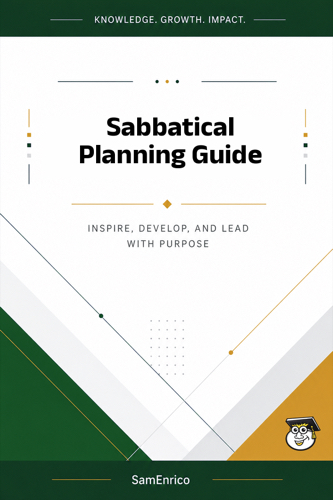
Sabbatical Planning Guide eBook
Take extended time off to reset and rediscover pur
by Staton Chia
Take extended time off to reset and rediscover purpose.
Formats
Free sample
Chapter 1: The Quiet Before--–- The most dangerous moment in any journey is not the obstacle. It is not the storm, the failure, the unexpected detour. The most dangerous moment is the silence just before you decide to move—when everything in your life looks perfectly fine from the outside, and yet something inside you has stopped breathing.You know this silence. It lives in the space between your last meeting and your front door. In the pause between your head hitting the pillow and the avalanche of tomorrow's tasks beginning its slow descent.
In the moment your child asks you a question about their day and you realize you have no idea what they said because you were already answering an email that could have waited.You are successful. By every external metric, you have arrived. The title, the salary, the respect of your peers. You have checked the boxes, climbed the ladders, collected the rewards. And yet.And yet.There is a quiet voice—not loud, never loud, because loud you could ignore—that whispers: Is this it?This chapter is not about burnout.
Burnout is a bonfire; you know when you are on fire. This chapter is about the slow, imperceptible dimming of a flame. The way a bright light can fade so gradually that you do not notice the darkness until someone hands you a photograph of who you used to be.You are not broken. You are not lazy. You are not ungrateful for the life you have built.
You are something much more common and much more dangerous: you are a high performer who has forgotten what it feels like to be truly alive, and you have been running on memory for so long that you no longer know you are running at all.The Success Trap Here is the paradox that undoes more careers, relationships, and nervous systems than any failure ever could: success is not the opposite of exhaustion. Success is its most common cause.When you are failing, you notice. The feedback is immediate and painful. Missed deadlines, disappointed clients, the quiet shuffling of your responsibilities to someone else. Failure demands your attention.Success is silent.
It rewards you with more work. It gives you a promotion that doubles your meetings. It hands you a team that needs your guidance. It fills your inbox not with complaints but with opportunities—which somehow feel even more urgent than complaints because they might slip away if you do not respond immediately.You are not tired because you are failing. You are tired because you are succeeding, and succeeding takes everything you have, and then it takes a little more, and you give it because that is what successful people do.This is the Success Trap.
You achieve. You are rewarded for achieving with more opportunities to achieve. You say yes because saying no feels like a betrayal of the people who believed in you, the potential you have not yet fulfilled, the version of yourself that never stops climbing. And somewhere along the way, without a clear moment of decision, you stop asking yourself what you want. You only ask what the climb requires.I have seen this pattern in executives who run billion-dollar portfolios and in freelancers who are one client away from solvency.
In parents who volunteer for every school committee and in artists who have not made art for years because the commissions pay too well to refuse. The Success Trap does not discriminate by income or industry. It discriminates by one trait only: the willingness to keep going long after the going stopped being joyful.The Vocabulary of Depletion One reason the Quiet Before is so hard to recognize is that we lack a precise language for what is happening. You are not depressed—you still enjoy some things. You are not burned out—you still care about your work.
You are not lazy—you are working harder than ever.You are, for lack of a better term, diminished.Not destroyed. Not collapsed. Just... smaller. The range of your emotions has narrowed.
You used to feel genuine delight at a beautiful sunset, a good meal, a friend's unexpected visit. Now you notice the sunset and think I should take a picture and then forget to look at the picture because you are already thinking about tomorrow's presentation.You used to feel healthy anger at injustice. Now you feel a low-grade irritation at everything and nothing—the slow traffic, the long line, the colleague who asks a question you answered in the memo you know they did not read.You used to feel curiosity. Now you feel competent. Competence is useful, but it is not the same as curiosity.
Curiosity opens doors. Competence walks through doors that have already been opened, again and again, until the path is worn smooth and you cannot remember why you wanted to go through the door in the first place.This diminishment happens so slowly that you adapt to each new level as it arrives. You do not notice that you laugh less often because the decrease was one percent per month over five years. You do not notice that you have stopped initiating plans with friends because the drift happened one canceled dinner at a time. You do not notice that you have not felt truly present in your own life for years because presence was replaced by productivity so gradually that you cannot pinpoint when the swap occurred.The Three Lies You Believe If you are going to take an extended break—not a vacation, not a long weekend, but a true sabbatical designed to reset your relationship with work and life—you will have to unlearn three lies that have become embedded in your identity.Lie #1: I will rest when I am done.Done is not a place.
It does not exist. There is no finish line where all projects are complete, all emails answered, all goals met. The nature of meaningful work is that it generates more meaningful work. Completion is not the end of the road; it is a fork that leads to two new roads.You know this. Intellectually, you know that "I will rest when this project is over" is a lie you have told yourself a hundred times.
But you keep telling it because the alternative—admitting that you will never be done, that rest must be seized rather than earned—is too frightening. If rest is not earned, then you have no excuse for not resting. And if you have no excuse, then every day you continue running is a choice. A choice you are responsible for.It is easier to believe in the mirage of "done" than to face the freedom of "enough."Lie #2: No one else can do this.Yes, they can. They might do it differently.
They might do it slower. They might make mistakes you would not have made. But they can do it. And more importantly, they should do it—because your perpetual availability is not generosity. It is a form of control.
It is you saying, I am the only one who can be trusted with this, which is a sentence that…
This is the end of the free sample. Get the eBook to keep going. Buy now
About this book
Details
- Author
- Staton Chia
- Publisher
- SamEnrico
- Language
- English
- Genre
- Non-Fiction, Self-Help, Sabbatical
- Released
- 2026-06-08
- Pages (approx.)
- 124
- Available as
- eBook, Audiobook

Read better in the ZLOADR app
Your eBooks on your phone or tablet. Sign in with your SamEnrico account and start reading.
More by Staton Chia
 Alcoholism and Sleep Recovery GuideStaton Chia$11.99
 Workaholism and Imposter SyndromeStaton Chia$11.99
 Equity IRR Sensitivity TableStaton Chia$11.99
 Stamp Duty TaxStaton Chia$11.99
 Multi Country Payout Compliance PrimerStaton Chia$12.99
 How to Produce Algae Control ProductsStaton Chia$11.99
 10 Ways to Use Ham Hock (Recipe Book)Staton Chia$11.99
You may also like
 Recovery Sabbatical GuideMerritt Brady$11.99
 The Career Break GuideHolton Garnet$11.99
 Workaholic Sabbatical GuideDiamond Tristan$11.99
 Team Creative SabbaticalLauer Lise$11.99
 Workplace Stress and Sabbatical PlanningGrossman Garland$11.99
 Time Blocking For SabbaticalFelton Tobie$11.99
 Sabbatical Planning for WorkaholicsFryer Freddy$11.99
 Burnout and Sabbatical PlanningEdgar Loura$11.99