
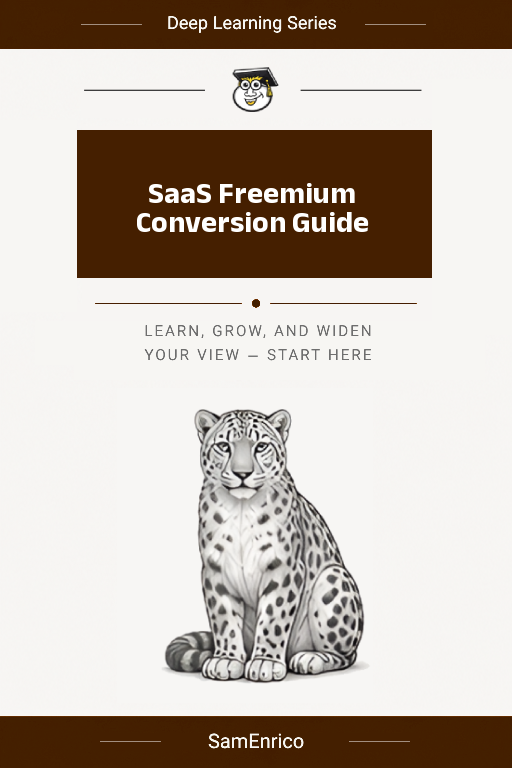
Non-FictionForecast & OutlookFreemium
SaaS Freemium Conversion Guide eBook
Discover free-to-paid conversion benchmarks, featu
Discover free-to-paid conversion benchmarks, feature gating, and upgrade path optimization.
Formats
Free sample
Chapter 1: Beyond The Dashboard--–- The dashboard glowed blue in the darkened conference room, casting long shadows across the faces of the executive team. The number in the center of the screen, bold and unflinching, read 2.8%. The head of product spoke first. “It’s below target.” The CEO, arms crossed, stared a moment longer before asking the question that no one in the room could answer: “But is it bad?”This scene plays out every single day in Saa S companies around the world. Teams gather around conversion dashboards, armed with industry anecdotes and half-remembered benchmarks, trying to decide whether to panic, celebrate, or simply sit in confused silence.
The truth is that most of them have no idea what their freemium conversion number actually means. They do not know whether 2.8% is a death sentence or a foundation for growth. They do not know which levers to pull to move it. And crucially, they do not know that the number staring back at them is a lagging indicator—a tombstone for decisions made weeks or months ago.This chapter exists to end that confusion. You will learn, with precision and data, what constitutes a healthy, warning, or dangerous conversion rate for your specific type of Saa S product.
You will discover why activation is the silent prerequisite that most teams ignore until it is too late. You will understand time-to-value as the hidden gear in your freemium engine. And you will walk away with a North Star metric that finally tells you the truth about whether your product actually converts the users who matter.Part One: The Benchmark Lie The most dangerous phrase in freemium Saa S is “industry average.” Teams cling to it like a security blanket, but averages obscure more than they reveal. A 3% conversion rate might be terrible for a product-led onboarding tool with a 70% activation rate, but it might be exceptional for an enterprise analytics platform where free users take thirty days to even understand the interface.Let us begin with raw, verified data points drawn from the 2023 Profit Well Saa S Benchmarks report, Lenny Rachitsky’s PLG research, and Open View’s annual survey of product-led companies. These are not guesses or conference anecdotes.
They are the closest thing the industry has to a standardized ruler.The median B2B Saa S freemium conversion rate falls between 2% and 5%. This means that half of all companies live in this range. Three percent, the number that triggers so much anxiety, is not a crisis. It is the statistical center of gravity for the entire industry. You are in good company, but good company is not the same as good business.The top quartile of performers converts at 10% to 15%.
These are the Slacks, Zooms, and Looms of the world—products where freemium is not just a marketing channel but the primary growth engine. The bottom quartile converts below 2%, and these companies rarely survive beyond eighteen months. They leak users at every stage of the funnel, and the leak starts long before the upgrade prompt.Now for the critical distinction that most founders ignore. B2C Saa S follows different rules entirely. Dropbox, often cited as the archetypal freemium success story, converts at roughly 3% to 4%.
But Dropbox addresses a market of billions of consumers, not thousands of businesses. Their customer acquisition cost is measured in pennies, and their viral coefficient has historically exceeded 1.0, meaning each free user brought in more than one additional free user. A 3% conversion rate on one hundred million free users yields three million paying customers. A 3% conversion rate on ten thousand B2B users yields three hundred paying customers. Same percentage, radically different business outcomes.Before you compare yourself to any benchmark, ask a simple question: is my peer group actually my peer group?
Comparing your B2B developer tool to a B2C file storage service is not humility. It is self-deception.Part Two: The Activation Prerequisite Here is the truth that most Saa S teams learn too late. You cannot convert what you have not activated. Conversion is a lagging indicator that only becomes relevant after users have experienced your product’s core value. Trying to optimize conversion before fixing activation is like trying to sell a second date to someone who never showed up for the first one.Activation is the moment a user experiences the “Aha!”—the instant when your product’s promise becomes tangible and undeniable.
For Calendly, activation is booking the first meeting. For Zoom, it is hosting a call with video that works flawlessly. For Slack, it is sending a message in a channel and receiving a reply. For Canva, it is exporting a design that looks professional. For Stripe, it is making the first successful API call and seeing a 200 response.Without this moment, users are not free users in the product-led sense.
They are tourists. They signed up, poked around, and left. Treating them as conversion opportunities is a fool’s errand. You cannot optimize your way around a missing value proposition.Based on analysis of over five hundred Saa S companies, activation rates cluster into four distinct zones. Each zone has a predictable range of conversion outcomes, and each requires a different strategic response.The Danger Zone: Activation Below 30%In this zone, conversion rates almost never exceed 1%.
The product has a fundamental value delivery problem. Users sign up but bounce before experiencing anything meaningful. Your marketing message may be misleading, your onboarding may be broken, or your product may simply not solve a real problem. The only correct response is to stop all conversion optimization work immediately and fix activation. No amount of pricing changes, upgrade nudges, or checkout optimization will save you here.
You are trying to harvest a field you never planted.The Warning Zone: 30% to 40% Activation Here, conversion rates typically range from 1% to 2%. You are activating some users, but not enough to build a sustainable business. The product has value, but that value is hidden behind friction, confusion, or poor timing. Your focus should be on reducing the steps to activation. Every extra click, every unnecessary form field, every confusing tooltip is a conversion killer at this stage.
Run a time-to-value audit immediately.The Healthy Zone: 40% to 60% Activation This is where most sustainable freemium businesses operate. Conversion rates of 2% to 5% become achievable. Your product reliably delivers value to a majority of users who give it a genuine try. Now you can shift focus from activation to conversion optimization without worrying that you are optimizing an empty funnel. This is the zone where the techniques in the rest of this book become relevant.The High-Performing Zone: Activation Above 60%Welcome to the top decile.
Companies in this zone routinely achieve conversion rates of 10% to 15% or higher. Their product is so intuitive and immediately valuable that most users experience the “Aha!” within minutes. Notion, Figma, and Loom have all touched this zone at various stages of their growth. Even here, conversion does not automatically reach 15%—activation is necessary but not sufficient. But you have earned the right to focus entirely on upgrade optimization.The most common mistake I see is founders staring at a 3% conversion rate and asking “how do we increase it?”…
This is the end of the free sample. Get the eBook to keep going. Buy now
About this book
Details
- Author
- Mallory Nelia
- Publisher
- SamEnrico
- Language
- English
- Genre
- Non-Fiction, Forecast & Outlook, Freemium
- Released
- 2026-06-01
- Pages (approx.)
- 140
- Available as
- eBook, Audiobook

Read better in the ZLOADR app
Your eBooks on your phone or tablet. Sign in with your SamEnrico account and start reading.
More by Mallory Nelia
 Body Language for Sales SuccessMallory Nelia$11.99
 MBSR For Social Anxiety GuideMallory Nelia$11.99
 Financial Recovery After Burnout WorkbookMallory Nelia$11.99
 Malachi Prophet AccountMallory Nelia$11.99
 The Self Esteem for Highly Sensitive PeopleMallory Nelia$11.99
 Excalibur’s Last Guardian: The Forgotten Knight of the Round TableMallory Nelia$11.99
 Understanding Kousseff SyndromeMallory Nelia$17.99
 Anodizing TechnicianMallory Nelia$11.99
 Proposal Personalization EngineMallory Nelia$12.99
 How to Start a Hobby in ScootersMallory Nelia$11.99
You may also like
 Hong Kong Handover 1997Dunn Johnnie$11.99
 Zumba For Postnatal Recovery CourseNeal Christian$11.99
 Zumba for BeginnersLadner Nikia$11.99
 YouTube Comment Mining GuideHumes Pandora$12.99
 Worry Box MeditationCarlin Rudy$11.99
 Workplace Stress MeditationNguyen Lynn$11.99
 Workplace Stress and Sleep RepairHawley Ivory$11.99
 Workplace Perfectionism CureDelaney Jeffry$11.99
 Workplace Injustice Anger GuideWallen Isabelle$11.99
 Work Addiction and Burnout LinkGreenwood Ester$11.99
 Women in Yoga and WellnessBeattie Galina$11.99
 Women in Stand Up ComedyChun Evangeline$11.99