
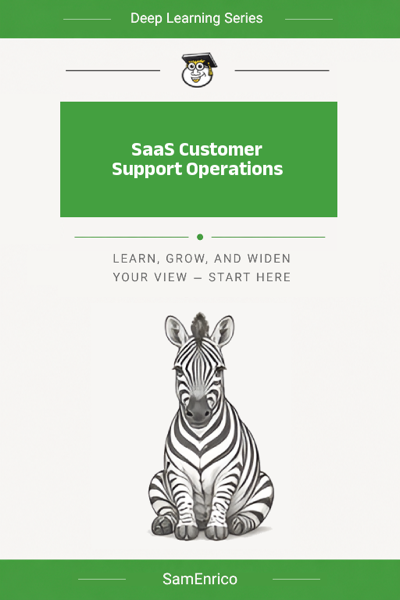
Non-FictionInformativeEducational
SaaS Customer Support Operations eBook
A Coursebook on SaaS Customer Support Operations
A Coursebook on SaaS Customer Support Operations
Formats
Free sample
Chapter 1: The Profit Paradox--– In most Saa S companies, the customer support department sits in a corner of the office — or a cluster of Slack channels — viewed with a mixture of gratitude and pity. Leadership appreciates that someone answers the emails and calms the angry customers, but they rarely invite the support director into the quarterly revenue review. Support is seen as a cost center, a necessary evil, the price of doing business. This chapter exists to shatter that assumption completely and permanently.The conventional wisdom in software-as-a-service is that revenue comes from sales, retention comes from customer success, and support is just there to put out fires. That wisdom is not merely outdated — it is dangerously wrong.
In the modern Saa S landscape, where products are increasingly similar, switching costs are falling, and customers have more choices than ever, the support experience has become one of the most powerful determinants of whether a customer stays, grows, or leaves. More importantly, support interactions have become the single richest source of revenue expansion data that most companies completely ignore.Consider this: every time a customer contacts support, they are revealing something valuable. They are revealing where your product is confusing, where it is broken, where it falls short of their expectations, and — most critically — what they are trying to accomplish that they cannot yet do. That last piece is the seed of every upsell and expansion opportunity your company will ever have. The customer who struggles to configure a basic integration is not just a problem to be solved; they are a candidate for a premium onboarding package.
The customer who repeatedly asks about a feature you do not have is not just a source of frustration; they are validation for your product roadmap and a potential beta tester for the feature when you build it. The customer who figures out a clever workaround and shares it with your agent is not just a ticket closed; they are a source of knowledge that can be packaged and sold to others.This chapter reframes customer support as a strategic revenue driver. It dismantles the cost-center mentality, introduces the metrics that connect support quality to financial outcomes, and provides a framework for transforming your support organization from a reactive expense into a proactive profit engine. By the end of this chapter, you will never look at a support ticket the same way again.The Hidden Economics of Customer Support To understand why support is the new sales, you must first understand a metric that every Saa S executive watches obsessively: Net Revenue Retention, or NRR. NRR measures the percentage of recurring revenue retained from existing customers over a given period, including upgrades, downgrades, and cancellations.
An NRR of 100% means you kept exactly what you had. An NRR of 120% means your existing customers grew their spending by 20% — a sign of a healthy, expanding business. An NRR below 100% means you are leaking revenue faster than you can replace it, a death spiral for any subscription business.Here is what most support leaders do not know: NRR and support quality are directly, measurably linked. A landmark study of over 500 B2B Saa S companies found that customers who reported a “very good” support experience had a 94% likelihood of renewing their subscription, compared to just 55% for customers who rated their support experience as “poor.” Even more striking, customers with high support satisfaction scores were three times more likely to purchase an additional product or upgrade within six months of their last support interaction.Why does this happen? The psychology is straightforward but powerful.
When a customer encounters a problem and receives fast, empathetic, effective support, something remarkable occurs: their loyalty to your company actually increases. This phenomenon, known in behavioral economics as the “service recovery paradox,” suggests that a well-handled problem can create more customer loyalty than a problem-free experience. The customer who struggles with a bug and then receives exceptional support remembers not the bug but the rescue. They feel valued. They feel heard.
And they become more receptive to everything else you offer.Conversely, poor support does not just lose you the immediate customer — it creates a negative multiplier effect. Angry customers tell an average of fifteen people about their bad experience. In the B2B Saa S world, where buying decisions often involve multiple stakeholders and lengthy sales cycles, a single poor support interaction can poison an entire account relationship, killing expansion opportunities that might have been worth tens or hundreds of thousands of dollars.Voice of Customer: The Untapped Goldmine Every support ticket contains data that product managers, marketers, and salespeople would pay dearly to access. But most organizations let that data rot in closed tickets, never analyzed, never categorized, never acted upon. The Voice of Customer (Vo C) framework changes that.Vo C is a systematic method for capturing, categorizing, and acting upon the feedback embedded in customer interactions.
In a support context, Vo C means treating every ticket not as a problem to be closed but as a data point to be categorized. The implementation is simpler than most leaders imagine. It requires three things: a taxonomy of feedback types, a consistent tagging process, and a regular cadence of sharing insights with other teams.A practical taxonomy might include seven categories: bug reports (something is broken), feature requests (something is missing), usability issues (something is too hard to use), documentation gaps (something is not explained well), billing questions (something about pricing or invoicing), security concerns (something about data protection), and integration problems (something about connecting to other tools). Every ticket should receive at least one tag. Complex tickets may receive multiple tags.Once tickets are tagged, the data becomes analyzable.
Which categories are growing fastest? That tells you where your product or documentation is failing. Which customers submit the most feature requests? Those are your expansion opportunities waiting to be cultivated. Which tickets take the longest to resolve?
Those are your biggest operational inefficiencies and your biggest customer frustrations.The most sophisticated support organizations go one step further: they close the loop. When a product manager decides to build a feature that customers have requested, they notify the customers who asked for it. When a documentation writer creates an article addressing a common confusion, they link it back to the tickets that revealed the gap. When a bug is fixed, support agents proactively reach out to customers who reported it. This closed-loop feedback transforms support from a reactive firefighting operation into a strategic intelligence function that drives product decisions and customer loyalty simultaneously.Negative Churn: The Ultimate Goal In the Saa S business model, the most powerful financial lever is not acquiring new customers — it is keeping existing ones longer and selling them more.
Negative churn is the holy grail: the scenario where expansion revenue from existing customers (upgrades, add-ons, cross-sells) exceeds lost revenue from customers who cancel or downgrade. When you have negative churn, you can grow your revenue even while losing customers, because the ones who stay are spending enough to more than compensate.Support teams are uniquely positioned to drive negative churn because they are the only function that talks to customers about their actual usage and struggles. Sales…
This is the end of the free sample. Get the eBook to keep going. Buy now
About this book
Details
- Author
- Sinclair Adena
- Publisher
- SamEnrico
- Language
- English
- Genre
- Non-Fiction, Informative, Educational
- Released
- 2026-05-04
- Pages (approx.)
- 153
- Available as
- eBook, Audiobook

Read better in the ZLOADR app
Your eBooks on your phone or tablet. Sign in with your SamEnrico account and start reading.
More by Sinclair Adena
 Financial Contract Term ExtractionSinclair Adena$11.99
 Turning the MindSinclair Adena$11.99
 World Geography PalaceSinclair Adena$11.99
 Self Esteem for Financial AdvisorsSinclair Adena$11.99
 Anger Management for OCD at WorkSinclair Adena$11.99
 Champollion BiographySinclair Adena$11.99
 Mindful Breathing For KidsSinclair Adena$11.99
 Treasure Diver's Ethics GuideSinclair Adena$11.99
 Legacy Without BurnoutSinclair Adena$11.99
 The Green Book of Greenwood: How a Black-Owned Insurance Empire Defied the OddsSinclair Adena$11.99
 The Frozen Plague Hunters: Arctic Spice Routes and the Birth of Pandemic ScienceSinclair Adena$11.99
 Silent Witness: The Trial That Shook the VaticanSinclair Adena$11.99
You may also like
 Hong Kong Handover 1997Dunn Johnnie$11.99
 Zumba For Postnatal Recovery CourseNeal Christian$11.99
 Zumba for BeginnersLadner Nikia$11.99
 YouTube Comment Mining GuideHumes Pandora$12.99
 Worry Box MeditationCarlin Rudy$11.99
 Workplace Stress MeditationNguyen Lynn$11.99
 Workplace Stress and Sleep RepairHawley Ivory$11.99
 Workplace Perfectionism CureDelaney Jeffry$11.99
 Workplace Injustice Anger GuideWallen Isabelle$11.99
 Work Addiction and Burnout LinkGreenwood Ester$11.99
 Women in Yoga and WellnessBeattie Galina$11.99
 Women in Stand Up ComedyChun Evangeline$11.99