
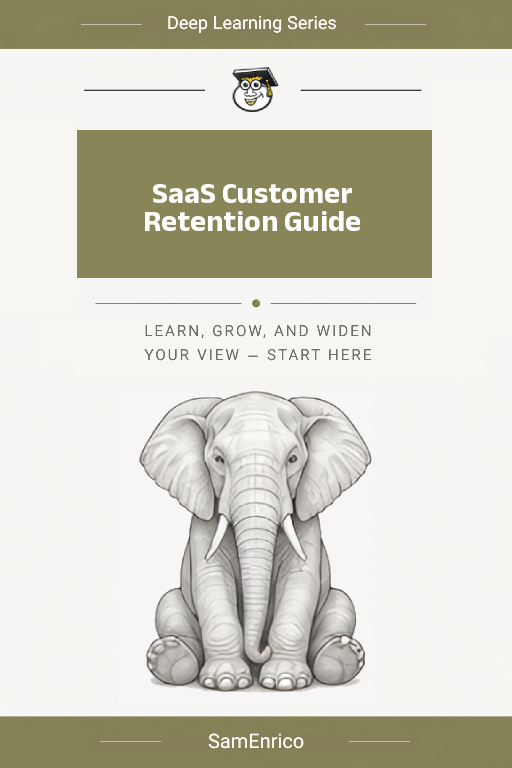
Non-FictionStrategic AtlasSaaS Intelligence
SaaS Customer Retention Guide eBook
Analyzes how top SaaS companies retain subscribers
by Oden Weston
Analyzes how top SaaS companies retain subscribers through product-led growth, usage alerts, and success teams.
Formats
Free sample
Chapter 1: The $1.6 Trillion Leak--–- In 2019, a little-known Saa S company called Peak Metrics had everything venture capitalists claim to love. They had raised $47 million. Their year-over-year revenue growth was 340 percent. They had 1,200 paying customers, including three Fortune 500 logos. Their product was objectively good—fast, reliable, and packed with features their competitors couldn’t match.
At their all-hands meeting in November of that year, the CEO projected a slide that read: “We are winning.” Six months later, Peak Metrics was dead.Not bankrupt in the dramatic, office-furniture-auction sense. But dead in the way that matters most in the subscription economy: their growth had stalled, their valuation had collapsed, and their board had forced a fire sale to a private equity firm for less than the company had raised. The post-mortem, leaked to a industry newsletter, contained a single chart that explained everything. Revenue from new customers had climbed steadily for eighteen months. But revenue from existing customers—the renewals, the upsells, the loyal base—had cratered.
In the last quarter of Peak Metrics’ life, they lost 47 percent of their subscription revenue to churn. They had built a leaky bucket, and no amount of new customer acquisition could fill it fast enough.Peak Metrics is not an anomaly. According to data from Profit Well and Recurly, the average Saa S company loses between 3 and 8 percent of its monthly recurring revenue to churn every single month. For a company with 10millioninannualrecurringrevenue(ARR),thatmeanslosingbetween10 million in annual recurring revenue (ARR), that means losing between 10millioninannualrecurringrevenue(ARR),thatmeanslosingbetween300,000 and 800,000everyyear—nottocompetitors,nottoproductfailures,buttotheslow,silenterosionofcustomercommitment.Multipliedacrosstheentire Saa Sindustry,which Gartnerestimatesat800,000 every year—not to competitors, not to product failures, but to the slow, silent erosion of customer commitment. Multiplied across the entire Saa S industry, which Gartner estimates at 800,000everyyear—nottocompetitors,nottoproductfailures,buttotheslow,silenterosionofcustomercommitment.Multipliedacrosstheentire Saa Sindustry,which Gartnerestimatesat260 billion in 2024, the annual loss to churn exceeds $1.6 trillion.
That is not a rounding error. That is the combined GDP of Australia and South Africa vanishing every year because companies are better at acquiring customers than keeping them.This book exists because that leak is preventable. The strategies, frameworks, and automations that follow have been extracted from the top 1 percent of Saa S companies—the ones with Net Revenue Retention (NRR) above 120 percent and annual churn below 2 percent. These companies have learned what Peak Metrics discovered too late: retention is not a customer success department. It is not a feature of your product.
It is not a set of emails you send when someone stops logging in. Retention is a system. And like any system, it can be designed, measured, optimized, and—most importantly—copied.The Myth of Growth-First Thinking Most founders and executives operate under an implicit theory that I call “Growth-First Thinking.” The logic seems irrefutable: acquire more customers, grow faster, achieve scale, and retention problems will solve themselves because large customer bases generate network effects, brand loyalty, and pricing power. This theory is seductive because it allows leaders to focus on what feels like progress—new logos, expanding sales teams, bigger marketing budgets—while ignoring the slow bleed happening in the back end of the business.The data, however, has repeatedly falsified this theory. A landmark study published in the Harvard Business Review analyzed 5,000 public and private Saa S companies over a ten-year period.
The researchers found zero correlation between customer acquisition rate and long-term retention. In fact, the fastest-growing companies in the study were actually slightly more likely to have below-average retention, because rapid growth often outpaces the company’s ability to onboard, support, and nurture new customers. Growth hides churn. It does not cure it.Consider the contrast between two companies that entered the project management software market in the same year: Asana and Wrike. Asana grew steadily, prioritizing product-led onboarding and user habit formation.
Wrike grew aggressively, pouring capital into outbound sales and enterprise deals. By 2020, both companies had similar revenue. But Asana’s NRR was 125 percent—meaning existing customers were spending 25 percent more year over year. Wrike’s NRR was 92 percent. The difference in valuation was not close.
Asana went public at a 5.5billionvaluation;Wrikewasacquiredfor5.5 billion valuation; Wrike was acquired for 5.5billionvaluation;Wrikewasacquiredfor2.25 billion. Both successful, but one built a retention engine while the other built an acquisition engine.The lesson is not that growth is bad. The lesson is that growth without retention is a treadmill. You run faster and faster just to stay in place. And when the market turns—as it always does—the treadmill stops.
The companies that survive are not the ones that grew the fastest. They are the ones that kept the customers they already had.The Math of Compounding Churn To understand why retention is the single most leveraged lever in the subscription economy, you need to understand two numbers: Gross Revenue Retention (GRR) and Net Revenue Retention (NRR). These are not academic abstractions. They are the difference between building a company worth billions and building a company that Peak Metrics its way into irrelevance.Gross Revenue Retention (GRR) measures the percentage of recurring revenue retained from existing customers, excluding any expansion revenue from upsells or cross-sells. If you start the year with 1millionin ARRfrom100customers,andthosesamecustomersgenerate1 million in ARR from 100 customers, and those same customers generate 1millionin ARRfrom100customers,andthosesamecustomersgenerate900,000 in ARR at the end of the year (after cancellations and downgrades), your GRR is 90 percent.
Simple. Painful.Net Revenue Retention (NRR) does something more revealing. It includes expansion revenue from upsells, cross-sells, and price increases. Using the same example: if your 100 customers started at 1million,somecanceled(1 million, some canceled (1million,somecanceled(100k loss), but others upgraded (150kinnewrevenue),yourending ARRwouldbe150k in new revenue), your ending ARR would be 150kinnewrevenue),yourending ARRwouldbe1.05 million, and your NRR would be 105 percent. You lost customers but grew revenue anyway.
That is the magic of negative churn.Now watch what happens to these numbers over time. A Saa S company with 80 percent GRR (terrible, but sadly common) and 100 percent NRR (no expansion) will lose half its customer base every three years. A company with 95 percent GRR and 120 percent NRR will double its revenue from existing customers every four years without acquiring a single new customer. The compounding effect is staggering. A 5 percent improvement in retention—from 90 percent to 95 percent GRR—can increase enterprise value by 25 to 100 percent, depending on the company’s margins and growth rate.
This is not marketing hype. This is discounted cash flow analysis.I have sat across the table from dozens of founders who proudly announced their 30 percent month-over-month user growth, only to admit when pressed that their NRR was 85 percent. They were running on a hamster wheel. Every dollar they spent on acquisition was subsidizing a leak they refused to fix. The most successful Saa S investors—the ones at A16Z, Battery, and Sapphire—now routinely ask for NRR before they ask for growth rate.
They know what Peak Metrics learned too late: a leaky bucket never fills.Why Customer Support Is Not Customer Success One of the most common mistakes I see is the conflation of Customer Support with Customer Success. They are not the same. They are not even close. Understanding the difference is the first step toward…
This is the end of the free sample. Get the eBook to keep going. Buy now
About this book
Details
- Author
- Oden Weston
- Publisher
- SamEnrico
- Language
- English
- Genre
- Non-Fiction, Strategic Atlas, SaaS Intelligence
- Released
- 2026-06-01
- Pages (approx.)
- 148
- Available as
- eBook, Audiobook

Read better in the ZLOADR app
Your eBooks on your phone or tablet. Sign in with your SamEnrico account and start reading.
More by Oden Weston
 Tree Root Grounding SleepOden Weston$11.99
 Hamstring Pelvic Floor LinkOden Weston$11.99
 HIIT Heart Rate Zone GuideOden Weston$11.99
 Assertiveness Scripts WorkbookOden Weston$11.99
 The Consistent Bedtime Routine GuideOden Weston$11.99
 The Iron Masters of the Sahel: Forging the Future in Ancient AfricaOden Weston$11.99
 How to Become a Long-chain BeamerOden Weston$11.99
 In App Conversion MessagesOden Weston$12.99
 The Breeder's Guide to Florida Cracker HorsesOden Weston$11.99
 Financial Advisor TraineeOden Weston$11.99
You may also like
 Hong Kong Handover 1997Dunn Johnnie$11.99
 Zumba For Postnatal Recovery CourseNeal Christian$11.99
 Zumba for BeginnersLadner Nikia$11.99
 YouTube Comment Mining GuideHumes Pandora$12.99
 Worry Box MeditationCarlin Rudy$11.99
 Workplace Stress MeditationNguyen Lynn$11.99
 Workplace Stress and Sleep RepairHawley Ivory$11.99
 Workplace Perfectionism CureDelaney Jeffry$11.99
 Workplace Injustice Anger GuideWallen Isabelle$11.99
 Work Addiction and Burnout LinkGreenwood Ester$11.99
 Women in Yoga and WellnessBeattie Galina$11.99
 Women in Stand Up ComedyChun Evangeline$11.99