
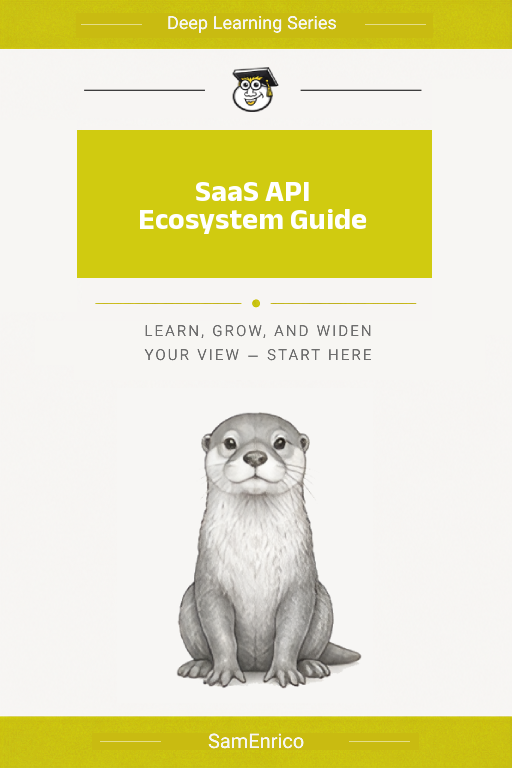
Non-FictionForecast & OutlookAPI SaaS
SaaS API Ecosystem Guide eBook
Discover embedded integrations, iPaaS growth, and
Discover embedded integrations, iPaaS growth, and open API adoption for software connectivity.
Formats
Free sample
Chapter 1: The Loneliest Software--–- The email arrived at 11:47 PM on a Tuesday. Mark, the CTO of a promising 47million Saa Scompanycalled Flow Matrix,hadbeenstaringathisscreenforfourteenhours.Histeamhadjustlosta47 million Saa S company called Flow Matrix, had been staring at his screen for fourteen hours. His team had just lost a 47million Saa Scompanycalled Flow Matrix,hadbeenstaringathisscreenforfourteenhours.Histeamhadjustlosta2.3 million enterprise deal. Not because their product failed a security audit. Not because the price was too high.
Not even because a competitor had better features.They lost because Flow Matrix could not connect to Net Suite.The prospect’s procurement director had been blunt in her final email: “Your platform solves our inventory problem brilliantly. But we run our entire financial close on Net Suite. We will not authorize a new system that requires our team to manually export CSV files every night and paste them into spreadsheets. We’re going with the vendor who already built the connector.”Mark closed his laptop. His company had spent eighteen months building the perfect inventory optimization engine.
Machine learning models that predicted demand with 94% accuracy. A user interface that cut training time from three weeks to two days. A mobile app that warehouse managers actually enjoyed using.None of it mattered. Because they forgot to make their software friendly.Not friendly in the customer support sense. Friendly in the way that software talks to other software.
Friendly in the way that a platform introduces itself to the rest of a company’s digital ecosystem and says, “I speak your language. I understand your data. I will not make your team do manual labor every time they want to share information between systems.”This book is for everyone who never wants to receive that 11:47 PM email.The Death of the All-in-One Suite Fifteen years ago, software vendors sold a comforting lie: buy everything from us, and you will never have integration problems again. Oracle, SAP, Microsoft—they built sprawling suites that promised to handle HR, finance, sales, customer support, and supply chain under a single roof. The value proposition was seductive.
One vendor. One contract. One support line. One way of doing everything.The problem was that “one way” was usually terrible for most things. A company that bought the full Oracle suite got an adequate HR system, a mediocre CRM, a clunky marketing automation tool, and an excellent database.
The other way around was equally bleak. Salesforce customers got a world-class CRM but a laughably bad accounting module.The market made its choice. Not dramatically, not overnight, but with the quiet persistence of thousands of procurement decisions. Companies began buying best-of-breed solutions. Use Salesforce for sales.
Hub Spot for marketing. Net Suite for finance. Workday for HR. Zendesk for support. Slack for communication.
Each product was chosen because it was genuinely superior at its specific job.This created a new problem. The average mid-sized company now uses 187 different software applications. Those applications are supposed to work together. A lead captured in Hub Spot should become an opportunity in Salesforce. A closed-won opportunity should create an invoice in Net Suite.
A paid invoice should trigger fulfillment in a warehouse management system. A fulfilled order should send a shipping confirmation back to Salesforce so the account manager knows to follow up.Instead, what actually happens is that a human being—usually a well-intentioned operations analyst named something like Jessica or Mike—spends three hours every morning exporting CSVs from one system, reformatting columns in Excel, and uploading the transformed data into another system. This is not a joke. This is not an edge case. This is how most of the global economy runs.The software industry has a name for this hidden labor.
It is called the spreadsheet tax. And it is the single largest unacknowledged cost of modern business operations.The Spreadsheet Tax: A Reckoning Let us calculate the spreadsheet tax for a typical company. You have 187 applications. Each application has at least five data flows that need to synchronize with other applications daily. That is 935 potential integration points.
In reality, most companies have not mapped their data flows, so they do not know the true number. They just know that Jessica and Mike are always busy and always asking for overtime.A conservative estimate: a company with 500 employees loses 8,000 person-hours per month to manual data reconciliation. At an average loaded cost of 60perhour,thatis60 per hour, that is 60perhour,thatis480,000 per month. Nearly $6 million per year. Gone.
Not to strategy. Not to innovation. To copying and pasting.The vendors who win in this environment are not necessarily the ones with the best features. They are the ones who make it easiest for Jessica and Mike to stop copying and pasting. They are the ones who build connectors.
They are the ones who make their software speak the language of every other important system in the stack.This insight flips the traditional software business model on its head. For decades, software companies competed on what their product could do. The feature war was the only war. Whoever had the most checkboxes won. But as products matured, feature parity became inevitable.
Every half-decent CRM has contact management, pipeline tracking, and reporting. Every viable HRIS has onboarding, payroll, and benefits administration. The features stopped being differentiators.Connectivity became the new battlefield.A study of 1,200 B2B Saa S purchasing decisions found that integration availability was the third most important factor in vendor selection, trailing only price and security compliance. For deals over 100,000inannualcontractvalue,integrationavailabilitymovedtosecondplace.Fordealsover100,000 in annual contract value, integration availability moved to second place. For deals over 100,000inannualcontractvalue,integrationavailabilitymovedtosecondplace.Fordealsover500,000, it became the top criterion.
Companies were willing to accept inferior features if the product connected seamlessly to their existing stack. They were willing to pay more for connectivity than for functionality.Think about what that means. The marginal value of your next feature—the one your product team has been debating for six months—is probably lower than the marginal value of your next connector. Your customers would rather have a Salesforce integration than a slightly better reporting dashboard. They would rather have a Net Suite sync than a fancy new visualization widget.This is not opinion.
This is revealed preference. Every time a prospect asks “Do you integrate with X?” they are telling you what matters. Every time a customer builds their own workaround using Zapier or Make, they are telling you that you failed. Every time a deal closes with a competitor who has the connector you lack, the market has delivered its verdict.A Taxonomy of Connectivity Before we go further, we need to be precise about what we mean when we talk about integration and connectivity. The software industry uses these terms sloppily, and that sloppiness leads to failed projects and disappointed customers.
Throughout this book, we will use three distinct categories. Understanding the differences between them is essential for making strategic decisions about where to invest.Public APIs An Application Programming Interface (API) is a set of rules that allows one piece of software to talk to another. A public API is one that your company intentionally exposes to external developers, partners, and customers. It is the front door to your product’s data…
This is the end of the free sample. Get the eBook to keep going. Buy now
About this book
Details
- Author
- Oglesby Silva
- Publisher
- SamEnrico
- Language
- English
- Genre
- Non-Fiction, Forecast & Outlook, API SaaS
- Released
- 2026-06-01
- Pages (approx.)
- 147
- Available as
- eBook, Audiobook

Read better in the ZLOADR app
Your eBooks on your phone or tablet. Sign in with your SamEnrico account and start reading.
More by Oglesby Silva
 Zephaniah Prophet AccountOglesby Silva$11.99
 Burnout Prevention for Librarians CourseOglesby Silva$11.99
 Workplace Stress for Call Center AgentsOglesby Silva$11.99
 Mindful Writing MBSR JournalOglesby Silva$11.99
 The Racial and Body Image Intersection GuideOglesby Silva$11.99
 The Battle of the Hydaspes: Alexander's Last Stand Against the UnbrokenOglesby Silva$11.99
 Animal Care TechnicianOglesby Silva$11.99
 Sales Battle Card Generator WorkbookOglesby Silva$12.99
 How to Start a Hobby in Scuba DivingOglesby Silva$11.99
 Understanding Kostmann SyndromeOglesby Silva$17.99
You may also like
 Hong Kong Handover 1997Dunn Johnnie$11.99
 Zumba For Postnatal Recovery CourseNeal Christian$11.99
 Zumba for BeginnersLadner Nikia$11.99
 YouTube Comment Mining GuideHumes Pandora$12.99
 Worry Box MeditationCarlin Rudy$11.99
 Workplace Stress MeditationNguyen Lynn$11.99
 Workplace Stress and Sleep RepairHawley Ivory$11.99
 Workplace Perfectionism CureDelaney Jeffry$11.99
 Workplace Injustice Anger GuideWallen Isabelle$11.99
 Work Addiction and Burnout LinkGreenwood Ester$11.99
 Women in Yoga and WellnessBeattie Galina$11.99
 Women in Stand Up ComedyChun Evangeline$11.99