
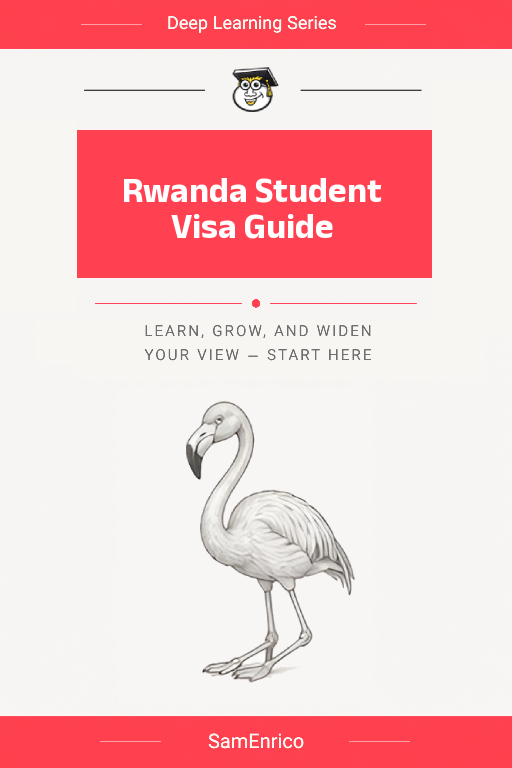
Non-FictionStudent's ShortcutVisa Guide
Rwanda Student Visa Guide eBook
Secures Rwandan student visa efficiently, includin
Secures Rwandan student visa efficiently, including application process, required documents, financial proof, and processing timelines.
Formats
Free sample
Chapter 1: The Hidden Syllabus--Every year, hundreds of international students arrive at Kigali International Airport with suitcases full of hope and folders full of mistakes. They have been accepted into reputable Rwandan universities. They have paid their tuition deposits. They have watched You Tube videos about the beauty of the Land of a Thousand Hills. But within weeks of arrival, many find themselves sitting across from immigration officers, explaining why they failed to register on time, why their bank statements don't match the requirements, or why they assumed the e-Visa in their email was all they needed.
Some are fined. A few are deported. And nearly all of them say the same thing: "I didn't know."This book exists to ensure you are never that student.The Rwanda you think you know versus the Rwanda that actually exists Before we dive into forms, deadlines, and portal screenshots, we need to address something more fundamental. The reason most student visa guides fail is not because they lack information. It is because they present information without context.
They tell you what documents to submit but not why immigration officers care about those specific documents. They give you deadlines but do not explain the philosophy behind those deadlines. And worst of all, they treat every country's immigration system as if it operates on the same logic.Rwanda does not operate on the same logic as the United States, Canada, or the United Kingdom. It is smaller, more agile, and unburdened by decades of bureaucratic sediment. The Rwanda Directorate General of Immigration and Emigration (DGIE) processes most applications digitally through the Irembo portal.
Decisions can come in seven days, not seven months. But speed cuts both ways. A quick approval means a quick rejection is equally possible. And because the system is efficient, there is no excuse for missing deadlines. In countries with famously slow immigration systems, a late application might be blamed on postal delays or overwhelmed caseworkers.
In Rwanda, the portal timestamps everything. You cannot argue with a digital record.Understanding this cultural and operational context is the first step toward a successful application. The hidden syllabus of Rwandan student visa success includes three principles that no official website will state outright but that every immigration officer expects you to understand.Principle one: Rwanda values intention over documentation Many countries approach student visas as a checklist exercise. Submit the forms, prove the funds, show the acceptance letter, and approval is almost automatic. Rwanda is different.
The DGIE is less interested in whether you have a piece of paper than in whether you have a genuine reason to be in Rwanda and a genuine reason to leave when your studies are complete. This is what we call throughout this book the Intent to Return Doctrine.You might be wondering why a country would care whether you leave. After all, educated graduates who remain and contribute to the economy sound like a benefit, not a problem. But immigration policy is not designed around abstract benefits. It is designed around risk.
Every country that hosts international students must guard against a simple risk: that the student will overstay their visa and remain without legal status. This strains public resources, creates enforcement headaches, and undermines the integrity of the immigration system.Rwanda manages this risk not by making the visa process slow and painful but by carefully evaluating your ties to your home country. If you have a job waiting for you at home, a business you plan to run, property you own, or family members who depend on you, you are statistically far less likely to overstay. If you have nothing to return to, you are a higher risk. The DGIE does not need to prove you intend to overstay.
It only needs to suspect that you might.This is why Chapter 1 of this book is not about bank statements or passport photos. It is about helping you articulate a truthful, documented answer to the question that matters most: "Why will you return home?"Principle two: The pre-arrival visa is temporary by design Another common point of confusion among international students is the distinction between the e-Visa they apply for before traveling and the Residence Pass they must apply for after arriving. The original outline of this book contained a significant inconsistency on this point, with Chapter 6 suggesting that the 15-day deadline applied to the acceptance letter and Chapter 8 placing it after arrival. Let us resolve that confusion clearly and permanently.The e-Visa you apply for through the Irembo portal is a permission to enter Rwanda. That is all.
It is not a permission to stay for the duration of your studies. Think of it as a ticket to the gate, not a seat at the table. Once you arrive, you have 15 calendar days to register at your university, secure accommodation, and apply for a Residence Pass, which is the document that actually authorizes your long-term stay.Why does Rwanda use this two-step process? Because the DGIE wants to verify that you have physically arrived, that you have enrolled in your program, and that you have a real address in the country before granting long-term status. An e-Visa can be approved based on documents submitted from anywhere in the world.
But a Residence Pass requires your physical presence. This is not bureaucracy for its own sake. It is a security measure that protects both the government and legitimate students.If you fail to apply for your Residence Pass within 15 days of arrival, you become an overstayer. Fines begin accruing immediately, and your university may also be penalized. Some students have arrived, settled into their apartments, started attending classes, and assumed everything was fine, only to discover weeks later that their e-Visa had expired and they had no legal status.
Do not let this be you.Principle three: Financial proof is about sustainability, not wealth The third hidden principle of the Rwandan student visa system concerns money. Many applicants assume that showing a large bank balance is sufficient. They borrow money from relatives, deposit it temporarily, print the statement, and return the funds. Others assume that a scholarship letter or a simple statement from a sponsor will suffice.Neither assumption is correct.The DGIE evaluates financial proof for sustainability. They want to see that the money in your account has been there for at least six consecutive months.
This is called the 6-Month Rule, and we will cover it in exhaustive detail in Chapter 3. Sudden large deposits that appear just before the statement date are red flags. A bank statement showing a healthy balance but erratic deposits over the six-month period may be rejected because it suggests irregular income that could dry up during your studies.Furthermore, the DGIE requires a specific formula: tuition for the entire academic year plus monthly living expenses based on the Kigali cost of living index. At the time of this writing, living expenses in Kigali average between 500and500 and 500and800 per month depending on your housing choices and lifestyle. A student who budgets only $300 per month is not being frugal.
They are being unrealistic, and the DGIE will treat their application as underfunded.The sponsorship commitment letter, if you are using a…
This is the end of the free sample. Get the eBook to keep going. Buy now
About this book
Details
- Author
- Maddox Lorina
- Publisher
- SamEnrico
- Language
- English
- Genre
- Non-Fiction, Student's Shortcut, Visa Guide
- Released
- 2026-05-30
- Pages (approx.)
- 137
- Available as
- eBook, Audiobook

Read better in the ZLOADR app
Your eBooks on your phone or tablet. Sign in with your SamEnrico account and start reading.
More by Maddox Lorina
 Eisenhower Matrix Quadrant GuideMaddox Lorina$11.99
 The Walking Meditation RetreatMaddox Lorina$11.99
 Assertiveness In Friendships WorkbookMaddox Lorina$11.99
 Eisenhower Matrix Printable KitMaddox Lorina$11.99
 The Black Dahlia Police Corruption AngleMaddox Lorina$11.99
 IOSS EU VAT Import GuideMaddox Lorina$12.99
 Understanding RhinotillexomaniaMaddox Lorina$17.99
 Marketing Assistant ManagerMaddox Lorina$11.99
 How to Become a Lens Mounter IiMaddox Lorina$11.99
You may also like
 Hong Kong Handover 1997Dunn Johnnie$11.99
 Zumba For Postnatal Recovery CourseNeal Christian$11.99
 Zumba for BeginnersLadner Nikia$11.99
 YouTube Comment Mining GuideHumes Pandora$12.99
 Worry Box MeditationCarlin Rudy$11.99
 Workplace Stress MeditationNguyen Lynn$11.99
 Workplace Stress and Sleep RepairHawley Ivory$11.99
 Workplace Perfectionism CureDelaney Jeffry$11.99
 Workplace Injustice Anger GuideWallen Isabelle$11.99
 Work Addiction and Burnout LinkGreenwood Ester$11.99
 Women in Yoga and WellnessBeattie Galina$11.99
 Women in Stand Up ComedyChun Evangeline$11.99