
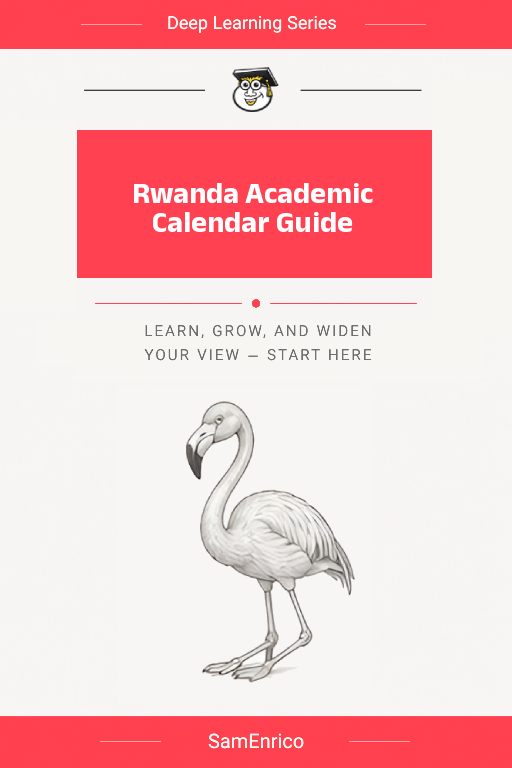
Non-FictionStudent's ShortcutAcademic Calendar
Rwanda Academic Calendar Guide eBook
Plans semester schedule in Rwanda including academ
by Dewey Dalia
Plans semester schedule in Rwanda including academic year (September-June), exam periods, and holiday breaks for international students.
Formats
Free sample
Chapter 1: The September Secret--–- You have probably already made your first mistake, and you do not even know it yet.If you are reading this book before arriving in Rwanda, that mistake is assuming the academic calendar works like the one in your home country. If you are reading it after arriving, that mistake has already cost you time, money, or both.Here is the truth that no university brochure will tell you: the Rwandan academic year begins in September, but not every student starts in September. The registration window closes on October 31, but some courses do not begin until November. The exam period is two weeks long, but the grading takes three times that. And the break you thought was a vacation is actually the most culturally complex period of the entire year.This chapter is called The September Secret because September is when everything begins, but almost nothing is what it seems.
By the time you finish these pages, you will understand not only the structure of the Rwandan academic year but also the strategic opportunities hidden inside that structure. You will learn why Rwanda aligned its calendar with its East African neighbors, how to exploit the gaps between semesters for internships and travel, and why the optional summer semester is either your greatest opportunity or your most expensive mistake.Let us start with the most important question.Why September?In most of the world, academic calendars follow national borders. The United States runs from August to May. The United Kingdom runs from September to April. Australia runs from February to November.
But Rwanda does something different. It aligns its calendar with the East African Community, a regional bloc that includes Kenya, Uganda, Tanzania, Burundi, and South Sudan.This alignment is not an accident. It is a deliberate policy decision made by the Rwandan Ministry of Education to facilitate student exchanges, credit transfers, and regional integration. If you are an international student from outside East Africa, this calendar offers you something that students in other countries do not have: the ability to seamlessly transfer credits across six countries without the bureaucratic nightmare of foreign qualification evaluations.Here is how it works. The East African Community has harmonized its academic calendars so that a student from the University of Nairobi can spend a semester at the University of Rwanda without losing a single credit.
The same applies to students from Uganda, Tanzania, Burundi, and South Sudan. For you, as an international student from outside the region, this means that your Rwandan credits are automatically recognized in five other countries. That is not true for most study abroad destinations.But the September start has another advantage, one that most international students overlook entirely. It creates what this book calls Calendar Arbitrage.Calendar Arbitrage: The Strategic Advantage No One Tells You About Calendar arbitrage is the practice of exploiting the gaps between different academic calendars to do things that students on a single calendar cannot do. Here is the most common example used by smart international students in Rwanda.Your Rwandan academic year ends in June.
Your exams finish in late May. That means you have June, July, and August completely free before the next academic year begins in September. A student at a European university, by contrast, finishes exams in July and starts again in September, leaving only August free. A student at an American university finishes in May but starts again in August, leaving June and July free.Here is what that means in practice. You can take a summer internship in London from June to August, return to Rwanda in September, and miss nothing.
A European student cannot do that because their internship would conflict with exams. An American student cannot do that because their internship would conflict with the start of their academic year. You can.The same principle applies to winter programs. The December break in Rwanda runs from December 20 to January 4. During those sixteen days, you could complete a short-term winter program at a university in the United States, where the January term often runs from January 2 to January 20.
You would attend the program, return to Rwanda, and start Semester II on time.This is not theoretical. This book has profiled international students who have completed two internships and one winter program during a single Rwandan academic year, giving them a resume advantage that students on traditional calendars cannot match.But there is a catch. Calendar arbitrage requires meticulous planning. You cannot book flights based on generic dates. You cannot assume that your university will follow the official calendar.
You need to know the exact dates, the variations by institution, and the hidden deadlines that can destroy your plans. That is what the rest of this chapter provides.The Standardized Rwandan Academic Timeline Throughout this book, all dates are based on the University of Rwanda's 2025-2026 academic calendar, which is representative of most Rwandan universities. However, as you will see in Chapter 3, your specific institution may differ. Always verify.Here is the standardized timeline that this book uses for all planning tools and templates:Semester I teaching weeks: September 15 – December 12 (12 weeks)Revision week: December 15 – December 19 (1 week)Semester I exams: December 20 – January 4 (2 weeks, note that this overlaps with the December break – see explanation below)December break: December 20 – January 4 (16 days)Semester II teaching weeks: January 12 – April 24 (12 weeks, with a one-week break for Easter in early April)Revision week: April 27 – May 1 (1 week)Semester II exams: May 4 – May 15 (2 weeks)Optional summer term: June 1 – July 24 (8 weeks, offered only at specific institutions – see Chapter 3)Year-end break: August 1 – September 14 (6 weeks)If you are looking at this timeline and feeling confused about the December overlap, you are not alone. This is the single most misunderstood feature of the Rwandan academic calendar.
Let me explain.The December Overlap: Exams and Break Happen at the Same Time In many countries, exams happen before the break. You take your finals, you go home, you relax. In Rwanda, exams and the December break happen simultaneously.Here is how it works. Semester I exams are scheduled for December 20 through January 4. That means you could have an exam on December 22, another on December 28, and another on January 3.
The break is not a break from exams. The break is a break from teaching. You are expected to study, travel, and celebrate the holidays all while preparing for and taking exams.This creates obvious problems for international students who book flights home for Christmas without checking their exam schedule. If your last exam is on January 3, you cannot fly home on December 22. You will fail that exam, and because of the 80 percent attendance rule described in Chapter 6, you may not be allowed to retake it until the following year.The solution is to book flexible flights or to plan your travel for after January 4.
Many international students choose to stay in Rwanda for the December break, take their exams, and then travel in early January before Semester II begins on January 12. This gives them a full week of travel from January 5 to January 11.If you must go home for the holidays, you have two options. First, request to take your exams early. Some professors will accommodate this if…
This is the end of the free sample. Get the eBook to keep going. Buy now
About this book
Details
- Author
- Dewey Dalia
- Publisher
- SamEnrico
- Language
- English
- Genre
- Non-Fiction, Student's Shortcut, Academic Calendar
- Released
- 2026-06-01
- Pages (approx.)
- 122
- Available as
- eBook, Audiobook

Read better in the ZLOADR app
Your eBooks on your phone or tablet. Sign in with your SamEnrico account and start reading.
More by Dewey Dalia
 The Gut Stress AxisDewey Dalia$11.99
 Assertiveness In Creative Fields CourseDewey Dalia$11.99
 ABCDE for Relocation PlanningDewey Dalia$11.99
 The Lifetime Emotion Regulation PlanDewey Dalia$11.99
 ABCDE For Therapy GoalsDewey Dalia$11.99
 Whispers from the Iron Curtain: The Secret Lives of Soviet Space DogsDewey Dalia$11.99
 Model AirplanesDewey Dalia$11.99
 Understanding Robin Sequence and OligodactylyDewey Dalia$17.99
 VAT for Construction GuideDewey Dalia$12.99
 How to Start a Drawing Ink Business (Beginners Guide)Dewey Dalia$11.99
You may also like
 Hong Kong Handover 1997Dunn Johnnie$11.99
 Zumba For Postnatal Recovery CourseNeal Christian$11.99
 Zumba for BeginnersLadner Nikia$11.99
 YouTube Comment Mining GuideHumes Pandora$12.99
 Worry Box MeditationCarlin Rudy$11.99
 Workplace Stress MeditationNguyen Lynn$11.99
 Workplace Stress and Sleep RepairHawley Ivory$11.99
 Workplace Perfectionism CureDelaney Jeffry$11.99
 Workplace Injustice Anger GuideWallen Isabelle$11.99
 Work Addiction and Burnout LinkGreenwood Ester$11.99
 Women in Yoga and WellnessBeattie Galina$11.99
 Women in Stand Up ComedyChun Evangeline$11.99