
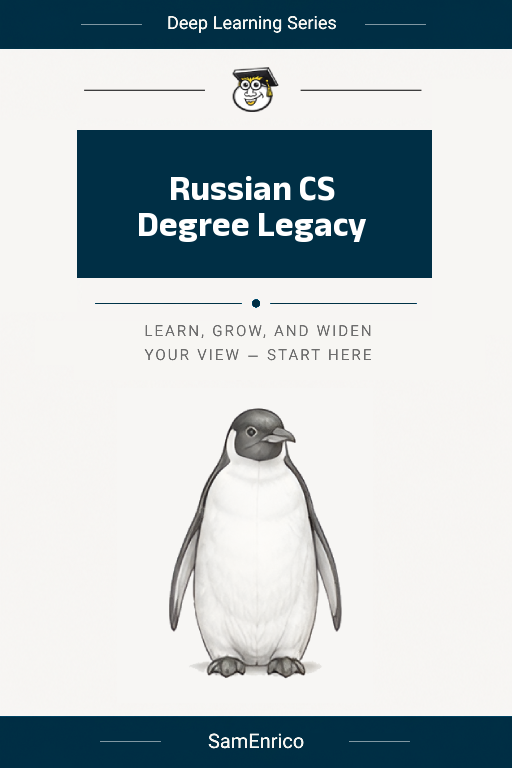
Non-FictionStudent's ShortcutEastern European Education
Russian CS Degree Legacy
Analyze why Russian and Eastern European employers
Analyze why Russian and Eastern European employers prize rigorous mathematical CS degrees over Western-style practical bootcamps.
Formats
About this book
Free sample
Chapter 1: The Sputnik Algorithm...--The story of modern software engineering begins not in a Silicon Valley garage, not in a Massachusetts Institute of Technology laboratory, and certainly not in a twelve-week coding bootcamp in San Francisco. It begins on October 4, 1957, with a beeping metal sphere the size of a beach ball, weighing barely 184 pounds, circling the Earth every ninety-eight minutes. Sputnik 1 did not contain a microprocessor. It did not run an operating system. It had no programming language, no framework, no dependencies.
But it carried something far more consequential for the future of computer science: a geopolitical panic that would reshape how half the world taught mathematics to its children.The Soviet Union had beaten the United States into space. The reaction in Washington was swift and terrified. President Eisenhower created the Advanced Research Projects Agency, which would later become DARPA. Congress passed the National Defense Education Act, pouring billions into science and math education. But while the Americans scrambled to catch up, something more profound was happening inside the USSR itself.
The Soviet leadership, upon reviewing the technological gap, made a strategic decision that would echo through the next seven decades of software engineering. They realized they could never win the hardware race. American semiconductors, American miniaturization, American manufacturing capacity – these were insurmountable advantages in an open competition. So they decided to win a different race entirely: the race of pure theory.This chapter traces the origins of the Soviet mathematical rigor that would eventually produce the world's most sought-after systems engineers. It is not a story of natural genius or mysterious Eastern European intellectual superiority.
It is a story of scarcity, strategy, and the brutal filtration of a talent pool through economic collapse. And it resolves the first major question that any Western reader brings to this topic: Was the Soviet system a secret engine of excellence, or did it simply survive by accident? The answer, as we shall see, is both – and neither.The Embargo That Shaped a Century To understand why Russian computer science education looks the way it does, you must first understand what Soviet…
This is the end of the free sample. Get the eBook to keep going. Buy now
Contents
- Chapter 1
- Chapter 2
- Chapter 3
- Chapter 4
- Chapter 5
- Chapter 6
- Chapter 7
- Chapter 8
- Chapter 9
- Chapter 10
- Chapter 11
- Chapter 12
Details
- Author
- Blackwood Deann
- Publisher
- SamEnrico
- Language
- English
- Genre
- Non-Fiction, Student's Shortcut, Eastern European Education
- Released
- 2026-06-01
- Pages (approx.)
- 159
- Available as
- eBook, Audiobook

Read better in the ZLOADR app
Your eBooks on your phone or tablet. Sign in with your SamEnrico account and start reading.
More by Blackwood Deann
 Personal Ing For Success Media FeaturesBlackwood Deann$11.99
 Co Parenting Through Anger ConflictsBlackwood Deann$11.99
 Intuitive Eating For ADHD Adults WorkbookBlackwood Deann$11.99
 Monthly Goal PrioritizationBlackwood Deann$11.99
 Placebo Effect Pain ManagementBlackwood Deann$11.99
 Whispers of the Wounded Knee: The Forgotten Songs of ResistanceBlackwood Deann$11.99
 Quantum Leap: The Race to Break Enigma’s CodeBlackwood Deann$11.99
 Understanding Bladder NeoplasmBlackwood Deann$17.99
 Amazon Ranking Optimization GuideBlackwood Deann$12.99
 Special Education SupervisorBlackwood Deann$11.99
 How to Start a Poultry Fat (edible) Rendering Business (Beginners Guide)Blackwood Deann$11.99
You may also like
 Hong Kong Handover 1997Dunn Johnnie$11.99
 Zumba For Postnatal Recovery CourseNeal Christian$11.99
 Zumba for BeginnersLadner Nikia$11.99
 YouTube Comment Mining GuideHumes Pandora$12.99
 Worry Box MeditationCarlin Rudy$11.99
 Workplace Stress MeditationNguyen Lynn$11.99
 Workplace Stress and Sleep RepairHawley Ivory$11.99
 Workplace Perfectionism CureDelaney Jeffry$11.99
 Workplace Injustice Anger GuideWallen Isabelle$11.99
 Work Addiction and Burnout LinkGreenwood Ester$11.99
 Women in Yoga and WellnessBeattie Galina$11.99
 Women in Stand Up ComedyChun Evangeline$11.99