
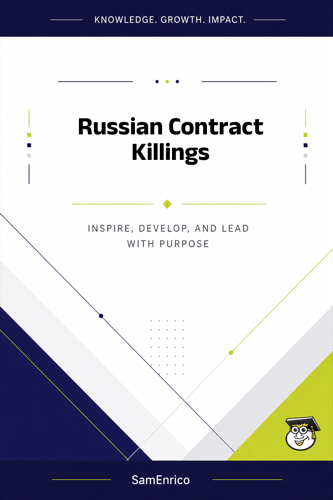
About this book
Free sample
Chapter 1: The Chekist's Shadow...--The man who would one day expose Russia's secret assassination machine began his career as a true believer. In 1988, a young Alexander Litvinenko walked through the doors of the KGB's administrative headquarters in Moscow, eager to serve his country. He was twenty-six years old, sharp, ambitious, and convinced that the security services represented the best of Soviet tradition—order, discipline, and protection of the homeland against enemies both foreign and domestic. He had no idea that sixteen years later he would be drinking poisoned tea in a London hotel bar, and that three weeks after that, his body would be buried in a lead-lined coffin, still too radioactive for open air.The story of Russian contract killings cannot be understood without first understanding the institution that created, refined, and eventually exported them: the Soviet security apparatus. This chapter establishes the historical and institutional foundations of state-sponsored political murder, tracing its lineage from the Bolshevik Revolution through the Cold War and into the Russia of Vladimir Putin.
It argues that the culture of violence, secrecy, and impunity cultivated by Soviet intelligence services did not vanish with the USSR's collapse in 1991. Rather, it was inherited, adapted, and intensified by the new Russian state. The methods changed. The targets changed. But the core belief—that the state has the right to eliminate its enemies by any means necessary—remained absolutely constant.To understand how a former KGB officer could become a whistleblower, then a target, then a martyr, we must first understand the shadow that the Cheka cast across the twentieth century.The Birth of State Murder On December 20, 1917, just weeks after seizing power in the October Revolution, Vladimir Lenin signed a decree establishing the All-Russian Extraordinary Commission for Combating Counter-Revolution and Sabotage.
It was known by its Russian acronym: the Cheka. Its first leader, Felix Dzerzhinsky, famously declared that the Cheka did not wage war against individuals but against "the entire infected class." This was not empty rhetoric. Within months, the Cheka had established a system of extrajudicial executions, mass arrests, and summary justice that would serve as…
This is the end of the free sample. Get the eBook to keep going. Buy now
Contents
- Chapter 1
- Chapter 2
- Chapter 3
- Chapter 4
- Chapter 5
- Chapter 6
- Chapter 7
- Chapter 8
- Chapter 9
- Chapter 10
- Chapter 11
- Chapter 12
Details
- Author
- Drew Esmeralda
- Publisher
- SamEnrico
- Language
- English
- Genre
- Non-Fiction, True Crime / Assassination
- Released
- 2026-06-07
- Pages (approx.)
- 137
- Available as
- eBook, Audiobook

Read better in the ZLOADR app
Your eBooks on your phone or tablet. Sign in with your SamEnrico account and start reading.
More by Drew Esmeralda
 The Foster Care Photo AlbumDrew Esmeralda$11.99
 Breaking Free From Opioid Dependency GuideDrew Esmeralda$11.99
 Atlantic Slave Trade SpainDrew Esmeralda$11.99
 Dishwasher Detergent ResidueDrew Esmeralda$11.99
 Local History PreservationistDrew Esmeralda$11.99
 Success Without Burnout for IT SupportDrew Esmeralda$11.99
 Remote Work Zoom FatigueDrew Esmeralda$11.99
 Whispers of the Silk Road: The Untold Journey of Zhang QianDrew Esmeralda$11.99
 The Unlikely Alliance: How a Computer Scientist and a Marine Biologist Saved the Great Barrier ReefDrew Esmeralda$11.99
 Service Providers Guide to PET BreedingDrew Esmeralda$11.99
 Last Mile Delivery Career GuideDrew Esmeralda$12.99
 Military Family EssaysDrew Esmeralda$12.99
You may also like
 Hong Kong Handover 1997Dunn Johnnie$11.99
 Zumba For Postnatal Recovery CourseNeal Christian$11.99
 Zumba for BeginnersLadner Nikia$11.99
 YouTube Comment Mining GuideHumes Pandora$12.99
 Worry Box MeditationCarlin Rudy$11.99
 Workplace Stress MeditationNguyen Lynn$11.99
 Workplace Stress and Sleep RepairHawley Ivory$11.99
 Workplace Perfectionism CureDelaney Jeffry$11.99
 Workplace Injustice Anger GuideWallen Isabelle$11.99
 Work Addiction and Burnout LinkGreenwood Ester$11.99
 Women in Yoga and WellnessBeattie Galina$11.99
 Women in Stand Up ComedyChun Evangeline$11.99