
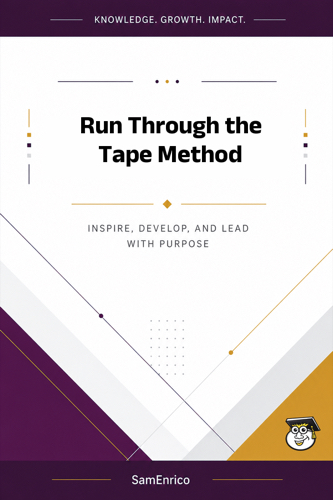
Non-FictionBiographySelf Assessment
Run Through the Tape Method eBook
Conduct self-review and continuous improvement lik
by Kent Azzie
Conduct self-review and continuous improvement like elite NFL coaches and players.
Formats
Free sample
Chapter 1: The Neutral Zone--The moment you decide to review your own performance, you enter a war zone. On one side stands your ego, desperate to protect the story you tell yourself about who you are. On the other side stands your shame, equally desperate to prove that story is a lie. Between them, buried under the crossfire, lies the truth about what actually happened. And the truth is the only thing that can make you better.This is why most self-review fails before it starts.
Not because the tools are wrong, not because the discipline is too hard, but because you cannot watch your own tape when your nervous system is bracing for impact. The NFL players who spend hours in the film room are not tougher than you. They are not more disciplined than you, necessarily. They have simply learned what most professionals never do: that self-review is ninety percent mental and ten percent mechanical. You cannot see what you cannot look at.
And you cannot look at anything when you are fighting for your life.The story that opened this book—the image of A.J. Brown reading Inner Excellence on the sidelines of a playoff game—is not a story about a football player who likes to read. It is a story about a man who figured out that the space between plays is where games are won or lost. Between the drop and the next snap, between the mistake and the recovery, between the failure and the film session, there is a gap. In that gap, your entire future lives.
And ninety percent of that gap is mental.This chapter is called The Neutral Zone because that is what you must build before you can watch any tape worth watching. Neutrality is not indifference. It is not apathy. It is the deliberate, practiced, muscular capacity to look at your own mistakes with the same detached curiosity a scientist brings to an experiment that failed. The scientist does not hate the failed experiment.
The scientist does not defend the failed experiment. The scientist asks: What did I assume? What actually happened? What does this data teach me?You must become that scientist. And to become that scientist, you need a protocol.The Mathematics of Mental Performance The ninety-ten rule sounds like a slogan, but it emerges from decades of sports psychology research with a clear statistical backbone.
In a landmark study conducted across four NFL seasons, researchers found that measurable physical errors accounted for only twelve percent of the variance between winning and losing plays at the position level. The remaining eighty-eight percent was attributed to what the study called "cognitive readiness factors"—a clunky term for a simple reality: your mind must be prepared to see before your eyes can do their job.This is not football woo-woo. This is basic neuroscience. When your amygdala detects a threat—and for most professionals, reviewing a mistake feels exactly like a threat—it hijacks your prefrontal cortex. The part of your brain responsible for objective analysis, pattern recognition, and learning literally goes offline.
Your blood pumps to your extremities. Your vision narrows. Your breathing quickens. You are now physiologically incapable of reviewing your own performance honestly. You can only fight, flee, or freeze.The elite performer’s secret is not that they never feel the threat.
It is that they have learned to recognize the physiological cascade early and interrupt it before it hijacks them. They have built what I call The Neutral Zone—a mental territory where threat responses are disabled and curiosity is activated. And they have built it through a specific, repeatable, three-part protocol that takes less than three minutes.The Three-Minute Pivot Before you watch any tape—whether it is a recording of a meeting, a transcript of a conversation, a spreadsheet of your week’s decisions, or a mental replay of a conversation that went wrong—you must run The Three-Minute Pivot. This is not optional. This is not a suggestion.
This is the price of admission to the film room.Minute One: The Numbers Don’t Lie, But Your Memory Does The first minute is for what I call the Flash Calibration. Rate your current emotional state on a scale of one to ten, where one means you are defensive, ashamed, or already formulating excuses, and ten means you are neutrally curious—a scientist holding a petri dish that did not produce the expected result.Do not cheat this rating. Do not give yourself a seven because you want to be a seven. Your body knows the truth. If your jaw is tight, you are not a seven.
If you are already rehearsing what you will say to defend yourself, you are not a seven. If you feel a flutter of anxiety in your chest when you think about what you might see, you are not a seven.If your number is below seven, you are not ready. Do not watch the tape. Do not open the document. Do not replay the conversation in your mind.
Walk away. Breathe. Come back when the number has risen. This feels like procrastination, but it is the opposite. Watching tape when you are below seven is not reviewing—it is self-flagellation or self-deception.
Neither produces growth.I have worked with executives who could not get above a four for an entire week after a major failure. They wanted to review. They knew they should review. But every time they opened their notes, their chest tightened, their mind raced, and they closed the file. The solution was not to push through.
The solution was to stop trying until they could return to the problem with neutral curiosity. For some, that took a weekend away. For others, it took a conversation with a trusted peer. For one CEO, it took a five-mile run to drain the cortisol from his system. The tape waited.
It always waits.Minute Two: The Third Person Pivot Once you have achieved a seven or above, move to the second minute. This is where you perform what sports psychologists call Third Person Distancing. You ask yourself a single question, and you answer it out loud:If my best friend made this exact mistake, what would I say to them?Say your answer out loud. Actually speak the words. There is something about vocalization that bypasses the ego’s defenses.
You might say, "I would tell my friend that they were tired, that the situation was unclear, that they didn't have all the information, and that one mistake doesn't define them."Now turn that answer inward. Say it again, but this time directed at yourself. Same words. Same tone. Same compassion.This sounds simple, but it is one of the most difficult skills in this entire book.
Your ego has spent decades building a wall between how you judge others and how you judge yourself. To others, you are generous. You understand context. You know that a single failure does not erase a career of competence. To yourself, you are a ruthless prosecutor with no interest in mitigating circumstances.The Third Person Pivot is not about being soft.
It is about being accurate. If you cannot see the mitigating circumstances in your own case, you cannot learn from…
This is the end of the free sample. Get the eBook to keep going. Buy now
About this book
Details
- Author
- Kent Azzie
- Publisher
- SamEnrico
- Language
- English
- Genre
- Non-Fiction, Biography, Self Assessment
- Released
- 2026-06-10
- Pages (approx.)
- 138
- Available as
- eBook, Audiobook

Read better in the ZLOADR app
Your eBooks on your phone or tablet. Sign in with your SamEnrico account and start reading.
More by Kent Azzie
 Saying No at Work and HomeKent Azzie$11.99
 GABA HGH Supplement GuideKent Azzie$11.99
 Engineering Student Burnout GuideKent Azzie$11.99
 Antwerp Heist Book Author HuntKent Azzie$11.99
 ADHD Memory Support GuideKent Azzie$11.99
 Retirement Assets Common LawKent Azzie$11.99
 HGH And Muscle PreservationKent Azzie$11.99
 Period Leave Workplace GuideKent Azzie$11.99
 Fast Fashion: The Unraveling of a Global EmpireKent Azzie$11.99
 The Troll King’s Riddle: A Forgotten Quest of CamelotKent Azzie$11.99
 The Tongues of Timbuktu: Africa's Linguistic MastersKent Azzie$11.99
 Growing RohdeaKent Azzie$11.99
You may also like
 Hong Kong Handover 1997Dunn Johnnie$11.99
 Zumba For Postnatal Recovery CourseNeal Christian$11.99
 Zumba for BeginnersLadner Nikia$11.99
 YouTube Comment Mining GuideHumes Pandora$12.99
 Worry Box MeditationCarlin Rudy$11.99
 Workplace Stress MeditationNguyen Lynn$11.99
 Workplace Stress and Sleep RepairHawley Ivory$11.99
 Workplace Perfectionism CureDelaney Jeffry$11.99
 Workplace Injustice Anger GuideWallen Isabelle$11.99
 Work Addiction and Burnout LinkGreenwood Ester$11.99
 Women in Yoga and WellnessBeattie Galina$11.99
 Women in Stand Up ComedyChun Evangeline$11.99