
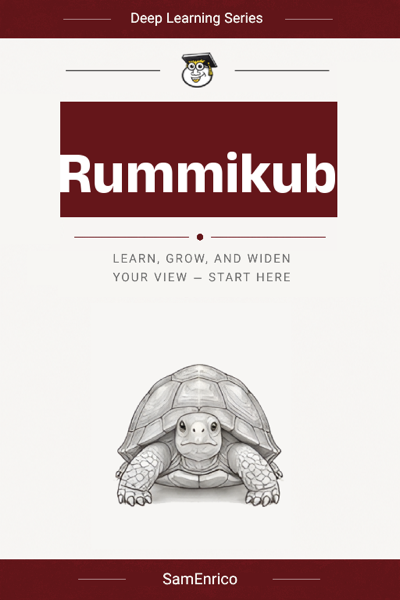
Non-FictionInformativeEducational
Rummikub eBook
A Coursebook on Rummikub
by Osburn Vince
A Coursebook on Rummikub
Formats
Free sample
Chapter 1: The Tile That Changed Everything...--–- The first time I watched my grandmother destroy my uncle at Rummikub, I thought she had cheated. She was seventy-three years old, wearing slippers, and drinking tea from a chipped mug. He was a regional chess champion in his thirties. She beat him in eleven minutes. Then she looked at me over her reading glasses and said, “The tiles don't care about your feelings.”–- That was the moment I realized Rummikub was not the gentle family pastime I had assumed.
It was a battlefield of logic, psychology, and hidden math disguised as a game for grandparents and cruise ship passengers. The tiles are innocent enough—small, colorful, satisfying to click together. But beneath that friendly exterior lies something closer to fencing than bingo. Every turn is a decision. Every discard is a confession.
Every Joker is a loaded weapon.–- This book exists because I spent the next decade learning what my grandmother already knew: that Rummikub, properly understood, is one of the most underrated strategy games ever invented. It outsells Scrabble in many countries. It has world championships. It has a mathematical depth that university game theory classes have used for case studies. And yet, most players learn from a folded paper rule sheet that explains nothing beyond basic mechanics.–- This chapter will change that.
We will explore where Rummikub came from, why it works the way it does, and most importantly, why the strategic trade-off between speed and points defines everything that follows in this book. By the time you finish these pages, you will never look at a rack of tiles the same way again.The Immigrant Who Invented a Global Obsession–- The story of Rummikub begins not in a board game studio or a corporate testing lab, but in the chaotic aftermath of World War II. Ephraim Hertzano was a Romanian immigrant who had settled in British Mandate Palestine—what would later become Israel. He was not a game designer by trade. He was a candy and cosmetics salesman.
But like many immigrants of his era, he understood something profound about entertainment: the best games are the ones that cost nothing to play once you own the equipment.–- In the 1940s, card games dominated home entertainment. But playing cards had a problem. They wore out. They bent. They got marked.
Children spilled drinks on them. Families playing gin rummy or canasta went through decks the way smokers go through matches. Hertzano saw an opportunity. What if a game could have the melding mechanics of rummy—the runs and sets that made the game endlessly replayable—but with the durability of mahjong tiles?–- He began hand-painting wooden tiles in his small apartment. The first sets were crude by modern standards.
The colors were hand-mixed. The numbers were painted with brushes that left inconsistent strokes. But the gameplay was solid. Hertzano tested the game with friends and family, refined the rules, and eventually started selling sets door-to-door. He did not have a marketing budget.
He had a suitcase full of tiles and a belief that good games spread by word of mouth.–- They did. By the 1950s, Rummikub—originally called "Rummikub" as a portmanteau of "rummy" and "cube"—had become a staple in Israeli homes. Tournaments emerged. Local champions were celebrated. The game crossed borders into Europe, then North America, then Asia.
Today, over fifty million sets have been sold worldwide. It is translated into more than twenty languages. There is a Rummikub World Championship held every three years, drawing competitors from thirty countries.–- But here is what most players do not know: the game they play at home is often not the game Hertzano invented. Over decades, house rules proliferated. The Joker, originally a simple wild card, became a source of endless argument.
The time limit, originally nonexistent, became a tournament standard. The initial meld requirement of thirty points—one of the most misunderstood rules in all of board gaming—has been ignored, modified, or outright deleted by millions of casual players.–- This book follows the official Wintogs Ltd. tournament rules, which are the closest we have to Hertzano's original vision. But we also respect the way families actually play. Throughout these chapters, you will find sidebars explaining common house rule variations and when it makes sense to adopt them.
The goal is not to tell you that your family's way of playing is wrong. The goal is to give you the tools to play better, regardless of which rules you choose.Rummikub's Secret DNA: Rummy Meets Mahjong–- To understand Rummikub, you must first understand its two parents: gin rummy and mahjong. The game is a hybrid, and like many hybrids, it inherits the strengths and weaknesses of both lineages.–- From gin rummy, Rummikub borrows the concept of melds. In card rummy, a meld is either a set (three or four cards of the same rank) or a run (three or more consecutive cards of the same suit). Rummikub uses identical meld structures, except that colors replace suits.
A set in Rummikub is three or four tiles of the same number, each in a different color. A run is three or more consecutive numbers of the same color. If you already know how to play gin rummy, you already understand eighty percent of Rummikub's basic mechanics.–- But here is where the two games diverge sharply. In gin rummy, once you lay down a meld, it stays exactly as you played it. You cannot rearrange the table.
You cannot steal cards from other players' melds. The game is linear: you build your hand, you go out, the round ends. Rummikub, by contrast, allows something revolutionary: table manipulation.–- This is where mahjong enters the picture. In mahjong, the tiles on the table are fluid. Players can rearrange exposed sets, take tiles from one meld to complete another, and generally treat the table as a shared resource rather than a collection of individual accomplishments.
Rummikub borrows this philosophy wholesale. The rule—which we will explore in depth in Chapter 7—is that you may break any existing meld on the table as long as you use every tile from that meld in new, valid configurations. You cannot leave orphans. But you can completely reorganize the entire board if your calculations hold.–- This hybrid nature creates a game that is simultaneously familiar and strange. New players often assume Rummikub is just rummy with tiles.
They play their first few rounds, lay down their initial thirty points, and feel comfortable. Then someone performs a manipulation that rearranges half the table in a single turn, and their jaw drops. That moment—the first time you witness a true manipulation—is when you realize you have been playing a different game than the experts.The Great Debate: Speed Versus Points–- Every Rummikub player eventually confronts a fundamental strategic question: should I try to go out quickly with a small score, or should I wait to go out with a larger score? The answer, as with most strategic questions, depends on context. But the framework for answering it must be established now, because it underlies every tactical decision…
This is the end of the free sample. Get the eBook to keep going. Buy now
About this book
Details
- Author
- Osburn Vince
- Publisher
- SamEnrico
- Language
- English
- Genre
- Non-Fiction, Informative, Educational
- Released
- 2026-06-02
- Pages (approx.)
- 116
- Available as
- eBook, Audiobook

Read better in the ZLOADR app
Your eBooks on your phone or tablet. Sign in with your SamEnrico account and start reading.
More by Osburn Vince
 Pattern Recognition for AuditorsOsburn Vince$11.99
 Vatican Religious Art DealerOsburn Vince$11.99
 Middle Manager Burnout RescueOsburn Vince$11.99
 Shania Twain Come On OverOsburn Vince$11.99
 The LLC Bank Account Setup GuideOsburn Vince$11.99
 The Imperial Crown of Charlemagne: Forge of a European LegacyOsburn Vince$11.99
 How to Become a Light-bulb AssemblerOsburn Vince$11.99
 Shea Butter Buyer EuropeOsburn Vince$12.99
 Waseda University Scholarship GuideOsburn Vince$12.99
 Understanding Seres–santamaria–arimany–muniz SyndromeOsburn Vince$17.99
You may also like
 Hong Kong Handover 1997Dunn Johnnie$11.99
 Zumba For Postnatal Recovery CourseNeal Christian$11.99
 Zumba for BeginnersLadner Nikia$11.99
 YouTube Comment Mining GuideHumes Pandora$12.99
 Worry Box MeditationCarlin Rudy$11.99
 Workplace Stress MeditationNguyen Lynn$11.99
 Workplace Stress and Sleep RepairHawley Ivory$11.99
 Workplace Perfectionism CureDelaney Jeffry$11.99
 Workplace Injustice Anger GuideWallen Isabelle$11.99
 Work Addiction and Burnout LinkGreenwood Ester$11.99
 Women in Yoga and WellnessBeattie Galina$11.99
 Women in Stand Up ComedyChun Evangeline$11.99