
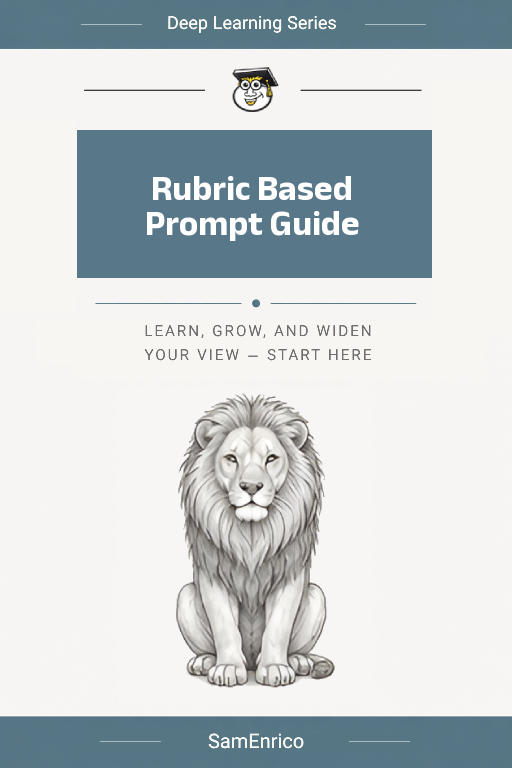
Rubric Based Prompt Guide Audiobook
Generate essays that match specific grading criter
Generate essays that match specific grading criteria using GPT prompts that incorporate your instructor's rubric categories and weightings.
Formats
Free sample
Chapter 1: The Hidden Map...--–- Every student knows the feeling. You stare at the grade at the top of the page—a C+, or worse, a B- when you were certain you had earned an A. The professor’s feedback is vague: “Needs deeper analysis” or “Argument could be stronger.” You read your essay again. It feels smart. It feels complete.
So what went wrong?The answer, counterintuitively, is that you wrote the essay too well. You wrote it the way you thought essays were supposed to be written: with passion, with eloquence, with a voice that sounded like you. And that is precisely why you missed the target. Because in almost every graded writing assignment in college, your professor is not actually looking for brilliance. They are looking for compliance—not compliance with arbitrary rules, but compliance with a specific, often invisible, set of criteria that they have already written down.That document is called a rubric.
And most students never use it the right way.The Illusion of the "Good Essay"Most students carry a mental model of what constitutes a good essay that they developed in high school. This model includes things like: a clear introduction with a thesis, three body paragraphs, a conclusion that restates the thesis, proper grammar, and maybe a few quotations from sources. This model is not wrong, but it is dangerously incomplete.College professors operate with a much more precise instrument. They are not asking themselves, “Is this essay good?” They are asking, “Does this essay meet the specific criteria I defined in my rubric?” And those criteria vary dramatically from professor to professor, from discipline to discipline, and even from assignment to assignment.Consider two different rubrics for history papers. Professor A values primary source analysis above all else: 40% of the grade comes from how well you interpret original documents.
Professor B values historiography: 40% comes from how well you engage with other scholars’ arguments. A single essay that would earn an A from Professor A might earn a C from Professor B, even though the writing quality is identical. The difference is not the essay. The difference is the rubric.This is the hidden truth that the traditional “write first, grade later” workflow ignores. Students spend hours crafting what they believe is a good essay, submit it, and then discover—too late—that what they wrote does not match what the professor…
This is the end of the free sample. Get the Audiobook to keep going. Buy now
About this book
Details
- Author
- Thorne Hannelore
- Publisher
- SamEnrico
- Language
- English
- Genre
- Non-Fiction, Student's Shortcut
- Released
- 2026-05-30
- Pages (approx.)
- 143
- Available as
- eBook, Audiobook

Listen in the VoxFlicks app
Audiobooks and audio dramas wherever you go. Sign in with your SamEnrico account and press play.
More by Thorne Hannelore
 Managing Open Door Policy HandbookThorne Hannelore$11.99
 Female CEOs Corporate RiseThorne Hannelore$11.99
 Delegation for ADHDThorne Hannelore$11.99
 Saving And Debt AttitudesThorne Hannelore$11.99
 Meditation Habit GuideThorne Hannelore$11.99
 Serial Killer Psychopathy PatternsThorne Hannelore$11.99
 Step Four Moral InventoryThorne Hannelore$11.99
 Mindset For Lifelong LearningThorne Hannelore$11.99
 The Shadow Triads: Hong Kong's Underworld War of 1925Thorne Hannelore$11.99
 The Ghost of Fort Jesus: The Witchcraft and Espionage Trial of Mombasa (1875)Thorne Hannelore$11.99
 A Collector's Handbook to the Chevrolet Ad UniversalThorne Hannelore$11.99
 Bootcamp Specialization Depth GuideThorne Hannelore$12.99
You may also like
 Hong Kong Handover 1997Dunn Johnnie$11.99
 Zumba For Postnatal Recovery CourseNeal Christian$11.99
 Zumba for BeginnersLadner Nikia$11.99
 YouTube Comment Mining GuideHumes Pandora$12.99
 Worry Box MeditationCarlin Rudy$11.99
 Workplace Stress MeditationNguyen Lynn$11.99
 Workplace Stress and Sleep RepairHawley Ivory$11.99
 Workplace Perfectionism CureDelaney Jeffry$11.99
 Workplace Injustice Anger GuideWallen Isabelle$11.99
 Work Addiction and Burnout LinkGreenwood Ester$11.99
 Women in Yoga and WellnessBeattie Galina$11.99
 Women in Stand Up ComedyChun Evangeline$11.99