
Non-FictionStudent's ShortcutGrading PrepQuality Assurance
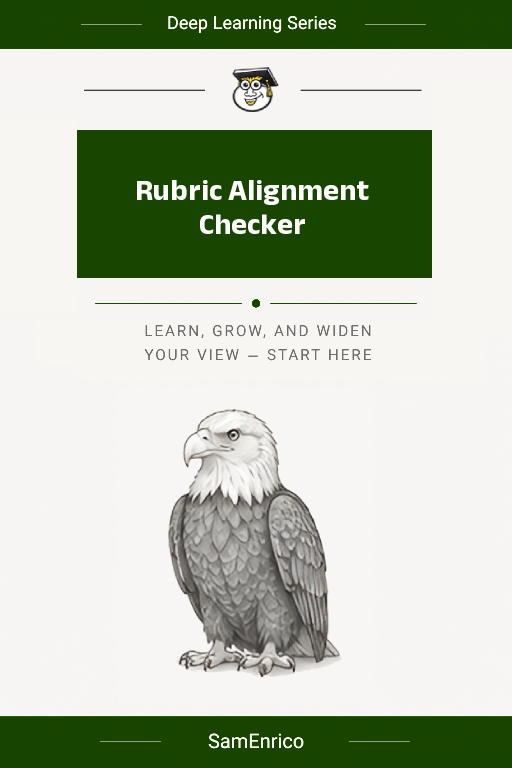
Rubric Alignment Checker eBook
Feed GPT your assignment rubric and draft to recei
Feed GPT your assignment rubric and draft to receive a scored breakdown and specific fixes before final submission.
Formats
Free sample
Chapter 1: The Hidden Contract--Every semester, thousands of students pour hundreds of hours into writing assignments they believe are excellent. They craft beautiful sentences. They weave in sophisticated vocabulary. They stay up until 3 AM perfecting transitions. And then they get the grade back: a C+.
Sometimes a D. Occasionally, a failing mark on a paper they thought was their best work.The professor’s comment reads: “Does not fully address the prompt.” Or “Lacks critical analysis.” Or, most painfully, “See rubric.”The student is devastated. Confused. Angry. They read the paper again.
It says exactly what they meant to say. It’s well-written. It’s thoughtful. So what happened?Here is the brutal truth that most students learn too late, often after years of frustration and grade point average damage: You did not fail because you wrote poorly. You failed because you wrote off-target.This distinction is everything.
A beautifully written paper that answers the wrong question is still a failing paper. A grammatically flawless essay that ignores half the rubric criteria is still a C-. A passionate argument that never cites the required number of sources is still incomplete. The professor is not grading your intelligence, your effort, or your creativity. The professor is grading your alignment with a document you probably glanced at for thirty seconds before starting to write.That document is the rubric.
And if you are not treating it as the answer key to your grade, you are leaving points on the table every single time you submit.This chapter introduces a concept that will transform how you approach every assignment from this moment forward: The Hidden Contract.The Contract You Didn’t Know You Signed Every time a professor hands out a rubric, they are doing something most students misunderstand. They are not providing “guidelines” or “suggestions” or “helpful tips.” They are providing a contract. The terms are simple, even if they are never stated aloud:If the student delivers exactly what the rubric defines as “Exceeds Expectations” in every row, the professor must award the corresponding grade.Think about what this means. A rubric is not a suggestion box. It is not a set of vague aspirations.
It is a legally binding (in the academic sense) agreement between you and the person holding the red pen. When you deliver what the rubric asks for, the professor is contractually obligated—by the logic of their own grading system, by the norms of their department, and by the expectations of their course evaluations—to give you the points.Most students never realize they have signed this contract. They treat the rubric as a formality, something to glance at before starting and then ignore until the grade comes back. They write what they want to say, not what the rubric demands they say. And then they are shocked when the professor enforces the terms of the agreement.Let me give you a concrete example.
A student receives a rubric for a history paper. The rubric has four rows: Thesis Statement (30%), Use of Primary Sources (30%), Organization (20%), and Grammar (20%). The “Exceeds Expectations” column for Thesis Statement says: “Presents a clear, arguable thesis that addresses the prompt’s comparative element and acknowledges a counterargument.”The student writes a thesis that is clear and arguable. It’s a good thesis. But it does not address the prompt’s comparative element.
It does not acknowledge a counterargument. The student thinks, “My thesis is strong. Surely the professor will see that.”The professor sees the rubric. The professor checks the box for “Proficient” (maybe 20 out of 30 points) instead of “Exceeds” (30 out of 30). Ten points lost.
The student never knew they were playing a game with rules they hadn’t read.This is the Hidden Contract. And once you see it, you cannot unsee it.The Scan Test: How Professors Actually Read Your Paper Here is something no professor will tell you, but every professor knows is true: They do not read your paper the way you read your paper.When you read your own work, you read every word. You savor your clever phrasing. You appreciate the logic of your transitions. You read slowly, generously, filling in gaps with your own intention.Professors do not have time for this.
A typical professor teaching a large lecture course of 200 students might have 400 pages of student writing to grade in a single week. That is eighty pages per day on top of teaching, research, meetings, and email. They are exhausted. They are behind. They are looking for reasons to move on to the next paper.So they do not read.
They scan.The Scan Test is simple: a professor scans your paper for evidence that matches the rubric. They are not reading for beauty. They are reading for verification. Does this paragraph contain a thesis statement? Highlight.
Does this sentence cite a source? Check. Is there a counterargument somewhere in the third page? Skim. Found it.
Move on.If a professor has to hunt for your thesis statement, you lose points. If they cannot find the required number of sources in the first two pages, you lose points. If they have to infer your argument rather than reading it explicitly stated, you lose points.This is not because professors are lazy or unfair. It is because the rubric is the grading instrument, and the professor is simply applying it. If the evidence is not where the rubric says it should be, the professor cannot give you credit for evidence they did not see.The Scan Test has profound implications for how you write.
You are no longer writing for a patient, generous reader who will “get” your subtle brilliance. You are writing for a tired, time-pressed scanner who is holding a checklist. Your job is to make the checklist easy to complete.Every sentence should answer the question: “Does this sentence help the professor check a box on the rubric?” If the answer is no, delete the sentence. If the answer is “maybe” or “eventually” or “if they read carefully,” rewrite the sentence.Holistic vs. Analytic Rubrics: Knowing Your Enemy Not all rubrics are the same.
Understanding the type of rubric you are facing changes how you approach the Hidden Contract.Holistic rubrics present a single set of criteria and produce a single overall score. They are more common in creative writing, portfolio reviews, and assignments where the “whole” is greater than the sum of its parts. A holistic rubric might say:Exceeds Expectations (90-100): Writing is sophisticated, engaging, and demonstrates original thinking. Few mechanical errors.Proficient (80-89): Writing is clear and competent but lacks originality or flair. Some mechanical errors.Developing (70-79): Writing is unclear or underdeveloped in multiple areas.
Frequent mechanical errors.Beginning (below 70): Writing fails to address the prompt or is incomprehensible.Holistic rubrics are dangerous because they are vague. What does “sophisticated” mean? What counts as “original thinking”? Different professors have different interpretations. The Hidden Contract is harder to execute when the terms are fuzzy.Analytic rubrics are your friend.
They break the assignment into multiple rows of specific criteria, each with its own point value. An analytic rubric might look like:Criterion Exceeds (30)Proficient (24)Developing (18)Beginning (12)Thesis Statement Arguable, specific, addresses…
This is the end of the free sample. Get the eBook to keep going. Buy now
About this book
Details
- Author
- Ramos Christopher
- Publisher
- SamEnrico
- Language
- English
- Genre
- Non-Fiction, Student's Shortcut, Grading Prep, Quality Assurance
- Released
- 2026-05-30
- Pages (approx.)
- 143
- Available as
- eBook, Audiobook

Read better in the ZLOADR app
Your eBooks on your phone or tablet. Sign in with your SamEnrico account and start reading.
More by Ramos Christopher
 Dream Journal for TeensRamos Christopher$11.99
 Bipolar And PsychedelicsRamos Christopher$11.99
 The Stress Proof Friendship GuideRamos Christopher$11.99
 Listening In Maritime GuideRamos Christopher$11.99
 Exam Prep Breath TechniqueRamos Christopher$11.99
 Gratitude for Mistakes MadeRamos Christopher$11.99
 Blue Zones Longevity SecretsRamos Christopher$11.99
 Psychological Resilience TrainingRamos Christopher$11.99
 Power Nap Energy Boost GuideRamos Christopher$11.99
 The Last Stand: How Walmart Outmaneuvered the Retail GiantsRamos Christopher$11.99
 The Flowering Sword: Love and Loyalty at the Battle of SagyedongRamos Christopher$11.99
 Steam and Steel: The Titans Who Built the Modern WorldRamos Christopher$11.99
You may also like
 Hong Kong Handover 1997Dunn Johnnie$11.99
 Zumba For Postnatal Recovery CourseNeal Christian$11.99
 Zumba for BeginnersLadner Nikia$11.99
 YouTube Comment Mining GuideHumes Pandora$12.99
 Worry Box MeditationCarlin Rudy$11.99
 Workplace Stress MeditationNguyen Lynn$11.99
 Workplace Stress and Sleep RepairHawley Ivory$11.99
 Workplace Perfectionism CureDelaney Jeffry$11.99
 Workplace Injustice Anger GuideWallen Isabelle$11.99
 Work Addiction and Burnout LinkGreenwood Ester$11.99
 Women in Yoga and WellnessBeattie Galina$11.99
 Women in Stand Up ComedyChun Evangeline$11.99