
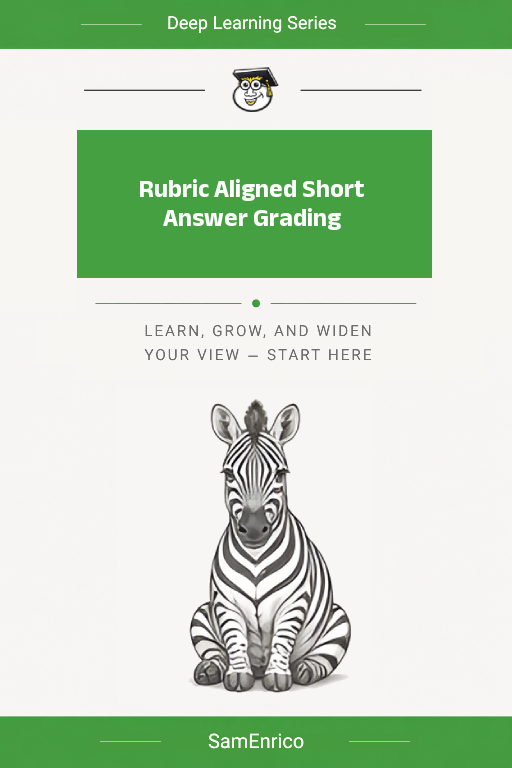
Non-FictionAI OperatorAssessment Automation
Rubric Aligned Short Answer Grading eBook
Upload your scoring rubric and let AI evaluate wri
Upload your scoring rubric and let AI evaluate written responses, providing consistent feedback and partial credit for each criterion in seconds.
Formats
Free sample
Chapter 1: The Grading Ceiling--–- It is 11:47 PM on a Sunday, and Sarah Chen, a 14-year veteran of the high school history classroom, has just finished her 67th short answer response of the evening. The prompt was simple: “Identify three causes of the Great Depression and explain how each contributed to economic collapse.” The rubric sits beside her laptop, coffee-stained and worn, with six criteria and point values ranging from 0 to 4. She reads a response from a student named Marcus: “The stock market crash made everyone poor. Also banks failed. And there was a drought called the Dust Bowl.” Sarah squints.
She knows Marcus attended the review session and participated in class discussions. The answer is not wrong, but it is thin. No mechanism of causation. No explanation of how bank failures led to a contraction of credit. According to the rubric, “Explanation” is worth 3 points.
She gives Marcus a 2. Or maybe a 1.5? She adds a question mark in the margin and moves to the next paper.Twenty minutes later, she encounters an almost identical answer from a student named Jessica. This time, Sarah is tired. Her eyes are dry.
She gives Jessica a 1 without the same deliberation. The two answers were different in name only, but they received different scores. Sarah closes her laptop, rubs her temples, and whispers something she has said a hundred times before: “There has to be a better way.”She is right. There is a better way. But before we can understand the solution—AI-aligned rubric grading—we must first understand the full, unvarnished anatomy of the problem.
This chapter is not about technology. It is about the hard biological and psychological limits of the human grader. It is about why short answer responses, specifically, break even the most dedicated teachers. And it is about the single most important realization that transforms how we think about grading: the problem is not you. The problem is the ceiling.The Unspoken Contract of Fairness Every teacher enters the profession with an implicit contract with their students: I will evaluate your work fairly, consistently, and thoughtfully.
You will receive the same standards as the student in the next row, the next period, and the next semester. This is the bedrock of educational ethics. Grades are not merely numbers; they are messages about learning, feedback about growth, and in many cases, gateways to opportunities like college admission, scholarships, and academic tracks.But here is the truth that grading training rarely acknowledges: the human brain is not built for consistency at scale.When we grade a single essay, we can be fair. When we grade ten, we begin to drift. When we grade fifty or one hundred short answer responses, the brain’s inherent limitations—fatigue, attentional blink, anchoring, contrast effects, and the decay of working memory—conspire against our best intentions.
The result is what I call the Grading Ceiling: the maximum number of responses a teacher can grade with full consistency and fairness before cognitive decline inevitably degrades judgment.For short answer responses, that ceiling is shockingly low. Research in educational psychology suggests that after approximately 30–40 short answer responses, grader reliability drops by as much as 25–30 percent. This is not speculation. It is replicated data from studies on rater fatigue in constructed-response assessments. And yet, the average secondary school teacher grades well over 150 short answer responses per week.The math is unforgiving.
The ceiling is not a wall we hit once; we hit it every single grading session, often within the first hour. Everything after that is a compromise between our ethical commitment to fairness and our biological reality as human beings.Why Short Answers Are Different from Essays It is worth pausing to ask: why short answers? Why not essays, or multiple choice, or projects? The answer reveals why this problem has been hiding in plain sight.Multiple choice questions are objective. There is a correct answer.
A machine can score them instantly, and while humans may tire, the answer key does not change. Essays, on the other hand, are complex enough that we expect some subjectivity. Two English teachers may reasonably give a five-paragraph essay different scores, and we accept that range as the cost of authentic assessment. Rubrics for essays are often holistic or contain enough ambiguity that professional judgment is celebrated, not problematized.Short answers occupy a brutal middle ground. They are long enough to contain multiple claims, evidence, and reasoning—often three to five sentences—but short enough that teachers expect consistency.
A short answer feels like it should have a single correct interpretation. Unlike an essay, where we forgive variance, a short answer feels binary: right or wrong, partial or complete. But it is not binary. It asks for partial credit, for nuance, for the difference between a student who almost understands and a student who fully understands.This is the Partial Credit Trap. The teacher must hold in working memory: the prompt, the rubric criteria (often 4–6 of them), the point values for each, the exemplars of partial mastery, and the student’s response.
Then, in a matter of seconds, the teacher must integrate all of this into a single score. This is not grading. This is cognitive triage.And the trap snaps shut when we realize that the same short answer, read at the beginning of a grading session versus the end, will receive different scores not because the answer changed, but because the grader changed.The Cognitive Science of Rubric Fatigue Let us go beneath the surface. Cognitive science offers a precise vocabulary for what happens during a grading session, and that vocabulary names the enemy.Attention is a limited resource. The brain does not have an infinite pool of focus.
Each short answer requires what psychologists call directed attention—the effortful, top-down concentration needed to compare a student’s response against a mental model of the rubric. Directed attention depletes over time, much like a muscle fatigues with repeated lifting. After 45 minutes of sustained grading, your ability to maintain the rubric in working memory drops by nearly half. You are not getting lazier; you are getting cognitively exhausted.Working memory has a narrow bandwidth. The average adult can hold approximately four to seven discrete items in working memory simultaneously.
A typical analytic rubric has four to six criteria. The prompt has one or two key demands. The student’s response contains multiple clauses. You are already at capacity before you make a single judgment. When you add the need to compare, evaluate, and assign points, you exceed capacity.
The brain responds by simplifying: it drops criteria, defaults to heuristics, or anchors on the first thing it notices (e.g., spelling errors, a strong opening sentence).Directional misalignment is the term for what happens when your internal grading standard shifts over time. Early in a session, you may be strict, adhering closely to the rubric’s highest bar. By the middle, you may become lenient, rewarding effort or proximity to the correct answer. By the end, you may become random—some responses over-scored, others under-scored, with no pattern except exhaustion. Research on rater effects in performance assessment shows that directional misalignment accounts for up to 15–20 percent of variance in scores across a…
This is the end of the free sample. Get the eBook to keep going. Buy now
About this book
Details
- Author
- Choate Jamika
- Publisher
- SamEnrico
- Language
- English
- Genre
- Non-Fiction, AI Operator, Assessment Automation
- Released
- 2026-05-27
- Pages (approx.)
- 155
- Available as
- eBook, Audiobook

Read better in the ZLOADR app
Your eBooks on your phone or tablet. Sign in with your SamEnrico account and start reading.
More by Choate Jamika
 Antwerp Heist Cold Case StatusChoate Jamika$11.99
 The Retrospective For CreativityChoate Jamika$11.99
 Gacy's Last LettersChoate Jamika$11.99
 Perfectionism in Students GuideChoate Jamika$11.99
 Restaurant Sitting RLSChoate Jamika$11.99
 The Two Minute Drill LifeChoate Jamika$11.99
 Biology Memory PegsChoate Jamika$11.99
 Retirement Assets PortabilityChoate Jamika$11.99
 Amazon FBM vs FBA GuideChoate Jamika$12.99
 PMS Acne Skincare GuideChoate Jamika$11.99
 The Forgotten Cartographer: Pedro de Queirós and the Lost Tribes of New GuineaChoate Jamika$11.99
 The Vanishing Act: The Disappearance of the SS PoetChoate Jamika$11.99
You may also like
 Hong Kong Handover 1997Dunn Johnnie$11.99
 Zumba For Postnatal Recovery CourseNeal Christian$11.99
 Zumba for BeginnersLadner Nikia$11.99
 YouTube Comment Mining GuideHumes Pandora$12.99
 Worry Box MeditationCarlin Rudy$11.99
 Workplace Stress MeditationNguyen Lynn$11.99
 Workplace Stress and Sleep RepairHawley Ivory$11.99
 Workplace Perfectionism CureDelaney Jeffry$11.99
 Workplace Injustice Anger GuideWallen Isabelle$11.99
 Work Addiction and Burnout LinkGreenwood Ester$11.99
 Women in Yoga and WellnessBeattie Galina$11.99
 Women in Stand Up ComedyChun Evangeline$11.99