
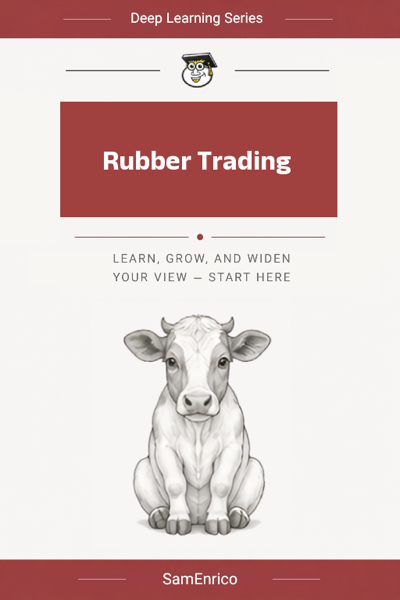
Rubber Trading eBook
A Coursebook on Rubber Trading
by Lorenz Reva
A Coursebook on Rubber Trading
Formats
Free sample
Chapter 1: The White Blood--The first time you see raw latex dripping from a tapped tree, you might mistake it for water. Pale, milky, almost translucent as it beads on the edge of a spiral cut. But touch it, and you understand immediately: this is not water. This is viscous, elastic, alive in a way that no other commodity is alive. It sticks to your fingers, stretches between them, and slowly, stubbornly, returns to itself.
The tappers who have spent forty years in the plantations of Southern Thailand call it nam yang—rubber water. But the traders who buy it, ship it, hedge it, and bet fortunes on its price have another name. They call it white blood.Because like blood, this liquid sustains an entire economic body. Without it, the global transportation system would collapse within weeks. Every tire on every car, every truck, every airplane landing gear, every hospital glove, every conveyor belt moving coal from mine to power plant—all of it depends on a substance that begins its life on a tree that only grows within a narrow band of latitude around the equator.
Ten degrees north to ten degrees south. That is the rubber belt. That is where the white blood flows. And understanding how that flow works—what speeds it up, what slows it down, what stops it entirely—is the first and most essential lesson in rubber trading.Before you can trade rubber, you must understand what rubber actually is. Not in the abstract, textbook sense.
But in the physical, biological, irreplaceable sense that makes it different from every other commodity on the exchange floor. Oil comes from the ground and will eventually run out, but you can drill anywhere. Gold is dug from mines scattered across every continent. Corn is planted and harvested on millions of farms from Iowa to Argentina to Ukraine. But rubber comes from one tree (Hevea brasiliensis), grown in one geographic band, tapped by one aging generation of farmers, and it cannot be replaced by anything else at scale—despite more than a century of trying.The Tree That Changed the World The story of rubber trading begins not in a boardroom or on an exchange floor, but in the rainforests of the Amazon basin.
For thousands of years, indigenous peoples of South America collected latex from wild Hevea trees, using it to waterproof clothing and create bouncing balls for ritual games. When European explorers encountered these balls in the sixteenth century, they brought them back across the Atlantic as curiosities—objects that bounced, that erased pencil marks from paper, that seemed to defy the normal behavior of solid matter.But it took nearly three hundred years for anyone to figure out what to do with this strange material. The breakthrough came in 1839 when Charles Goodyear accidentally dropped a mixture of rubber and sulfur onto a hot stove. Instead of melting, the rubber charred but remained elastic. He had discovered vulcanization—a chemical process that cross-links rubber molecules, transforming them from a sticky, temperature-sensitive mess into a durable, elastic material that could withstand heat and cold.
This single accident created the modern rubber industry. And it locked natural rubber into a relationship with human civilization that has not been broken since.The problem, for those who wanted to trade rubber, was that the entire supply was controlled by wild trees in the Amazon. Brazil held a monopoly, and it guarded that monopoly fiercely. The country banned the export of Hevea seeds under penalty of death. But in 1876, a British explorer named Henry Wickham smuggled 70,000 seeds out of Brazil aboard a steamship bound for London.
Only 2,700 germinated. Those seedlings were shipped to the Royal Botanic Gardens at Kew, and from there to British colonies in Southeast Asia—to Ceylon (now Sri Lanka), to Singapore, and most importantly, to Malaya (now Malaysia and part of Thailand).Those 2,700 seeds broke the Brazilian monopoly forever. Within fifty years, Southeast Asia was producing more than ninety percent of the world's rubber. The Brazilian industry collapsed and never recovered. And the center of the rubber universe shifted east, where it remains today.
Every trader who watches rubber prices on the Shanghai, Tokyo, or Singapore exchanges owes that ability to a botanical heist that happened nearly a hundred and fifty years ago.The Biology of Supply To understand why rubber prices move the way they do, you have to understand the tree itself. Hevea brasiliensis is a biological machine with very specific inputs, very specific outputs, and very little tolerance for variation. It grows only in tropical climates with consistent rainfall, temperatures between 20 and 35 degrees Celsius, and deep, well-drained soils. It takes five to seven years from planting to first tapping. It reaches peak yield between fifteen and twenty-five years.
And after thirty-five to forty years, its productivity declines so sharply that it must be replaced.This long lifecycle is perhaps the single most important fact for a rubber trader to internalize. Because it means supply cannot respond quickly to price signals. When the price of oil spikes, producers can drill more wells within months. When the price of corn rises, farmers can plant more acres the following spring. But when the price of rubber doubles, you cannot wake up tomorrow and decide to produce more rubber.
The trees that will be tapped five years from now are already in the ground. The trees that will be tapped ten years from now have not even been planted.This creates what economists call supply inelasticity. And it makes rubber prices prone to sharp, dramatic spikes when unexpected demand surges or supply disruptions occur. The 2011 rubber price spike, which sent TSR20 futures above six dollars per kilogram, was not caused by a sudden change in global tire demand. It was caused by flooding in Thailand that shut down tapping for six weeks.
The trees kept growing, but the tappers could not reach them. And because there was no way to make up that lost production later—you cannot tap a tree twice as hard to compensate for lost time—the supply shock translated directly into a price shock.The tapping process itself is another source of supply variability that traders must understand. Tappers typically work at night or in the early morning, when the internal pressure of the tree is highest. They make a spiral cut across the bark, shaving off a thin slice to open the latex vessels. The latex flows for four to six hours, dripping into a collection cup.
A good tapper can extract about thirty grams of dry rubber per tree per tapping. A large plantation might tap three hundred trees per tapper per night. The math is brutal, the work is hard, and the workforce is aging.There is no mechanical replacement for a skilled tapper. Attempts to automate tapping have failed for decades. The cut must be precise—too deep and you damage the cambium, killing the tree.
Too shallow and you do not open enough latex vessels. The angle must be correct. The shaving must be consistent. These are skills passed down through generations, and in Thailand, Indonesia, and Vietnam, the younger generation is not interested in learning them. They are…
This is the end of the free sample. Get the eBook to keep going. Buy now
About this book
Details
- Author
- Lorenz Reva
- Publisher
- SamEnrico
- Language
- English
- Genre
- trading, Informative, Educational
- Released
- 2026-05-04
- Pages (approx.)
- 142
- Available as
- eBook, Audiobook

Read better in the ZLOADR app
Your eBooks on your phone or tablet. Sign in with your SamEnrico account and start reading.
More by Lorenz Reva
 Brain Training Games Evaluation GuideLorenz Reva$11.99
 Winter Fireplace GuideLorenz Reva$11.99
 Sober Podcast Listening GuideLorenz Reva$11.99
 Project Quality Assurance Across ProjectsLorenz Reva$11.99
 The Evening Body Scan for InsomniaLorenz Reva$11.99
 The Admiral Who Defied the Storm: Isoroku Yamamoto and the Soul of the Pacific WarLorenz Reva$11.99
 How to Start a Ostriches Raising and Breeding Business (Beginners Guide)Lorenz Reva$11.99
 Stanley Black DeckerLorenz Reva$12.99
 College Essay Sensory Details GuideLorenz Reva$12.99
 Understanding Noonan Like SyndromeLorenz Reva$17.99
You may also like
 Shift Work Shift Trading GuideDuff Cathrine$11.99
 Insider Trading SentimentWurtz Shawnda$11.99
 Gambler's Fallacy TradingGaydos Shu$11.99
 Cryptocurrency Trading AddictionGeorge Kathleen$11.99
 Brokerage Account Margin TradingSegura Hermila$11.99
 Gambling Addiction and Day TradingClanton Hyacinth$11.99
 Beginner Mindfulness for Stock TradersFultz Mary$11.99
 Dividend Capture Strategy GuideWallace Antoinette$11.99
 Unauthorized Trading CasesQuintanilla Ima$11.99
 Insider Trading Heist TheoryTripp Luvenia$11.99
 Trader Distraction Control GuideSummers Gina$11.99
 Loss Aversion Trading GuideBoucher Ellamae$11.99