
Non-FictionInformativeEducational
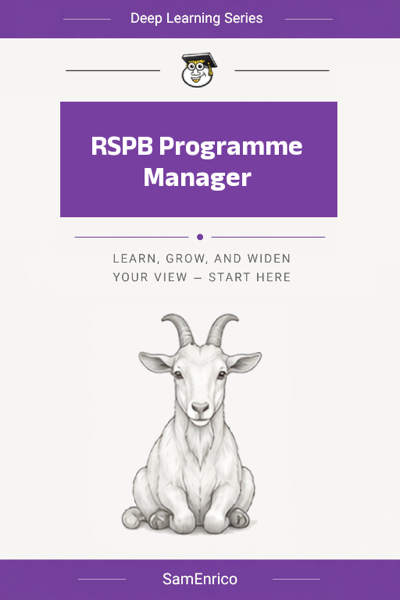
RSPB Programme Manager eBook
A Coursebook on RSPB Programme Manager
by Soliz Kraig
A Coursebook on RSPB Programme Manager
Formats
Free sample
Chapter 1: The Iron Cage--The curlew’s call is the sound of a dying world.I heard it first on a wet March morning on the Lancashire mosses, standing knee-deep in peat-stained water, watching a Programme Manager named Helen do something that no textbook had ever taught her. She was rewriting a five-year habitat restoration plan on the back of a coffee-stained envelope because the previous night’s storm had breached three kilometres of predator fencing. The birds were due to arrive in ten days. The contractors were booked for July – three months too late. And the donor who had given £400,000 for this programme was arriving for a site visit in six hours.Helen looked at me and said something I have never forgotten: “Everyone thinks conservation is about loving nature.
It’s not. It’s about managing the gap between what the birds need and what the world allows.”That gap is the iron cage of the RSPB Programme Manager.This chapter is about why that cage exists, what it is made of, and how you learn to live inside it without losing either your effectiveness or your soul. If you are reading this book because you aspire to run conservation programmes at scale, you need to understand one uncomfortable truth before you learn a single tool or template: you cannot save everything. You cannot even save most things. You can only choose where to place your finite resources – your time, your budget, your political capital, your staff’s energy – and then live with the consequences of the choices you did not make.The Curlew’s Warning: Why Generic Project Management Fails in Conservation Let me be brutal.
If you have come from corporate project management – IT, construction, financial services – you will find the RSPB disorienting. In a bank, when you need more time, you ask the client. In a construction firm, when costs overrun, you renegotiate the contract. In conservation, the client does not speak, the contract is with a species that cannot compromise, and the only thing that negotiates is the rising tide.The standard project management frameworks – PRINCE2, PMBOK, Agile, Waterfall – were all designed for environments where stakeholders are human, requirements can be documented, and success is defined by humans. That is not our world.
Our stakeholders include wading birds that will abandon a nest if a tractor passes within 200 metres. Our requirements shift when the climate does something the models did not predict. And our definition of success – favourable conservation status – is measured in breeding pairs, not pounds or deadlines.Consider the numbers. Between 1970 and 2020, the United Kingdom lost 38 million breeding birds from its skies. The turtle dove has declined by 98 per cent.
The willow tit by 94 per cent. The curlew – Helen’s bird, my bird, the bird whose haunting call opens this chapter – has halved in just twenty-five years. These are not abstract statistics. They are the report card of a generation of conservationists who worked harder than any before them and still watched their patients slip away.The Programme Manager sits at the desk where that failure is measured. You will be the person who has to tell the RSPB Council that despite five years of work and two million pounds, the hen harrier population has not recovered.
You will be the person who has to explain to a volunteer surveyor that the chicks she monitored all summer did not fledge. And you will be the person who has to decide, with imperfect data and insufficient time, where to place the resources that might – just might – bend the curve.The Iron Triangle, Reforged Every project manager knows the Iron Triangle: Scope, Time, Cost. You cannot change one without affecting the others. In corporate settings, this triangle is managed through negotiation. The client wants more features?
Extend the deadline or increase the budget. The deadline moves forward? Reduce scope.In RSPB conservation, the triangle is made of different materials.Scope is not a wish list of features. It is a set of ecological conditions that a given species requires to breed successfully. For a curlew, that means damp grassland with short vegetation in spring, proximity to wet feeding areas, and the absence of ground predators.
You cannot negotiate with a curlew. You cannot offer it a compromise. If the vegetation is too tall, the bird will nest elsewhere or not nest at all. So scope is fixed by biology.Cost is not a number you can ask the client to increase. Yes, you can fundraise.
Yes, you can apply for grants. But there is no commercial customer who values the outcome enough to pay what it truly costs. The RSPB’s income is ultimately limited by membership fees, donations, and a small amount of government funding. Every pound you spend on one programme is a pound not spent on another. That means every pound carries an opportunity cost measured in lost conservation impact elsewhere.Time is not a deadline set by a project board.
It is the breeding cycle of the species you are trying to save. For ground-nesting birds, the constraint is absolute: no disturbance between March and August. That is not a guideline. It is the law. Schedule 1 of the Wildlife and Countryside Act 1981 makes it a criminal offence to intentionally disturb a Schedule 1 bird – which includes nearly all of the species the RSPB prioritises – during the breeding season.
A contractor who drives a digger within 200 metres of a lapwing nest is committing a crime. So time is fixed by statute.When all three sides of the triangle are fixed, something else must give. That something is you.The Adaptive Thresholds That Saved the Curlew Let me tell you the full story of the curlew recovery programme that succeeded where others failed. It is the closest thing we have to a template for how to live inside the iron cage.In 2015, the RSPB launched a five-year programme targeting curlew recovery across three landscapes: the Shropshire Hills, the Lancashire mosses, and the North Pennines. The goal was ambitious: a 20 per cent increase in breeding pairs across the three sites, or roughly forty additional nesting attempts per year.
The budget was £1.8 million, raised from a combination of a lottery grant and private donors. The timeline was fixed by the curlew’s breeding cycle – five years, each with an inviolable March-to-August moratorium on disturbance.The first two years were a disaster. In Year One, the Shropshire site lost eleven of thirteen nests to fox predation. In Year Two, a late April snowstorm killed the first broods across all three sites. The Programme Manager, a woman named Sarah who had come from a background in wetland restoration, did what most of us would have done: she doubled down on the existing plan.
More predator fencing. More nest cameras. More weekend shifts for the volunteers.It did not work. By the end of Year Two, the curlew population had not increased. It had fallen by 8 per cent.Here is where Sarah did something different.
Instead of blaming the weather or the foxes or the volunteers, she convened a review that explicitly asked: what assumptions have we made that might be wrong? The answer, it turned out, was fundamental.…
This is the end of the free sample. Get the eBook to keep going. Buy now
About this book
Details
- Author
- Soliz Kraig
- Publisher
- SamEnrico
- Language
- English
- Genre
- Non-Fiction, Informative, Educational
- Released
- 2026-05-06
- Pages (approx.)
- 151
- Available as
- eBook, Audiobook

Read better in the ZLOADR app
Your eBooks on your phone or tablet. Sign in with your SamEnrico account and start reading.
More by Soliz Kraig
 Parental OCD Self Care GuideSoliz Kraig$11.99
 Sales Networking TechniquesSoliz Kraig$11.99
 Coping with Hair Loss EmotionallySoliz Kraig$11.99
 Sims Compulsive Play GuideSoliz Kraig$11.99
 DoorDash Challenge Bonus CompletionSoliz Kraig$11.99
 The Silk Road Gambit: How a Caravan King Built an EmpireSoliz Kraig$11.99
 Project Management Mobile Apps GuideSoliz Kraig$12.99
 Landing a UN Job Without ConnectionsSoliz Kraig$12.99
 Understanding Mental Mixed Retardation Deafnes Clubbed DigitsSoliz Kraig$17.99
 How to Become a Tube OperatorSoliz Kraig$11.99
You may also like
 Hong Kong Handover 1997Dunn Johnnie$11.99
 Zumba For Postnatal Recovery CourseNeal Christian$11.99
 Zumba for BeginnersLadner Nikia$11.99
 YouTube Comment Mining GuideHumes Pandora$12.99
 Worry Box MeditationCarlin Rudy$11.99
 Workplace Stress MeditationNguyen Lynn$11.99
 Workplace Stress and Sleep RepairHawley Ivory$11.99
 Workplace Perfectionism CureDelaney Jeffry$11.99
 Workplace Injustice Anger GuideWallen Isabelle$11.99
 Work Addiction and Burnout LinkGreenwood Ester$11.99
 Women in Yoga and WellnessBeattie Galina$11.99
 Women in Stand Up ComedyChun Evangeline$11.99