
Non-FictionHealth & WellnessShoulder Health
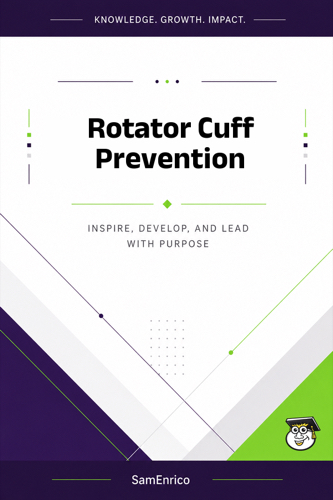
Rotator Cuff Prevention Audiobook
Teaches external rotation and scapular stability f
Teaches external rotation and scapular stability for overhead athletes and throwers.
Formats
Free sample
Chapter 1: The Golf Tee--–- Imagine holding a golf ball in one hand and a golf tee in the other. Now, try to balance the ball on top of the tee. It sits there precariously, requiring constant, micro-adjustments to keep it from rolling off. Any sudden movement, any shift in the platform, and the ball tumbles. That is your shoulder.
The "golf ball" is the head of your humerus—the upper arm bone. The "tee" is the glenoid fossa, a shallow, pear-shaped socket on the edge of your shoulder blade. This elegant but inherently unstable design is the reason you can throw a baseball ninety-five miles per hour, but it is also the reason that same shoulder is a ticking time bomb without the right preparation.Most athletes spend their entire careers training the muscles they can see in the mirror—the pectorals, the deltoids, the biceps. They bench press, they shoulder press, they curl. And then they wonder why their rotator cuff tears.
The problem is not a lack of strength. The problem is a fundamental misunderstanding of anatomy. You have been taught that the rotator cuff is a "lifting" muscle group. That is wrong. The rotator cuff does not lift your arm.
That is the job of the deltoid and the pectorals. The rotator cuff's primary, non-negotiable function is to center the golf ball on the tee. It is a dynamic stabilizer, a set of four small but mighty muscles that fire milliseconds before you move your arm, compressing the humeral head into the glenoid so that when the deltoid pulls, the ball doesn't slide off the edge.When the rotator cuff fails as a stabilizer, it fails as a mover. And when it fails catastrophically, you are looking at surgery, six months of rehab, and a throwing arm that never quite feels the same. This chapter is your anatomy wake-up call.
By the time you finish reading, you will understand exactly which muscles we are trying to save, why the teres minor and infraspinatus are the unsung heroes of velocity, and how a "lazy" scapula is almost always the root cause of a torn cuff. You will never look at a shoulder press the same way again.The Glenohumeral Joint: A Design Flaw Turned Superpower To understand prevention, you must first understand instability. The glenohumeral joint is a ball-and-socket joint, but unlike the hip—which has a deep, acetabular…
This is the end of the free sample. Get the Audiobook to keep going. Buy now
About this book
Details
- Author
- Pina Lawrence
- Publisher
- SamEnrico
- Language
- English
- Genre
- Non-Fiction, Health & Wellness, Shoulder Health
- Released
- 2026-06-05
- Pages (approx.)
- 156
- Available as
- eBook, Audiobook

Listen in the VoxFlicks app
Audiobooks and audio dramas wherever you go. Sign in with your SamEnrico account and press play.
More by Pina Lawrence
 Substance Recovery Work EsteemPina Lawrence$11.99
 Temple Run Addiction GuidePina Lawrence$11.99
 Keto Pizza Crust GuidePina Lawrence$11.99
 The Clockwork Cosmos: Huygens and the Birth of Modern AstronomyPina Lawrence$11.99
 Renewable Energy Systems OverviewPina Lawrence$11.99
 How to Start a Pipeline Construction Business (Beginners Guide)Pina Lawrence$11.99
 How to Produce ChemicalsPina Lawrence$11.99
 AI Closing Process AutomationPina Lawrence$12.99
You may also like
 Hong Kong Handover 1997Dunn Johnnie$11.99
 Zumba For Postnatal Recovery CourseNeal Christian$11.99
 Zumba for BeginnersLadner Nikia$11.99
 YouTube Comment Mining GuideHumes Pandora$12.99
 Worry Box MeditationCarlin Rudy$11.99
 Workplace Stress MeditationNguyen Lynn$11.99
 Workplace Stress and Sleep RepairHawley Ivory$11.99
 Workplace Perfectionism CureDelaney Jeffry$11.99
 Workplace Injustice Anger GuideWallen Isabelle$11.99
 Work Addiction and Burnout LinkGreenwood Ester$11.99
 Women in Yoga and WellnessBeattie Galina$11.99
 Women in Stand Up ComedyChun Evangeline$11.99