
Non-FictionHealth & WellnessRotating Shifts
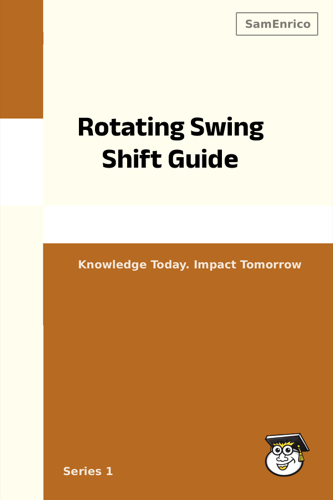
Rotating Swing Shift Guide eBook
Manages weekly rotation between days, evenings, ni
by Tan Albina
Manages weekly rotation between days, evenings, nights.
Formats
Free sample
Chapter 1: The Impossible Clock--–- Every rotating shift worker has heard the same well-intentioned but dangerously false advice: “You’ll get used to it.” Some variation of this lie is whispered in break rooms, shouted over factory noise, or texted from a well-meaning spouse who thinks you just need more coffee. It is the single most destructive myth in the history of shift work, and it has ruined more careers, marriages, and health outcomes than any single schedule ever designed by management.The truth is brutal and freeing at the same time: your body will never fully adapt to a weekly rotation between days, evenings, and nights. Not in a month. Not in a year. Not in a decade.
The human circadian system is not broken; it is working exactly as evolution designed it. And what evolution did not design for was a 7-day cycle that asks you to wake at 5:00 AM on Monday, 2:00 PM on Thursday, and 10:00 PM the following Tuesday.This chapter is not a collection of comforting half-truths. It is a surgical dissection of why weekly rotation feels like jet lag without the vacation—and why the solution is not to try harder, but to stop trying to do the impossible. By the time you finish these pages, you will understand the precise biological mechanisms that make your schedule so punishing, why the swing shift is the most deceptive of all, and most importantly, why everything you have been told about “adjusting” is backward. You cannot out-will your circadian rhythm.
But you can outsmart it.The 16-Hour Problem That Breaks Every Worker Let us begin with a simple clock exercise. Imagine you work a day shift. You wake at 6:00 AM, commute, work from 8:00 AM to 4:00 PM, and go to bed around 10:00 PM. Your body’s master clock—the suprachiasmatic nucleus, a tiny cluster of neurons deep in your hypothalamus—has settled into a rhythm. It releases cortisol around 6:30 AM to wake you.
It suppresses melatonin around 7:00 AM so you feel alert. It ramps up melatonin again around 9:00 PM to prepare you for sleep.Now imagine your schedule rotates next week to night shift. You must now wake at 10:00 PM, work from 12:00 AM to 8:00 AM, and sleep from 12:00 PM to 6:00 PM. The difference in your wake time between day shift (6:00 AM) and night shift (10:00 PM) is 16 hours.Here is the cruel mathematics of human biology: under ideal, laboratory-controlled conditions—complete darkness, perfect temperature, no social obligations, no children, no noisy neighbors—the human circadian clock can shift at a maximum rate of about 1 to 1.5 hours per day. Some people, particularly those over 40, shift even more slowly.
At 1.5 hours per day, a 16-hour shift would require nearly 11 days of perfect conditions. You have 7 days. And your conditions are far from perfect.This means something profound and non-negotiable: you are not failing to adapt. You are attempting the biologically impossible. The fatigue you feel is not a character flaw.
The brain fog is not laziness. The irritability with your spouse is not a relationship problem. These are predictable, measurable, and inevitable consequences of asking your body to do something no human body was designed to do.The research is unambiguous. A landmark study from the Journal of Sleep Research followed rotating shift workers over two years and found that even after 12 months on a weekly rotation schedule, none of the subjects achieved full circadian entrainment. Their melatonin rhythms remained fragmented.
Their cortisol curves stayed flattened. Their subjective alertness scores never rose above 60% of those on fixed shifts. The body does not “learn” to rotate weekly. It learns to survive it—barely.Social Jetlag: The Invisible Tax You have probably heard of jet lag. You fly from New York to London, cross five time zones, and spend three days feeling like a zombie.
Your digestion is off. You wake at 3:00 AM wide awake. You crash at 4:00 PM. That is jet lag.Social jetlag is the same phenomenon, but instead of an airplane, the culprit is your schedule. Every time your rotation flips, you are effectively crossing time zones—without leaving your hometown.
A shift from day shift to night shift is like flying from Los Angeles to Tokyo. A shift from night shift to swing shift is like flying from Tokyo to Istanbul. And a shift from swing shift back to day shift is like flying from Istanbul to New York. In a single month, you may circumnavigate the globe twice, biologically speaking.But there is a cruel twist. Unlike airplane travel, where you eventually return home and stay there, social jetlag on a rotating schedule never ends.
Just as your body begins to drag its clock toward the new shift—maybe 30 minutes per day, if you are lucky—it is time to rotate again. The result is a permanent state of circadian misalignment. Your internal clock is constantly chasing a target that moves every Sunday night.The consequences are not merely uncomfortable. They are measurable in years of life lost. Chronic circadian misalignment is associated with a 40% increased risk of metabolic syndrome, a 30% increased risk of cardiovascular disease, and a statistically significant increase in all-cause mortality.
Shift workers, on average, die earlier than their fixed-schedule counterparts. This is not fear-mongering. This is the data that employers do not want you to see and that most shift work books soften with optimistic language.This book will not lie to you. Weekly rotation shortens life expectancy—if you do nothing. But the purpose of this guide is not to pretend otherwise.
It is to give you the tools to claw back as much of that lost health as biologically possible. You cannot eliminate the risk. But you can reduce it from catastrophic to manageable.The Swing Shift Trap: Why Evenings Are the Real Villain Most rotating workers fear the night shift. They dread the 3:00 AM wall, the silent house at 6:00 AM, the pale sunlight that feels alien. But the night shift is honest about its demands.
It announces itself. You know, when you work nights, that you are fighting against the sun.The swing shift—typically 4:00 PM to 12:00 AM or 3:00 PM to 11:00 PM—is far more deceptive. It feels almost normal. You wake up, have coffee, run errands, see sunlight. You go to work in the afternoon, which does not feel strange.
You finish at midnight, which feels late but not absurd. You go home, wind down, and fall asleep around 2:00 AM. Then you wake at 7:00 AM to take the kids to school because, after all, you are on “evenings,” not “nights,” and you have responsibilities.This is the trap. The swing shift seduces you into maintaining a day-shift life while working evening hours. The result is chronic sleep restriction that compounds week after week.
You are not getting the 7–9 hours you need. You are getting 5 hours, then 4, then 5 again. By Friday, your cognitive performance is equivalent to someone with a blood alcohol level of 0.08%—legally drunk in every state.Let us name the numbers. On a swing shift with a 2:00 AM bedtime and a 7:00 AM wake time, you are sleeping 5 hours. One night of 5 hours is survivable.
Five consecutive nights of 5 hours creates a sleep debt of 10–15 hours. That debt does not vanish on your…
This is the end of the free sample. Get the eBook to keep going. Buy now
About this book
Details
- Author
- Tan Albina
- Publisher
- SamEnrico
- Language
- English
- Genre
- Non-Fiction, Health & Wellness, Rotating Shifts
- Released
- 2026-06-06
- Pages (approx.)
- 139
- Available as
- eBook, Audiobook

Read better in the ZLOADR app
Your eBooks on your phone or tablet. Sign in with your SamEnrico account and start reading.
More by Tan Albina
 IBS Medication Options HandbookTan Albina$11.99
 Daily Purpose RitualsTan Albina$11.99
 Phentermine Weight LossTan Albina$11.99
 Teresas Intellectual FormationTan Albina$11.99
 Coffee and Cigarette Pairing BreakTan Albina$11.99
 The DBT Skills for AdultsTan Albina$11.99
 Family Time Blocking GuideTan Albina$12.99
 The Silk Thief of Florence: The Legend of Francesco di MarcoTan Albina$11.99
 The Shanghai Silk Heist: A Love Triangle That Sparked a BloodbathTan Albina$11.99
 A Collector's Handbook to the Hudson Six (1936-39)Tan Albina$11.99
 Portfolio Career for ADHD ProfessionalsTan Albina$12.99Family Time Blocking GuideTan Albina$12.99
You may also like
 Hong Kong Handover 1997Dunn Johnnie$11.99
 Zumba For Postnatal Recovery CourseNeal Christian$11.99
 Zumba for BeginnersLadner Nikia$11.99
 YouTube Comment Mining GuideHumes Pandora$12.99
 Worry Box MeditationCarlin Rudy$11.99
 Workplace Stress MeditationNguyen Lynn$11.99
 Workplace Stress and Sleep RepairHawley Ivory$11.99
 Workplace Perfectionism CureDelaney Jeffry$11.99
 Workplace Injustice Anger GuideWallen Isabelle$11.99
 Work Addiction and Burnout LinkGreenwood Ester$11.99
 Women in Yoga and WellnessBeattie Galina$11.99
 Women in Stand Up ComedyChun Evangeline$11.99