
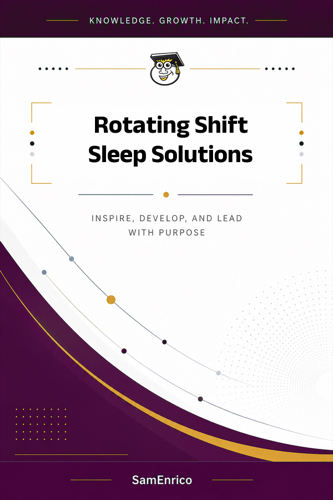
Rotating Shift Sleep Solutions eBook
Manage constantly changing schedules with strategi
Manage constantly changing schedules with strategic napping and light exposure.
Formats
Free sample
Chapter 1: The 3:00 AM Question--It is 3:00 AM. You are standing at a nurse’s station, a factory control panel, a truck stop bathroom, or a police cruiser. Your eyelids weigh more than your entire body. Your thoughts feel like wading through cold honey. And somewhere in the fog, a quiet question surfaces: How long can I keep doing this?You are not weak.
You are not lazy. You are not broken. You are asking a human body to do something it was never designed to do, and you have been doing it without the right tools. That ends now.This book exists because millions of shift workers are suffering unnecessarily. Not from lack of effort—you have tried caffeine, blackout curtains, melatonin, sleeping pills, and the desperate weekend crash.
You have explained to your spouse, your children, your friends that you are not ignoring them. You are just exhausted in a way that daytime people cannot understand. The problem is not your effort. The problem is that most advice for shift workers is written by people who have never worked a rotating schedule, or worse, is copied from advice for permanent night shift workers. Rotating shifts are a different beast entirely.
A permanent night worker eventually adapts. You never do. Your schedule changes just as your body begins to find a rhythm.This chapter answers the 3:00 AM question. It explains why rotating shifts are uniquely punishing, why you are not imagining the severity of your fatigue, and why the solution is not more caffeine or more willpower. The solution is understanding three simple levers that will reappear throughout this book: Light (the ON switch for your brain), Darkness and Naps (the OFF switch), and Timing (when you eat, move, and rest).
Master these three things, and you stop surviving shift work. You start managing it.But first, you need to understand why nothing has worked so far. And that story begins with a paradox.The Paradox of the Rotating Schedule Let us start with a hard truth. Your body has a master clock called the suprachiasmatic nucleus, a tiny bundle of approximately twenty thousand neurons buried deep in your hypothalamus. This clock did not read your employment contract.
It does not care about your shift rotation. It runs on a cycle that averages twenty-four hours and eleven minutes, and it uses light as its primary reset button. Every morning, sunlight hits your eyes, and your brain says, It is daytime. Wake up. Release cortisol.
Suppress melatonin. Every evening, darkness falls, and your brain says, It is nighttime. Prepare for sleep. Release melatonin. Lower core temperature.That system works beautifully for people who work nine to five.
It works reasonably well for permanent night workers, who can eventually flip their clocks after weeks or months of consistent exposure. But you are neither of those people. You are a rotating shift worker, and your schedule forces your body to live in three different time zones over the course of a single week without ever getting on an airplane.Here is the paradox. On paper, rotating shifts seem fair. Everyone shares the burden of nights and weekends.
No one gets stuck on permanent nights for years. But biologically, rotating shifts are the worst possible schedule. Your body never fully adapts to any schedule because by the time it starts to adjust, the schedule changes again. Research from the Journal of Sleep Research shows that it takes five to seven days for the human circadian system to shift by eight hours. Most rotating schedules change every two to three days.
You are permanently in a state of partial adaptation, which feels like permanent jet lag without the vacation.Consider two common rotation patterns. Forward rotation moves from day shift to evening shift to night shift. For example, Monday and Tuesday on days (7 AM to 3 PM), Wednesday and Thursday on evenings (3 PM to 11 PM), Friday and Saturday on nights (11 PM to 7 AM). Forward rotation follows the body’s natural tendency to delay sleep. Humans find it easier to stay up later than to go to bed earlier.
So forward rotation is the less evil option. Backward rotation moves from night shift to evening shift to day shift. This forces the body to advance sleep, which is like telling yourself to go to bed four hours earlier every few days. Backward rotation is circadian torture, and it should be illegal for any employer to schedule this way without explicit worker consent and hazard pay. If your employer uses backward rotation, your fatigue is not your fault.
You are fighting biology itself. If your employer uses forward rotation, you still have a significant challenge, but at least the direction works with your body rather than against it.The key insight from decades of shift work research is this: Consistency is impossible for rotating shift workers, but rhythm is everything. You cannot maintain the same bedtime every night. You can, however, maintain a predictable sequence of light exposure, napping, and meal timing relative to your upcoming shift. That is the core philosophy of this entire book.
Stop trying to be consistent. Start trying to be strategic.Shift Work Disorder vs. Being Tired Now we need to distinguish between two very different experiences. The first is ordinary tiredness. You skip a few hours of sleep, you feel groggy the next day, and you recover after one good night of rest.
This is what happens to new parents, medical residents during short rotations, and people who stay up too late watching television.The second is Shift Work Disorder, a recognized medical condition in the International Classification of Diseases. Shift Work Disorder is diagnosed when someone who works non-traditional hours experiences significant insomnia when trying to sleep and excessive sleepiness when trying to stay awake, to the point that it interferes with work performance, driving safety, or quality of life. Unlike ordinary tiredness, Shift Work Disorder does not resolve with one good night of sleep because the underlying problem is circadian misalignment, not simple sleep debt.Here is how to tell which one you are dealing with. Ordinary tiredness feels like a heavy blanket. Shift Work Disorder feels like a war.
You lie down after a night shift, exhausted beyond words, and your body refuses to sleep. Your mind races. Your heart pounds. You watch the clock tick from 9 AM to 10 AM to 11 AM, knowing that you need to wake up in a few hours, and the anxiety makes sleep even more impossible. Then you drag yourself to work, and your eyes close involuntarily during a safety briefing, at the assembly line, behind the wheel.
Those moments of microsleep—two to thirty seconds of unconsciousness that you may not even notice—are the hallmark of Shift Work Disorder.If you have ever nodded off for just a second while driving home, you have experienced a microsleep. If you have ever walked into a room and forgotten why, you may have experienced the cognitive fog of chronic circadian disruption. If you have ever snapped at your partner or child for no reason, you have experienced the irritability that comes from living in a permanent state of biological jet lag.The good news is that Shift Work Disorder…
This is the end of the free sample. Get the eBook to keep going. Buy now
About this book
Details
- Author
- Fincher Melvin
- Publisher
- SamEnrico
- Language
- English
- Genre
- Non-Fiction, Health & Wellness, Shift Work
- Released
- 2026-06-11
- Pages (approx.)
- 140
- Available as
- eBook, Audiobook

Read better in the ZLOADR app
Your eBooks on your phone or tablet. Sign in with your SamEnrico account and start reading.
More by Fincher Melvin
 Chromium For Blood SugarFincher Melvin$11.99
 Hybrid Employee Resource GroupsFincher Melvin$11.99
 Social Media Body Comparison CourseFincher Melvin$11.99Social Media Body Comparison CourseFincher Melvin$11.99
 Peg System for Memorizing DatesFincher Melvin$11.99
 The Unseen Hand: How a Forgotten Mathematician Cracked the Enigma Code Before TuringFincher Melvin$11.99
 Bloodline of the Sun: The Secret Dynasty of the Akan QueensFincher Melvin$11.99
 Understanding Erosive Pustular Dermatosis of The ScalpFincher Melvin$17.99
 Life Support System Operation (Spacecraft)Fincher Melvin$11.99
 CV Writer Marketing PlanFincher Melvin$12.99
 Mentoring Career Paths Across CulturesFincher Melvin$12.99
 How to Become a InterpreterFincher Melvin$11.99
You may also like
 Weight Loss For Shift WorkersDyson Sheree$11.99
 Nap for Shift Workers GuideSanchez Tina$11.99
 Napping for Shift WorkersMaynard Carlotta$11.99
 The Shift Worker Nap GuideTierney Tatiana$11.99
 Shift Work Cortisol RecoveryMatthew Sydney$11.99
 Low Carb for Shift WorkersWall Marya$11.99
 Shift Work Disorder GuideLanham Barabara$11.99
 Shift Worker Sleep RecoveryWang Gertha$11.99
 Keto For Shift Workers HandbookGallagher Saran$11.99
 Night Shift Breast Cancer RiskSchmitz Corinne$11.99
 Night Shift Nap GuideChisolm Jarrett$11.99
 Morning Nap StrategyLyles Temple$11.99