
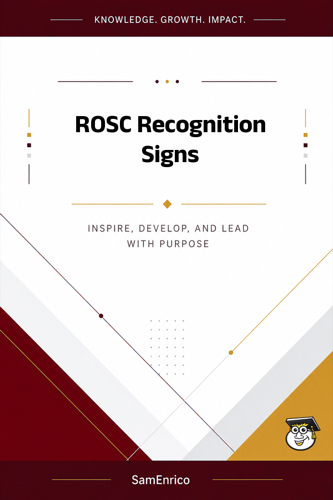
ROSC Recognition Signs
Teaches identifying return of spontaneous circulat
Teaches identifying return of spontaneous circulation: coughing, breathing, pulse detection.
Formats
About this book
Free sample
Chapter 1: The 7-Second Bet--–- The paramedic’s hands hovered six inches above the patient’s chest. Sweat dripped from her chin onto the man’s hospital gown. Behind her, the cardiac monitor beeped in an organized, almost musical rhythm—sinus tachycardia at 110 beats per minute. The capnography waveform showed a tidy box shape with an end-tidal CO₂ reading of 38 mm Hg. The patient’s lips, which had been the color of bruised plums three minutes earlier, were now a pale, mottled pink.“I’ve got a carotid pulse,” the nurse at the head of the bed said.
“It’s thready, but it’s there.”The paramedic—let us call her Maya—had been running this code for twenty-two minutes. The patient, a sixty-seven-year-old man with a history of hypertension and diabetes, had collapsed in the cafeteria. Initial rhythm: ventricular fibrillation. Three shocks. Seven rounds of epinephrine.
Two doses of amiodarone. And now, this.Maya looked at her watch. The last pulse check had been forty-five seconds ago. According to the American Heart Association guidelines, she had exactly seven seconds to make a decision. Seven seconds to answer one question: Is this patient in cardiac arrest, or has he achieved return of spontaneous circulation?She placed her index and middle fingers on the patient’s carotid artery, just lateral to the trachea.
She felt something—a soft, squishy sensation that could have been a pulse, or could have been her own thumb, or could have been the residual bouncing of chest wall motion from the last round of compressions.“I’m not sure,” she said.The emergency department attending physician, a woman with twenty years of experience named Dr. Chen, stepped closer. “Then you are certain it is absent,” she said. “Resume compressions.”Maya hesitated. The monitor looked so good.
The capnography number was almost normal. The patient’s chest was rising—not in the irregular, gasping way of agonal breathing, but in slow, deliberate expansions. Three breaths in the last twenty seconds.“He’s breathing,” Maya said.Dr. Chen shook her head. “Those are not spontaneous breaths.
Look at the rate—barely six per minute. And watch the chest wall. It’s not coordinated. That’s a brainstem reflex, not…
This is the end of the free sample. Get the eBook to keep going. Buy now
Contents
- Chapter 1
- Chapter 2
- Chapter 3
- Chapter 4
- Chapter 5
- Chapter 6
- Chapter 7
- Chapter 8
- Chapter 9
- Chapter 10
- Chapter 11
- Chapter 12
Details
- Author
- Pippin Dottie
- Publisher
- SamEnrico
- Language
- English
- Genre
- Non-Fiction, Health & Wellness, Clinical Signs
- Released
- 2026-06-06
- Pages (approx.)
- 150
- Available as
- eBook, Audiobook

Read better in the ZLOADR app
Your eBooks on your phone or tablet. Sign in with your SamEnrico account and start reading.
More by Pippin Dottie
 Pacific Theater Veterans StoriesPippin Dottie$11.99
 The Remote Career Path GuidePippin Dottie$11.99
 DHT Blocker Nutrition GuidePippin Dottie$11.99
 The Forgotten Heist: The 1971 D.B. Cooper Skyjacking MysteryPippin Dottie$11.99
 How to Produce Blossom Set For TomatoesPippin Dottie$11.99
 Bench Grinder OperationPippin Dottie$11.99
 UK Director Loan ImpactPippin Dottie$12.99
 A Beginners Guide to Hiking (Volume 1)Pippin Dottie$11.99