
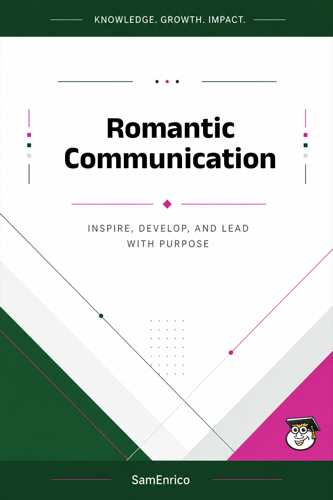
Non-FictionSelf-HelpRelationship Communication
Romantic Communication eBook
Express needs to partner without blame or withdraw
by Kane Marry
Express needs to partner without blame or withdrawal.
Formats
Free sample
Chapter 1: The Garbage That Ended Everything...–- Mia placed two wine glasses on the kitchen island, the stems catching the low light of their apartment. James was on the couch, scrolling through his phone, his work bag still slung over one shoulder. She had been home for an hour. He had not looked up. She poured the wine—a Malbec, his favorite—and said, as calmly as she could manage, “Can you take the garbage out?
It’s been three days.”James glanced at the kitchen, at the overflowing bin, then back at his phone. “In a minute.”Mia felt something in her chest tighten. “You said that yesterday.”“It’s garbage, Mia. It’s not an emergency.”“It’s not about the garbage,” she heard herself say, her voice rising. “It’s that you never help.
You come home, you sit down, and you disappear into that screen. I am not your mother. I should not have to ask.”James looked up, finally. His expression was flat. “Here we go.
Every single night. I worked ten hours today. I am exhausted. And you want to fight about trash.”“I want to fight about the fact that I am alone in this apartment even when you are sitting right there.”He stood up, grabbed his bag, and walked toward the bedroom. “I am not doing this.
Goodnight.”The bedroom door closed. Not a slam—worse. A soft, deliberate click. The sound of someone who had perfected the art of leaving without leaving. Mia stood alone in the kitchen, the two wine glasses still full, and felt the familiar mixture of rage and shame.
She had done it again. She had started with a reasonable request—take out the garbage—and within ninety seconds, they were fighting about respect, love, worth, and who worked harder. The garbage never made it to the curb.That night, Mia lay awake and asked herself a question that would change everything: What if the garbage was never the point?The Great Masquerade Most couples do not fight about what they think they are fighting about.This is the single most important insight in this entire book, and it is the foundation upon which everything else is built. When Mia said, “Take out the garbage,” she believed she was asking for a chore to be completed. When James heard “Take out the garbage,” he heard criticism, nagging, and the implication that he was failing as a partner.
Both of them were wrong about what was actually happening. The garbage was not the issue. The garbage was a costume, a disguise, a decoy. The real conversation was happening beneath the surface, in a language neither of them knew how to speak.The Blame-Shutdown Loop is the name we give to this pattern. It works like this: Partner A feels an unmet need—for help, for attention, for reassurance, for rest.
Instead of expressing the need directly (which requires vulnerability), Partner A expresses a complaint, a criticism, or a demand. This is blame. Partner B, hearing blame, feels attacked. The brain interprets criticism as a threat. The body prepares to fight, flee, or freeze.
Most often, Partner B chooses withdrawal—silence, distance, a closed door. Partner A experiences withdrawal as rejection. The original unmet need intensifies. Partner A blames again, harder this time. Partner B withdraws further.
The loop spins faster and faster until someone slams a door, sleeps on the couch, or gives up entirely.Here is what Mia and James did not know: they were not enemies. They were two people who had never been taught how to translate their fear into a request.The Four Great Masqueraders After analyzing thousands of couples in conflict, researchers have identified four topics that consistently serve as masks for deeper attachment needs. These are the topics that couples fight about most often—not because they matter most, but because they are the safest battlegrounds. It is easier to argue about dishes than it is to say, “I am afraid you do not want me anymore.” It is less vulnerable to complain about money than to admit, “I do not feel safe in this relationship.” The Four Great Masqueraders are:1. Chores and Domestic Labor The surface fight is about fairness.
“You never do the dishes.” “I took out the trash last time.” “You left your socks on the floor again.” These arguments sound like accounting disputes, as if love could be measured in loads of laundry. But the real need underneath is almost always about teamwork and recognition. When Mia said, “I am not your mother,” she was not asking for help with the garbage. She was asking to feel like she and James were on the same side. She wanted to feel seen, appreciated, and partnered.
The garbage was just the messenger.For the partner on the receiving end of chore-related blame, the experience is often one of inadequacy and shame. James heard “you are failing” and withdrew not because he did not care, but because he did not know how to succeed. The gap between “I need help” and “you are a failure” is the space where most chore fights live and die.2. Sex and Physical Intimacy The surface fight is about frequency. “You never want to have sex anymore.” “All you ever think about is sex.” “We used to be so connected.” These conversations are almost always radioactive because they touch the deepest parts of our self-worth.
The real need underneath is about desirability and connection. The partner who initiates sex and is turned down is not primarily frustrated about the lack of orgasm. They are afraid of being unwanted. “You do not desire me” feels like “I am not enough.”The partner who declines sex is often experiencing a different but equally vulnerable fear: pressure and obligation. “If I say no, you will be angry.
If I say yes when I do not want to, I will feel used.” Neither partner is wrong. Both are afraid. But because they are speaking in the language of blame (“You never want me”) and withdrawal (“You always pressure me”), the conversation becomes a standoff rather than a confession.3. Money and Financial Decisions The surface fight is about spending. “You spent how much on that?” “We cannot afford this.” “You are so cheap.” Money fights are rarely about the actual dollar amount.
They are about security and autonomy. For one partner, money represents safety—a buffer against disaster, proof that the family will be okay. For the other partner, money may represent freedom—the ability to enjoy life, to feel unconstrained, to experience joy without guilt.When these two worldviews collide, the fight is never about the purchase. It is about whether the relationship prioritizes security or spontaneity, planning or presence. And because neither partner wants to admit that they are afraid—afraid of poverty, afraid of control, afraid of a life without pleasure—they fight about the price tag instead.4.
Technology and Attention The surface fight is about screen time. “You are always on your phone.” “You never look at me when I am talking.” “You would rather scroll than spend time with me.” This masquerader is the newest…
This is the end of the free sample. Get the eBook to keep going. Buy now
About this book
Details
- Author
- Kane Marry
- Publisher
- SamEnrico
- Language
- English
- Genre
- Non-Fiction, Self-Help, Relationship Communication
- Released
- 2026-06-07
- Pages (approx.)
- 118
- Available as
- eBook, Audiobook

Read better in the ZLOADR app
Your eBooks on your phone or tablet. Sign in with your SamEnrico account and start reading.
More by Kane Marry
 Transformers Voice LegacyKane Marry$11.99
 Creative Habits for TruckersKane Marry$11.99
 Senior Scam Victim EsteemKane Marry$11.99
 Ortho Evra Patch GuideKane Marry$11.99
 Lutein For Macular HealthKane Marry$11.99
 Gen Z Thrifting TrendsKane Marry$11.99
 The Healers of Nubia: Surgeons of the NileKane Marry$11.99
 Navigating Breakup DiscussionsKane Marry$11.99
 The Angel of Death: Sydney's Victorian PoisonerKane Marry$11.99
 How to Produce Parchment PaperKane Marry$11.99
 How to Produce CrackersKane Marry$11.99
 Qatar Energy Sector B2B SalesKane Marry$12.99
You may also like
 Hong Kong Handover 1997Dunn Johnnie$11.99
 Zumba For Postnatal Recovery CourseNeal Christian$11.99
 Zumba for BeginnersLadner Nikia$11.99
 YouTube Comment Mining GuideHumes Pandora$12.99
 Worry Box MeditationCarlin Rudy$11.99
 Workplace Stress MeditationNguyen Lynn$11.99
 Workplace Stress and Sleep RepairHawley Ivory$11.99
 Workplace Perfectionism CureDelaney Jeffry$11.99
 Workplace Injustice Anger GuideWallen Isabelle$11.99
 Work Addiction and Burnout LinkGreenwood Ester$11.99
 Women in Yoga and WellnessBeattie Galina$11.99
 Women in Stand Up ComedyChun Evangeline$11.99