
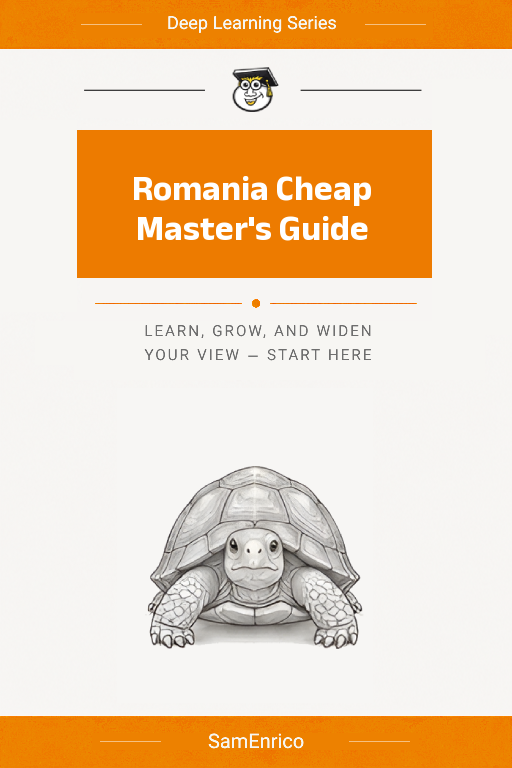
Non-FictionStudent's ShortcutRomania
Romania Cheap Master's Guide eBook
Pay €2,000-3,500 per year for English-taught maste
Pay €2,000-3,500 per year for English-taught master's programs in Romania.
Formats
Free sample
Chapter 1: The Tuition Conspiracy--–- You are being overcharged for your master's degree. Not because the education is better. Not because the professors are more qualified. Not because the facilities are superior. You are being overcharged because of a simple, brutal reality: prestigious universities in English-speaking countries have convinced the world that expensive equals excellent.This is the tuition conspiracy.
And it has worked brilliantly.American universities charge international students 30,000to30,000 to 30,000to70,000 per year for master's degrees. British universities charge £20,000 to £40,000. Australian universities charge similar fortunes. And students pay it. They borrow.
They work multiple jobs. They drain their parents' savings. They arrive in debt and graduate in more debt, carrying a financial burden that will follow them for decades.The conspiracy succeeds because it exploits fear. If you do not pay, the thinking goes, you will not get a good job. If you do not get a good job, you will have wasted your potential.
So you pay. You borrow. You comply.But what if there is another way?What if you could earn a fully accredited European master's degree for €2,000 to €3,500 per year? What if that degree was taught entirely in English? What if the university was integrated into the European Higher Education Area, making your degree recognized across the European Union?
What if living costs were €600 to €900 per month—half of what you would pay in Germany or France, a third of what you would pay in the United Kingdom?This is not a fantasy. This is Romania.This chapter dismantles the tuition conspiracy. You will see the actual numbers comparing Romania to traditional study destinations. You will learn why Romanian universities offer the same European qualifications as their more expensive counterparts. You will discover the surprising availability of English-taught programs.
And you will understand why Romania is not a compromise but a strategic choice that leaves you with a degree, not a decade of debt.The Numbers That Will Change Your Mind Let us start with hard numbers. Not opinions. Not marketing. Just euros and cents.The European Education Area, the official education authority of the European Union, confirms that non-EU/EEA students in Romania pay between €2,000 and €5,000 per year on average. Most public university programs fall in the €2,000 to €3,500 range—the focus of this book.
Private universities and specialized programs in medicine or engineering may cost up to €5,000.Now compare.A master's degree in the United Kingdom costs international students £20,000 to £40,000 per year—€23,000 to €46,000. That is ten to twenty times more than Romania.A master's degree in the United States costs 30,000to30,000 to 30,000to70,000 per year—€28,000 to €65,000. That is fifteen to thirty times more.Even Germany, famous for free tuition, requires proof of living funds around €11,000 per year—nearly double Romania's living costs. And German universities are increasingly competitive, with admission rates for international students dropping every year.Let us do the full math. A two-year master's program in Romania at €3,000 per year costs €6,000 in tuition.
Living expenses at €800 per month for twenty-four months cost €19,200. Add approximately €2,000 for fees, insurance, and travel. Total: about €27,000 for an entire European master's degree.That same two-year degree in the United Kingdom would cost £40,000 per year in tuition alone—£80,000 total, or approximately €93,000. Living expenses add another £24,000 (€28,000). Total: over €120,000.Romania: €27,000.
United Kingdom: €120,000.For the same European degree.This is not about getting a worse education for less money. This is about refusing to pay a 400% markup for the same product.The Quality Question You Are Probably Asking I can hear your objection. It is the same objection every student makes when they first learn about Romania."But is the education any good?"Let me answer with facts, not promises.Romanian universities are fully integrated into the European Higher Education Area (EHEA). This is not a marketing claim. It is a legal and structural reality.
The EHEA includes 48 countries and over 800 institutions. Membership requires compliance with the Bologna Process, which standardizes degree structures, credit systems, and quality assurance across Europe.What does this mean for you? It means your Romanian master's degree uses the same three-cycle system (bachelor's, master's, doctoral) as Germany, France, Italy, and Spain. It means your credits are measured in ECTS (European Credit Transfer and Accumulation System), the same system used throughout Europe. It means your degree is recognized for further study or employment in any EHEA country.The University of Bucharest was founded in 1864.
Babeș-Bolyai University in Cluj-Napoca traces its roots to 1581, making it one of the oldest universities in Europe. Alexandru Ioan Cuza University of Iași was founded in 1860. These are not fly-by-night institutions. They have educated generations of Romanian and international students.Are they Oxford or Cambridge? No.
Are they delivering solid, accredited, internationally recognized European master's degrees at a fraction of the cost? Absolutely.Here is a question worth sitting with: Is the marginal prestige of a slightly more famous name worth an extra €90,000 in debt?Only you can answer that. But the math is not complicated.The English-Taught Myth Buster Another objection. "I do not speak Romanian. How can I study there?"Here is the truth: you do not need to speak Romanian.The European Education Area explicitly confirms that "many Romanian universities offer full-degree programs in English, French, or German." The University of Bucharest offers English-taught master's programs in humanities, social sciences, mathematics, and natural sciences.
Babeș-Bolyai University offers English-taught programs in international relations, European studies, computer science, business, and environmental science. The West University of Timișoara, Alexandru Ioan Cuza University of Iași, and the University of Oradea all offer multiple English-taught master's programs.Do you need English proficiency documentation? Yes. Most universities require B1 or B2 level on the Common European Framework of Reference for Languages (CEFR). This typically means an IELTS score of 6.0-6.5 or a TOEFL i BT score of 80-90.Native English speakers from countries where English is an official language (United Kingdom, United States, Canada, Australia, Ireland, etc.) are typically exempt from language testing.
Confirm with your chosen university.Will learning some Romanian enrich your experience? Absolutely. You will make friends more easily, navigate daily life more smoothly, and understand the culture more deeply. But you do not need to master Romanian to earn your degree. The instruction, assignments, exams, and official communications will be in English.This book focuses exclusively on English-taught programs.
For readers interested in Romanian-taught programs, Chapter 7 covers the language preparatory year. But for the vast majority of international students, English-taught programs are the path.The Living Cost Reality Here is where Romania truly separates from other European destinations.Students in Romania typically need €600 to €900 per month for accommodation, food, transportation, and daily expenses. That is the national average. But averages hide important variation.Bucharest, the capital, costs more: €800-1,000 per month. Cluj-Napoca, the vibrant tech hub, costs €700-900 per month.
Mid-sized cities like Iași, Timișoara, and Brașov cost €600-800 per month. Smaller university cities like Oradea, Craiova, and Galați cost just €500-700 per month.Now compare. A student in Munich, Germany, needs €1,200-1,500 per month. A student in London needs €1,500-2,000 per month. A student in Paris needs €1,300-1,800 per month.
A student in Dublin needs €1,400-1,900 per month.Romania is roughly half the cost of Germany and one-third the cost of…
This is the end of the free sample. Get the eBook to keep going. Buy now
About this book
Details
- Author
- Spellman Darcie
- Publisher
- SamEnrico
- Language
- English
- Genre
- Non-Fiction, Student's Shortcut, Romania
- Released
- 2026-05-30
- Pages (approx.)
- 125
- Available as
- eBook, Audiobook

Read better in the ZLOADR app
Your eBooks on your phone or tablet. Sign in with your SamEnrico account and start reading.
More by Spellman Darcie
 GAD And Personal SafetySpellman Darcie$11.99
 Self Sabotage Inner Voice CureSpellman Darcie$11.99
 Conversation Starters for Double DatesSpellman Darcie$11.99
 Family Healing After GamblingSpellman Darcie$11.99
 PGD Awareness MonthSpellman Darcie$11.99
 Workaholic Coaching GuideSpellman Darcie$11.99
 Microaggression Confrontation GuideSpellman Darcie$11.99
 Social Skills TrainingSpellman Darcie$11.99
 The Shadow of the Silk Road: The Highwayman of the HimalayasSpellman Darcie$11.99
 Maui’s Fishing Line: The Hook That Raised the IslandsSpellman Darcie$11.99
 Mastering The Art of TinkuSpellman Darcie$11.99
 How to Produce a Hob (Hearth)Spellman Darcie$11.99
You may also like
 Hong Kong Handover 1997Dunn Johnnie$11.99
 Zumba For Postnatal Recovery CourseNeal Christian$11.99
 Zumba for BeginnersLadner Nikia$11.99
 YouTube Comment Mining GuideHumes Pandora$12.99
 Worry Box MeditationCarlin Rudy$11.99
 Workplace Stress MeditationNguyen Lynn$11.99
 Workplace Stress and Sleep RepairHawley Ivory$11.99
 Workplace Perfectionism CureDelaney Jeffry$11.99
 Workplace Injustice Anger GuideWallen Isabelle$11.99
 Work Addiction and Burnout LinkGreenwood Ester$11.99
 Women in Yoga and WellnessBeattie Galina$11.99
 Women in Stand Up ComedyChun Evangeline$11.99