
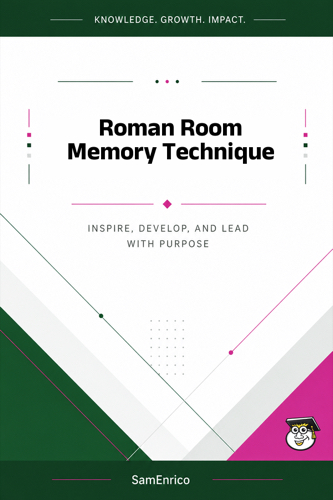
Roman Room Memory Technique eBook
Apply ancient Roman rhetorical methods to organize
Apply ancient Roman rhetorical methods to organize speeches and arguments.
Formats
Free sample
Chapter 1: The Collapsed Banquet...--–- The story begins with a dead poet, a pile of rubble, and a discovery that would change human communication for two thousand years. In the year 477 BC, a man named Simonides of Ceos attended a dinner party that he should not have survived.The host was a wealthy Thessalian nobleman named Scopas, who had commissioned Simonides to compose and recite a lyric poem in honor of his recent athletic victory. Simonides, already famous throughout the Greek world for his poetic skill, arrived at the banquet hall expecting an evening of celebration, wine, and generous payment. He performed his poem brilliantly. The guests applauded.
Scopas, however, was not pleased.According to the account preserved by Cicero centuries later, Scopas told Simonides that he would pay only half the agreed fee. The other half, Scopas declared, should be collected from the twin gods Castor and Pollux, since Simonides had devoted equal verses to praising them. The room went silent. Insulting a poet was bad manners. Insulting a poet who had just praised the gods was something else entirely.Simonides did not argue.
He sat down and waited for an opportunity to collect his full payment.That opportunity came in a form no one could have predicted. A few moments later, a servant rushed in to tell Simonides that two young men were waiting outside, urgently requesting to speak with him. Simonides rose from his seat and walked out of the banquet hall. The two young men were not there. He searched the courtyard.
Nothing. He turned back toward the hall.Behind him, the roof collapsed.The entire building crumbled in a thunder of stone and timber. Every person inside died instantly. Every guest, every servant, every musician, every cupbearer. The bodies were so crushed and mangled that not even their own families could identify them.But Simonides could.Standing in the rubble, he realized something extraordinary.
He closed his eyes and walked backward through his memory, retracing his steps through the banquet hall. He remembered exactly where each guest had been sitting. He remembered which pillar had stood behind which table. He remembered the order of the couches, the position of the wine jars, the arrangement of the torches on the walls. He could name every single victim because he could still see them, in his mind's eye, occupying their precise locations in the space.The families buried their dead.
The story spread across Greece. And Simonides, who had lost his fee but gained something far more valuable, is remembered as the inventor of the Method of Loci—the art of placing memories in physical space.This book is about what happened next, when the Romans took this Greek memory trick and transformed it into the most powerful system of persuasion ever invented.The Problem That Notes Cannot Solve Let me pause the ancient history for a moment and ask you a question that will determine whether this book changes your life or simply decorates your shelf.Have you ever stood in front of an audience—a boardroom, a classroom, a wedding reception, a job interview—and forgotten what you meant to say next?Of course you have. Every person reading this book has experienced that cold moment of panic. Your notes are in your hand or on the screen behind you. You look down at them.
You see the bullet points you wrote so carefully the night before. But the words blur. The order feels wrong. Your mouth opens and something comes out, but it is not quite what you planned, and certainly not what you practiced.Here is what most people believe about that experience: they believe they forgot because they have a bad memory.That is incorrect. Almost certainly false.You do not have a bad memory.
You have an untrained memory, and more importantly, you have a memory that is being asked to do the wrong job. You are asking your brain to hold verbal information in linear sequence—a task for which it is evolutionarily ill-equipped—while ignoring its ancient, powerful, almost limitless capacity for spatial navigation.The neuroscience is clear on this point. Your brain contains specialized place cells in the hippocampus that fire only when you imagine yourself in a specific physical location. These cells have been honed over hundreds of thousands of years of evolution. Your ancestors who could not remember where the safe water was, where the predator lived, and which cave entrance faced south did not survive to become your ancestors.
Spatial memory is not a skill you learn. It is the hardware you inherited.Verbal memory, by contrast, is a recent overlay. It is fragile, effortful, and easily disrupted by stress. When you stand in front of an audience and your heart rate increases and your palms sweat and your prefrontal cortex starts to shut down under pressure, the first thing you lose is your verbal sequence memory. The second thing you lose is your confidence.
The third thing you lose is your audience.But here is the good news, and it is genuinely good: you do not need to fight your brain's ancient wiring. You can use it. The Roman Room method is not a technique for forcing your brain to do something unnatural. It is a technique for letting your brain do what it already does best, and simply redirecting that power toward a new target.Simonides discovered this by accident in the rubble of a banquet hall. The Romans perfected it by design in the law courts and political forums of the Republic.
And you are about to learn it in the pages of this book.What the Romans Added That the Greeks Missed The Greeks, for all their genius, used the Method of Loci primarily as a storage system. A Greek orator would build a memory palace—often an actual building they knew well, such as their own home or a public temple—and would place images representing the points of their speech at specific locations along a walking route. When it was time to speak, they would walk through the palace in their imagination and "read" the images in order. This worked well for memorizing a fixed text.But the Romans faced a different rhetorical problem.Roman oratory was not the delivery of a memorized script. Roman oratory was combat.
A Roman senator or lawyer might rise to speak with a general plan, but he had to be ready to adapt based on interruptions, objections, new evidence introduced by the opposition, or a sudden shift in the mood of the crowd. A Greek memorized a poem. A Roman won a case.The Roman innovation was dispositio—the art of arranging arguments not just for memory, but for persuasion. The Romans realized that physical space could do more than store information. It could structure logic.
It could encode emotional weight. It could create a sequence so natural that the audience would feel the force of the argument before the speaker even stated it explicitly.Consider the difference between two ways of organizing the same argument.The Greek way: You have six points to make. You place one image at each of six locations…
This is the end of the free sample. Get the eBook to keep going. Buy now
About this book
Details
- Author
- Shields Theron
- Publisher
- SamEnrico
- Language
- English
- Genre
- Non-Fiction, Self-Help, Rhetoric
- Released
- 2026-06-09
- Pages (approx.)
- 154
- Available as
- eBook, Audiobook

Read better in the ZLOADR app
Your eBooks on your phone or tablet. Sign in with your SamEnrico account and start reading.
More by Shields Theron
 Iron Sharpens Iron WorkoutsShields Theron$11.99
 Pregnancy Dream JournalShields Theron$11.99
 The Gacy Tip LineShields Theron$11.99
 Exam Anxiety Management WorkbookShields Theron$11.99
 Retirement Assets Special NeedsShields Theron$11.99
 Team Lateral Thinking PuzzlesShields Theron$11.99
 IUD Menstrual Changes GuideShields Theron$11.99
 Bed Partner RLS TipsShields Theron$11.99
 The Shattered Crescent: How Persia Could Have Conquered the OttomansShields Theron$11.99
 The Falconer’s Crown: Birds of the Medieval CourtShields Theron$11.99
 The Unseen Pages: The Secret Life of Virginia Woolf’s Lost ManuscriptsShields Theron$11.99
 The Dancer's Guide to KathakaliShields Theron$11.99
You may also like
 Hong Kong Handover 1997Dunn Johnnie$11.99
 Zumba For Postnatal Recovery CourseNeal Christian$11.99
 Zumba for BeginnersLadner Nikia$11.99
 YouTube Comment Mining GuideHumes Pandora$12.99
 Worry Box MeditationCarlin Rudy$11.99
 Workplace Stress MeditationNguyen Lynn$11.99
 Workplace Stress and Sleep RepairHawley Ivory$11.99
 Workplace Perfectionism CureDelaney Jeffry$11.99
 Workplace Injustice Anger GuideWallen Isabelle$11.99
 Work Addiction and Burnout LinkGreenwood Ester$11.99
 Women in Yoga and WellnessBeattie Galina$11.99
 Women in Stand Up ComedyChun Evangeline$11.99