
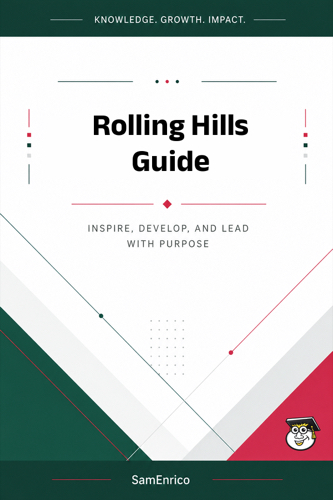
Rolling Hills Guide
Run down soft green hills, feeling grass under you
Run down soft green hills, feeling grass under your feet and wind in hair.
Formats
About this book
Free sample
Chapter 1: The Cartography of Gentleness--–- The first time I asked a group of stressed-out office workers to describe a rolling hill, they gave me a list of verbs: climb, conquer, summit, reach, ascend. Not one person said lie down. Not one said run down. Not one said surrender. That moment, sitting in a gray conference room under fluorescent lights, I realized we had lost not just our connection to hills but the very language of softness.
We know how to talk about mountains—their majesty, their danger, their demand for respect—but we have almost no vocabulary for the gentle slope that asks nothing of us except to be present. This book exists to rebuild that vocabulary, and this chapter lays its foundation: the scientific, psychological, and embodied reasons why rolling hills heal us in ways that peaks and cliffs and forests cannot.The modern human being is exhausted in ways our ancestors could not have imagined. Not physically exhausted—though many of us are that too—but attentionally exhausted, sensorily exhausted, existentially exhausted. We spend our days in what psychologists call directed attention: the focused, effortful mode of concentration required for screens, spreadsheets, traffic, small talk, decision-making, and the endless triage of notifications. Directed attention is like a muscle.
It fatigues. And when it fatigues, we become irritable, impulsive, forgetful, and sad. We snap at our children. We cry in parking lots. We scroll social media for an hour and cannot remember a single thing we saw.Enter the rolling hill.
Not the jagged peak, which demands its own form of directed attention (where is the next foothold? how much daylight remains? am I safe?). Not the dense forest, which can feel claustrophobic and disorienting. The rolling hill—open, gentle, predictable, curved—offers something else entirely.
It offers what psychologists Rachel and Stephen Kaplan called soft fascination.The Science of Soft Fascination In the 1980s, the Kaplans proposed Attention Restoration Theory (ART), one of the most rigorously tested and replicated ideas in environmental psychology. Their argument was simple but radical: natural environments restore our depleted attentional resources, but not…
This is the end of the free sample. Get the eBook to keep going. Buy now
Contents
- Chapter 1
- Chapter 2
- Chapter 3
- Chapter 4
- Chapter 5
- Chapter 6
- Chapter 7
- Chapter 8
- Chapter 9
- Chapter 10
- Chapter 11
- Chapter 12
Details
- Author
- Peralta Mendy
- Publisher
- SamEnrico
- Language
- English
- Genre
- Non-Fiction, Self-Help, Hill Imagery
- Released
- 2026-06-11
- Pages (approx.)
- 127
- Available as
- eBook, Audiobook

Read better in the ZLOADR app
Your eBooks on your phone or tablet. Sign in with your SamEnrico account and start reading.
More by Peralta Mendy
 Breath and ImpermanencePeralta Mendy$11.99
 The Late Bloomer TeenPeralta Mendy$11.99
 Pregnancy After Loss AnxietyPeralta Mendy$11.99
 Plastic Toxin Exposure PreventionPeralta Mendy$11.99
 Financial Stress Coping For Couples GuidePeralta Mendy$11.99
 Sarcopenia Strength Training ProtocolPeralta Mendy$11.99
 Carnegie Teaches WealthPeralta Mendy$11.99
 Neil Gorsuch TrumpPeralta Mendy$11.99
 The Opioid Algorithm: How Silicon Valley Built the Next Drug EpidemicPeralta Mendy$11.99
 The Art of the Steal: How a Billion-Dollar Scam Unraveled the Art WorldPeralta Mendy$11.99
 The Last Philosopher: Plato’s Republic in a Ruined WorldPeralta Mendy$11.99
 Growing StenocarpusPeralta Mendy$11.99