
Non-FictionProfessional's Cheat SheetRolling ForecastAgile Budgeting
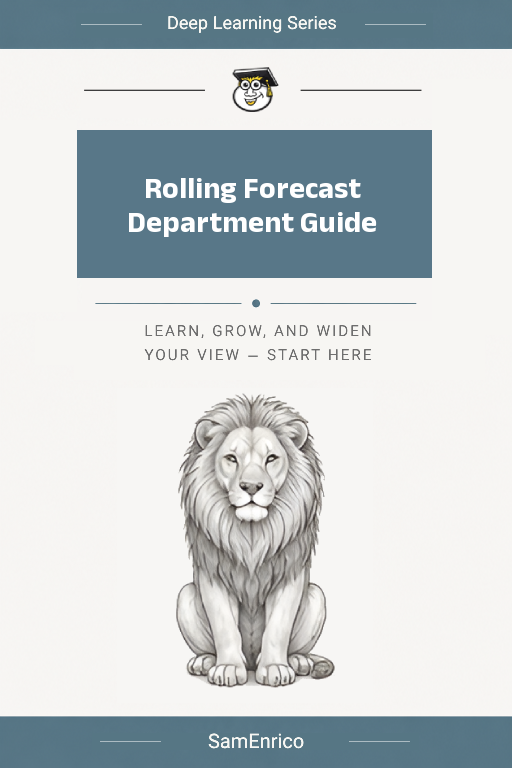
Rolling Forecast Department Guide eBook
Update department forecasts monthly rather than an
by Blue Romeo
Update department forecasts monthly rather than annual static budgets to adapt quickly to business changes.
Formats
Free sample
Chapter 1: The Budget Lie--For seventeen years, Margaret believed she was doing her job well. As the Vice President of Finance at a mid-sized manufacturing company, she had perfected the annual budgeting ritual. Every August, she distributed templates to department heads. Every September, she endured the back-and-forth negotiations. Every October, she consolidated the numbers.
Every November, she presented to the board. And every December, she watched as the budget she had spent four months building became obsolete within weeks of the new fiscal year.The last time Margaret ran the annual budget process, something broke inside her. It was a Tuesday in late January—barely three weeks into the new fiscal year—when her CEO walked into her office and closed the door. A major competitor had just announced a 15% price cut. Supply chain costs had spiked due to a port closure in Asia.
And two key customers had delayed their orders until Q3."I need a new forecast by Friday," the CEO said.Margaret looked at the 47-tab spreadsheet she had just finished. The one that took fourteen weeks to build. The one that had already been reviewed by three different committees. The one that was, for all practical purposes, fiction."We don't have a process for that," she said.The CEO stared at her. "Then build one."That was the moment Margaret realized the terrible truth: the annual budget was not a plan.
It was a lie. A well-intentioned, highly ritualized, deeply expensive lie that her entire profession had been telling for generations. And she was tired of being part of the deception.This book is for everyone who has ever felt what Margaret felt. The finance professionals who spend months building budgets that are obsolete before they are printed. The department heads who sandbag their targets because they know the budget will be used against them.
The CEOs who nod along during budget presentations while secretly knowing the numbers are fantasy. And the board members who demand predictability in an unpredictable world.The traditional annual budget is not merely outdated. It is actively harmful to the organizations that rely on it. In volatile markets—which is to say, every market today—static budgets create delays, distort behavior, waste resources, and lull leadership into a false sense of control. And yet, the vast majority of companies continue to run the same annual ritual, year after year, as if the world still moved at the pace of a 1980s assembly line.This chapter will show you why the annual budget fails, how it damages your organization, and what you can do starting tomorrow to begin escaping its grip.
By the time you finish reading, you will understand why the budget is a lie—and why the truth will set you free.The Origins of a Bad Habit To understand why the annual budget is broken, you first need to understand where it came from. The modern budgeting process was invented in the 1920s, most notably at General Motors under the leadership of Alfred Sloan and Donaldson Brown. At the time, it was a revolutionary innovation. Before the budget, companies operated without any formal financial planning. They drifted.
The budget gave them direction.But here is what most finance professionals forget: the 1920s were a fundamentally different economic environment. Markets were stable. Competition was local. Information traveled at the speed of postal mail. Labor costs changed once a year, if at all.
Raw material prices were predictable. A company could reasonably project its revenue and expenses twelve months into the future because the underlying conditions would not change much during that period.That world no longer exists. It has not existed for decades. And yet, the annual budget persists—not because it works, but because it is familiar. Finance professionals learn budgeting in school.
They practice it in their first jobs. They refine it as they climb the corporate ladder. By the time they become CFOs, the annual budget feels as natural as breathing.This is what psychologists call institutional inertia. The process continues because the process exists. No one stops to ask whether it still serves its purpose.
No one calculates the true cost of spending four months every year building a plan that will be irrelevant in ninety days. No one measures the damage caused by forcing managers to play the budgeting game instead of managing the business.Margaret, the VP of Finance from our opening story, eventually calculated the cost. Her company spent 14 weeks on the annual budget. That represented 3,360 person-hours across the finance team and department heads. At an average loaded cost of 75perhour,thedirectexpensewas75 per hour, the direct expense was 75perhour,thedirectexpensewas252,000.
But the opportunity cost was far larger. During those 14 weeks, her finance team was not analyzing market trends, evaluating acquisition targets, or helping the business pivot. They were arguing over whether the sales department's headcount should be 47 or 49."The budget took over my life," Margaret told me years later, after she had successfully transitioned her company to rolling forecasts. "And for what? By February, the numbers were meaningless.
We were managing from a plan that had already failed."The Decay Curve: Why Forecasts Die Let us examine a fundamental mathematical reality that most finance professionals ignore. A forecast has a half-life. In stable industries, forecast accuracy decays at roughly 1-2% per week. In volatile industries, the decay can be 5% or more per week. By the time you reach ninety days, the typical forecast is no better than a random guess.This is not speculation.
It is the conclusion of decades of research in operations research and financial planning. The forecast accuracy decay curve shows that:Month 1: ±5-10% accuracy (useful for decision-making)Month 2: ±10-20% accuracy (caution advised)Month 3: ±20-35% accuracy (directional only)Month 4+: ±35-50%+ accuracy (essentially random)Now consider what this means for the annual budget. You build your budget in October and November. You finalize it in December. You present it to the board in January.
By the time you start executing against it in February, your forecast for months 6 through 12 is already in the "essentially random" category. You are making decisions based on numbers that have no relationship to reality.The annual budget is not a plan. It is a time capsule. It captures your assumptions about the world at a single moment in time and then asks you to live by those assumptions for an entire year. In a world where a pandemic can shut down the global economy in weeks, where a single tweet can crash a stock price, where a competitor can launch a disruptive product overnight, this is not prudent planning.
It is willful blindness.I once worked with a retail company that had an immaculate annual budget process. Every line item was justified. Every assumption was documented. Every variance was explained. The budget was a work of art.
It was also completely useless. The company missed its revenue forecast by 40% in the first quarter because a new entrant had disrupted their category. The budget, beautiful as it was, had not anticipated the disruption. And because the company was locked into its annual plan, it took them six months to adjust their strategy. By then, they had lost…
This is the end of the free sample. Get the eBook to keep going. Buy now
About this book
Details
- Author
- Blue Romeo
- Publisher
- SamEnrico
- Language
- English
- Genre
- Non-Fiction, Professional's Cheat Sheet, Rolling Forecast, Agile Budgeting
- Released
- 2026-06-01
- Pages (approx.)
- 143
- Available as
- eBook, Audiobook

Read better in the ZLOADR app
Your eBooks on your phone or tablet. Sign in with your SamEnrico account and start reading.
More by Blue Romeo
 Navigating Work From Home IssuesBlue Romeo$11.99
 Remote Retreats for EnterprisesBlue Romeo$11.99
 Medicare Housing Transition GuideBlue Romeo$11.99
 Etsy Digital Planner Product ResearchBlue Romeo$11.99
 Deep Work for Sales ProfessionalsBlue Romeo$11.99
 The Phantom of Route 66: The Unsolved Mystery of the Vanishing TravelersBlue Romeo$11.99
 The Last Mile: The Miracle of the 1998 Jamaican Bobsled TeamBlue Romeo$11.99
 Understanding Chondrodysplasia Punctata, Sheffield TypeBlue Romeo$17.99
 Creative Professional Mental BoardBlue Romeo$12.99
 Mortgage BrokeringBlue Romeo$11.99
 Ultimate Handbook Guide to Pago Pago : (American Samoa) Travel GuideBlue Romeo$11.99
You may also like
 Hong Kong Handover 1997Dunn Johnnie$11.99
 Zumba For Postnatal Recovery CourseNeal Christian$11.99
 Zumba for BeginnersLadner Nikia$11.99
 YouTube Comment Mining GuideHumes Pandora$12.99
 Worry Box MeditationCarlin Rudy$11.99
 Workplace Stress MeditationNguyen Lynn$11.99
 Workplace Stress and Sleep RepairHawley Ivory$11.99
 Workplace Perfectionism CureDelaney Jeffry$11.99
 Workplace Injustice Anger GuideWallen Isabelle$11.99
 Work Addiction and Burnout LinkGreenwood Ester$11.99
 Women in Yoga and WellnessBeattie Galina$11.99
 Women in Stand Up ComedyChun Evangeline$11.99