
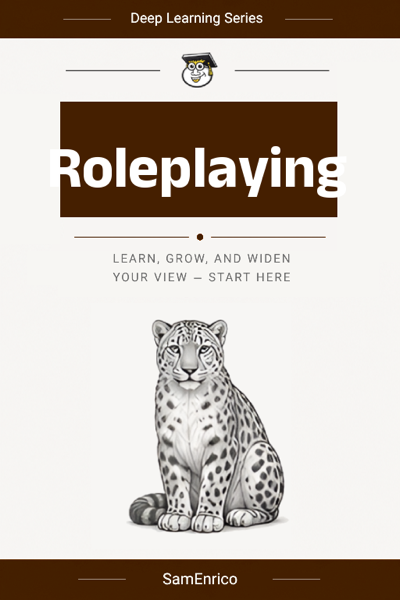
Non-FictionInformativeEducational
Roleplaying eBook
A Coursebook on Roleplaying
A Coursebook on Roleplaying
Formats
Free sample
Chapter 1: The Infinite Mask...--Roleplaying is not a game. At least, not always. And it is certainly not a single, simple thing you can point to and say, “That. That right there is roleplaying.” If you ask five different people what roleplaying means, you might receive five entirely different answers: a therapist describing how a patient rehearsed a difficult conversation with their boss; a student recounting the time their history class reenacted the constitutional convention; a gamer explaining how their half-elf warlock betrayed the party for a cursed artifact; an improviser reminiscing about the night the audience shouted “suggestion” and the scene dissolved into chaos. All of these are roleplaying.
None of them is the whole story.This book exists because roleplaying has been hiding in plain sight for over a century, fractured across disciplines that rarely speak to one another. The psychodramatist and the dungeon master share more than either might suspect. The classroom teacher running a mock trial and the improv actor building a scene from a single word are drawing from the same deep well of human behavior: the ability to step into another self, to try on a mask, to act “as if.” And yet, the therapeutic literature rarely cites tabletop roleplaying games. Game masters seldom borrow from educational simulation design. Improv textbooks almost never mention Jacob Moreno.
This silence is a loss. The goal of The Roleplaying Coursebook is to break down those walls.This first chapter serves as your map. Before you can master the techniques of embodiment, facilitation, or narrative design, you must understand the territory. What counts as roleplaying? How did we get here?
And most importantly, why does distinguishing between different kinds of roleplaying matter for your own practice?We will build a shared vocabulary. We will tour the four major domains where roleplaying flourishes: clinical, recreational, educational, and performance. We will trace the surprising historical lineage that connects a Viennese psychiatrist from the 1920s to a teenager rolling dice in a basement in the 1970s to a live-action vampire larp in a city park today. And we will establish the single most important question you will ever ask as a roleplayer or facilitator: What is this roleplay for?By the end of this chapter, you will never again look at a “game” and see only a game. You will see a technology of identity, a tool for learning, a container for healing, and a stage for creation.
Let us begin.The Four Domains: A Field Guide The most common mistake newcomers make is assuming that all roleplaying operates under the same rules. They try to run a therapy session like a game night, or judge an improv scene like an educational simulation, and wonders why everything feels off. The solution is to recognize that roleplaying manifests in four distinct domains, each with its own objectives, rule structures, relationships to reality, and markers of success.Domain One: Clinical and Therapeutic Roleplaying The clinical domain is the oldest formalized roleplaying practice, originating in the psychodrama of Jacob Moreno in the 1920s and later developing into dramatherapy, sociodrama, and various cognitive-behavioral rehearsal techniques. In this domain, roleplaying serves healing and growth. The participant—often called a protagonist or client—steps into a role to externalize internal conflicts, practice new behaviors, or experience situations from another perspective in a safe environment.The rule structure here is therapist-led but client-driven.
A trained facilitator (therapist, counselor, or dramatherapist) sets the frame, establishes safety protocols, and guides the process, but the content emerges from the client’s own life and needs. There are no win conditions. There is no audience. Success is measured by therapeutic outcomes: increased insight, emotional catharsis, behavioral change, or symptom reduction.Key techniques include role reversal (playing the other person in a conflict), doubling (a second actor voices the protagonist’s unspoken inner thoughts), soliloquy (speaking aloud an internal monologue while others freeze), and concretization (making abstract emotions physically present through objects or spatial arrangements). These will be explored in depth in Chapter 7.If you are facilitating clinical roleplaying, you ask: Is the client safer than when they arrived?
Have they expressed something previously unspeakable? Do they leave with new understanding or a rehearsed skill?Domain Two: Recreational Roleplaying The recreational domain is the most widely recognized in popular culture, encompassing tabletop roleplaying games (TTRPGs) like Dungeons & Dragons, Call of Cthulhu, and Monsterhearts, as well as live-action roleplay (LARP), solo journaling games, and online roleplaying communities. Here, roleplaying serves entertainment, social bonding, and aesthetic enjoyment.The rule structure is system-driven and facilitator-mediated. A game master (or GM) adjudicates rules, portrays non-player characters, and describes the world, while players control their individual characters within a mechanical framework of dice rolls, resource expenditure, and procedural resolution. Unlike therapy, there are often win conditions—defeating the dragon, solving the mystery, surviving the horror—but they are understood as challenges within a game, not measures of human worth.Critically, recreational roleplaying is defined by consensual fictionality.
Everyone at the table agrees that the goblins are not real, the treasure is not actual currency, and the betrayal was between characters, not players. This consensual frame is what allows intense emotional experiences without real-world consequences—at least, when it works well. When the frame breaks, we get “bleed,” the subject of Chapter 2.If you are facilitating recreational roleplaying, you ask: Is everyone having fun? Are players engaged with the fiction? Does the group want to play again next week?Domain Three: Educational Roleplaying The educational domain encompasses simulations, reenactments, case-method roleplays, and experiential learning exercises used in classrooms, corporate training, medical education, and civic engagement.
Here, roleplaying serves learning and skill development. Participants step into roles—a historical figure, a job candidate, a patient, a diplomat—to understand systems, practice communication, or grapple with ethical dilemmas.The rule structure is facilitator-guided with defined learning objectives. Unlike therapy, the goal is not personal healing but cognitive or behavioral change. Unlike recreational play, winning is usually secondary to reflection (though victory conditions may be used as pedagogical tools, a point we will revisit in Chapter 8). The signature feature of educational roleplaying is the debrief: a structured, post-session discussion that extracts lessons from the experience.Key methodologies include “Reacting to the Past” (college students roleplaying historical moments), disaster simulation exercises (emergency responders practicing coordination), and business negotiation roleplays.
These will be explored in depth in Chapter 8.If you are facilitating educational roleplaying, you ask: What did participants learn? Can they articulate the systemic pressures or decision-making trade-offs they experienced? Will they behave differently in the real world as a result?Domain Four: Performance Roleplaying The performance domain includes improvisational theatre, sketch comedy, and any roleplaying where the primary output is watched by an audience. Here, roleplaying serves entertainment and artistic expression, but unlike recreational roleplaying, the participants are performers and the ultimate judge is the spectator.The rule structure is ensemble-driven and audience-responsive. Improv troupes follow principles like “yes, and,” status transactions, and genre pastiche, but the scene’s success is measured by laughter, tension, applause, or silence.
Unlike therapy or education, there is no obligation to personal growth or learning outcomes. Unlike recreational gaming, there is no mechanical system (no dice…
This is the end of the free sample. Get the eBook to keep going. Buy now
About this book
Details
- Author
- Hawks Tonette
- Publisher
- SamEnrico
- Language
- English
- Genre
- Non-Fiction, Informative, Educational
- Released
- 2026-05-07
- Pages (approx.)
- 146
- Available as
- eBook, Audiobook

Read better in the ZLOADR app
Your eBooks on your phone or tablet. Sign in with your SamEnrico account and start reading.
More by Hawks Tonette
 The Funnel for DentistsHawks Tonette$11.99
 TM For Children Teens GuideHawks Tonette$11.99
 Governor of the PandemicHawks Tonette$11.99
 IBS Histamine Intolerance GuideHawks Tonette$11.99
 Physical Theft Data Leak ScriptsHawks Tonette$11.99
 The Forgotten Bomb: The Secret Life of the Tsar BombaHawks Tonette$11.99
 The Crown’s Shadow: How a Teenage Queen Navigated a Nation on the BrinkHawks Tonette$11.99
 Infinite Loading GuideHawks Tonette$12.99
 Business Plan QR Code GeneratorHawks Tonette$12.99
 Understanding Cleft Lip Palate-tetraphocomeliaHawks Tonette$17.99
 How to Become a Chalk CutterHawks Tonette$11.99
You may also like
 Hong Kong Handover 1997Dunn Johnnie$11.99
 Zumba For Postnatal Recovery CourseNeal Christian$11.99
 Zumba for BeginnersLadner Nikia$11.99
 YouTube Comment Mining GuideHumes Pandora$12.99
 Worry Box MeditationCarlin Rudy$11.99
 Workplace Stress MeditationNguyen Lynn$11.99
 Workplace Stress and Sleep RepairHawley Ivory$11.99
 Workplace Perfectionism CureDelaney Jeffry$11.99
 Workplace Injustice Anger GuideWallen Isabelle$11.99
 Work Addiction and Burnout LinkGreenwood Ester$11.99
 Women in Yoga and WellnessBeattie Galina$11.99
 Women in Stand Up ComedyChun Evangeline$11.99