
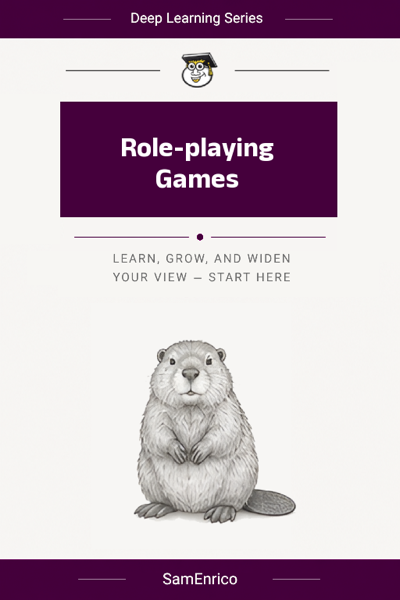
Non-FictionInformativeEducational
Role-playing Games eBook
A Coursebook on Role-playing Games
by Ojeda Niki
A Coursebook on Role-playing Games
Formats
Free sample
Chapter 1: The Magic Circle’s Edge...--–- Imagine you are sitting at a table. There are dice in your hand—plastic, polyhedral, clattering with possibility. Across from you, a friend speaks in a voice that is not their own, describing a corridor that does not exist, torches that cast no real light, a door that has never been built. And yet, you see it. You smell the damp stone.
You reach for that door. This is the ordinary miracle of role-playing games: a group of people, sitting still, making things up together, and believing them.For decades, this act has been dismissed as childish, misunderstood as occult, or reduced to a mere hobby. But in recent years, role-playing games (RPGs) have exploded into mainstream culture. Critical Role streams to millions. Dungeons & Dragons has its own Hollywood movie.
Baldur’s Gate 3 won Game of the Year. The once-fringe activity of pretending to be an elf has become a billion-dollar industry. Yet amid this renaissance, a curious problem has emerged: no one can quite agree on what an RPG actually is. Is it a game? A story?
A therapy? A social experiment? The answer, as this chapter will show, is all of these and none of them. To understand RPGs—to truly master them, design them, or even just play them well—you first need to step inside the Magic Circle. Then, just as importantly, you need to know where its edges fray.This is not a book about one game.
It is not a rulebook for Dungeons & Dragons, Call of Cthulhu, Pathfinder, or any single system. Instead, this is a coursebook: a guided tour through the entire landscape of role-playing, from its wargaming roots to its digital future, from the psychology of why we play to the economics of how games get made. Whether you are a first-time player nervously rolling your first d20, a Game Master (GM) preparing a session for tonight, a designer sketching mechanics on napkins, or a therapist curious about using RPGs in clinical practice, this book has been built for you. A Reader’s Guide at the front of this volume will direct you to the chapters most relevant to your goals. For now, start here.
Every journey into role-playing begins with a single, deceptive question.The Question That Refuses to Stay Answered Ask ten role-players to define an RPG, and you will receive eleven answers. The common definitions tend to circle three poles: game, story, and simulation. A gamer might say: “An RPG is a game where you control a character and overcome challenges using rules.” A storyteller might counter: “No, an RPG is a collaborative narrative engine; the rules are just there to generate unexpected plot twists.” A simulationist might insist: “An RPG is a physics engine for the imagination; it models a fictional world so you can explore it systematically.” Each of these perspectives is true, and each is incomplete.To resolve this, we must first distinguish RPGs from activities that look similar but function differently. A board game, for all its charms, has fixed win conditions. When you finish Monopoly, someone has won.
When you finish a session of Dungeons & Dragons, the story continues. There is no final victory screen. Improvised theater, meanwhile, has no formal resolution mechanics. Performers on a stage never roll dice to see if their joke lands; they simply commit and the audience reacts. RPGs, however, routinely delegate narrative authority to dice, cards, or other randomizers.
War games—the direct ancestor of RPGs—focus on army-level tactics, not individual character persistence. In Warhammer 40,000, your carefully painted captain can die and be replaced next game without emotional weight. In an RPG, that same captain has a name, a backstory, a grudge against goblins. Their death matters.So here is the definition that will guide this book—a definition deliberately revised to include both shared and solitary play, as we will explore in Chapter 7:A role-playing game is a game in which players adopt the roles of characters in a fictional setting, using rules to resolve actions. This can be shared (tabletop, live action) or solitary (journaling games, gamebooks).Notice what this definition does not say.
It does not say “requires a Game Master.” Some of the most celebrated RPGs in recent years—Fiasco, The Quiet Year, Wanderhome—have no GM at all. It does not say “requires dice.” Diceless systems like Amber Diceless Role-Playing and Nobilis resolve conflicts through bidding, resource expenditure, or simple narrative consent. It does not even say “requires multiple players.” Solo journaling games like Thousand Year Old Vampire and gamebooks like the Lone Wolf series prove that one person alone can role-play, using prompts as their imagined conversation partner.This inclusive definition matters because it reveals the essential unit of role-playing: not the rules, not the dice, and not even the group, but the Shared Imagined Space (SIS) . The SIS is the fictional reality that all participants (or a single participant, in solo play) collaboratively maintain. When you picture that dungeon corridor, you are building the SIS.
When your friend describes the torchlight flickering, they are adding to it. When the dice say you miss your attack, the SIS absorbs that fact: the goblin dodged left. The SIS is fragile. It requires constant negotiation, constant “yes, and…” and constant acceptance that what one person imagines may not match another’s vision. The GM might picture a ruined castle with a collapsed eastern tower; the player, hearing “ruined castle,” imagines a crumbling keep with a moat.
Neither is wrong, but the SIS must converge. This convergence is the hidden labor of every RPG session.The Magic Circle: Where Play Happens In 1938, the Dutch historian Johan Huizinga published Homo Ludens (Man the Player), a book arguing that play is not a trivial pastime but a fundamental engine of culture. Huizinga introduced the concept of the “Magic Circle” : a temporary, agreed-upon space—not necessarily physical—where the ordinary rules of life are suspended and the special rules of play take over. Inside the Magic Circle, missing an attack roll is a tragedy. Outside the Magic Circle, it is just a plastic die.
Inside, the king’s assassination is a plot twist. Outside, it is just words.The Magic Circle explains something profound about RPGs that other definitions miss: the voluntary suspension of disbelief. When you watch a movie, the suspension is passive. The screen presents images; you choose to believe them or not. In an RPG, the suspension is active.
You do not just watch the elf struggle; you are the elf. You speak as them. You make decisions that you, as a player, would never make because the elf would choose differently. This active suspension is exhausting and exhilarating. It is why a three-hour RPG session can feel more draining than a full day of work.
You are constantly negotiating between two selves: your real self (who knows it is just a game) and your fictional self (who genuinely fears the dragon).However—and this is crucial—the Magic Circle is not a perfect seal. Food arrives. Phones buzz. A player says something off-color and the table freezes. The GM forgets a rule and the illusion hiccups.…
This is the end of the free sample. Get the eBook to keep going. Buy now
About this book
Details
- Author
- Ojeda Niki
- Publisher
- SamEnrico
- Language
- English
- Genre
- Non-Fiction, Informative, Educational
- Released
- 2026-05-08
- Pages (approx.)
- 151
- Available as
- eBook, Audiobook

Read better in the ZLOADR app
Your eBooks on your phone or tablet. Sign in with your SamEnrico account and start reading.
More by Ojeda Niki
 Personal Ing For Success Value PropositionOjeda Niki$11.99
 Intuitive Eating Postpartum WorkbookOjeda Niki$11.99
 The AI Displacement Talent FlowOjeda Niki$11.99
 Acetaminophen Liver SafetyOjeda Niki$11.99
 The Layaway GraduateOjeda Niki$11.99
 The Forgotten Depths: The Medieval Cave Explorers of Southeast AsiaOjeda Niki$11.99
 How to Start a Private Security Business (Beginners Guide)Ojeda Niki$11.99
 Australian Coding Education MapOjeda Niki$12.99
 FinCEN BOI Reporting GuideOjeda Niki$12.99
 Understanding Biliary Malformation Renal Tubular InsufficiencyOjeda Niki$17.99
You may also like
 Hong Kong Handover 1997Dunn Johnnie$11.99
 Zumba For Postnatal Recovery CourseNeal Christian$11.99
 Zumba for BeginnersLadner Nikia$11.99
 YouTube Comment Mining GuideHumes Pandora$12.99
 Worry Box MeditationCarlin Rudy$11.99
 Workplace Stress MeditationNguyen Lynn$11.99
 Workplace Stress and Sleep RepairHawley Ivory$11.99
 Workplace Perfectionism CureDelaney Jeffry$11.99
 Workplace Injustice Anger GuideWallen Isabelle$11.99
 Work Addiction and Burnout LinkGreenwood Ester$11.99
 Women in Yoga and WellnessBeattie Galina$11.99
 Women in Stand Up ComedyChun Evangeline$11.99